Showing posts with label grains of paradise. Show all posts

Monday, March 18, 2013

Délices d'Afrique, grains of paradise, etc.

I'm still expressing appreciation to others who are helping to promote African cuisine:
  • Koranteng my son-in-law with a sophisticated African francophone and anglophone palate, who recently provided a delightful addition to the Africa Cookbook Project, Marguerite Abouet's 2012 Délices d'Afrique --50 recipes charmingly illustrated by Agnès Maupré. The recipes feature Ivorian cuisine and are bursting with flavor just as the exuberant illustrations are filled with good humor on each of the book's 124 pages.

  • Several weeks ago, Nigerian colleague Ozoz of "Kitchen Butterfly" fame, wrote a lovely post (with her always-exceptional photos)  about alligator pepper (aka grains of paradise), including a recipe using it for okwu-oji, a Nigerian version of groundnut soup.  She has also shared some photos of atariko, which I mentioned in a grains of paradise post in January, and which Nigerians often use in pepper soup and banga (palmnut soup). We continue to applaud her commitment to promoting Nigerian cuisine.
  • I was grateful to have Frederick Douglass Opie provide links to several resources/talks on African food and foodways (and to Africa is a Country for alerting me to them).
Upcoming posts:

My current challenge is to tackle 2 recipes for the regional Ghanaian cookbook that I've long delayed: 

The toasted cornmeal and palmnut soup one-pot that my husband fondly remembers his grandmother making, and whose standard I've never been able to achieve: aprapransa, and a green snail soup he also loves called abunabuna. I'll be working on these this week, In the meantime,  if anyone has any suggestions or treasured recipes, please feel free to share.


:

Friday, January 11, 2013

Grains of Paradise or Alligator Pepper?

This past semester two of my students selected "grains of paradise" as a West African ingredient to research. One of the first things they announced in their presentation was that "grains of paradise,"  aframomum (or amomum) melequeta is also known as "alligator pepper," the dried seeds of the same plant. While all  "aframomums"  appear to belong to the ginger family (Zingiberaceae), and more specifically are types of cardamom, there seems to be quite a bit of confusion over the different types of "aframomums."

  My own search for clarity began years ago when I remembered reading  in H. O. Anthonio and M. Isoun's 1982 Nigerian Cookbook (Macmillan) about a spice called "atariko" that sounded like it might be melequeta pepper ("small seeds sold in, or removed from, an alligator pepper-like pod. Highly scented, but not as hot as alligator pepper. It is expensive so use only a few of the tiny seeds to flavor pepper soups, or banga soup. . ." (p. 17). [Incidentally, I notice that this material was appropriated verbatim in a 2008 posting on Nigerialand (http://nigeriandishes.blogspot.com/2008_05_01_archive.html) without any attribution to its source. Sigh.]

In the scientific literature the names "grains of paradise," "alligator pepper," and "aframomum melegueta" are often used interchangeably, especially by Nigerians. For example, 
  • Tolu Odugbemi's Outlines and Pictures of Medicinal Plants from Nigeria, published by the University of Lagos press in 2006, p. 74, where he lists the species name as "Aframomum melegueta, the family name as Zingiberaceae, the local (Nigerian) names as "ata-ire, atare, itaye," and the common names as "alligator pepper, grains of paradise," whose leaves and seeds are both eaten. However, he also lists 2 other Aframomum plants. Odugbemi does not use the name "grains of paradise", though he separately lists a plant as "Aframomum granum-paradisi," whose local name is oburo-wawa, common name "Afromum lillies," and whose roots are eaten rather than seeds. Finally, he lists another Aframomum plant (Aframomum sceptrum), known as "oburo-etu," or "oboro," or "bear berry," whose leaves and seeds are both eaten, too.  
  •  Ndukwu and Ben-Nwadibia from the University of Port Harcourt, in a paper on "Ethnomedicinal Aspects of Plants in the Niger Delta," list names for Aframomum melegueta as "grains of paradise, Guinea grains, and alligator pepper," with local names: "Bini - ehin-edo; ehie ado; Igbo - Ose oji; Urhobo - erhie; Yoruba - oburo; ata; ata-ire." 
  • Colleagues Aiyeloja and Bello in a 2006 paper "Ethnobotanical potentials of common herbs in Nigeria: A Case Study of Enugu State" include the name aframonum (sic) melegueta with the simple "common name" of "alligator pepper," and further distinguish the Yoruba, Hausa, and Igbo names as "ataare," "ose-orji or okwa," and "chilla or citta," respectively. Are you confused yet?
  
2 Ghanaian sources I consulted have this to say: 
  • O. B. Dokosi, in Herbs of Ghana, Ghana Universities Press,1998, p. 471-477, lists 8 types of Aframomums, two of which are Aframomum melegueta (he also calls this type Guinea grains, but NOT alligator pepper) and Aframomum daniellii. He explains that except for Aframomum melegueta, the local generic genus name for Aframomum plants is sensam in Twi (He also gives details on numerous other indigenous names for some of the species). In a  detailed discussion of Aframomum (or Amomum) melegueta, he gives names in Twi ("wisa" or "fam wisa" or "ground wisa," to differentiate if from Piper guineese, called "sorowisa" or "sky wisa," that is obtained from "above ground".  
  • Aframomum melegueta is also called "wisapa" (real wisa).  Dokosi lists numerous other indigenous language names for it, but differentiates between 2 types of Aframomum melegueta: "adowa wisa," a type that grows wild and is usually used mainly for medicinal purposes, and "wisa-pa" or "apokuo" (Akim and Ashanti names meaning "proper wisa.") He gives details on both the culinary and medicinal properties of the plants.
  • In the Ghana Herbal Pharmacopoeia, published by Science and Technology Policy Research Institute [STEPRI], revised, 2007) has several pages devoted to "grains of paradise," (pp. 108-111). Here, however, they also list common names of Aframomum melegueta as "Guinea grains, alligator pepper, or melegueta pepper." (And also include the Twi, Fante, Ga-Adangbe, Nzema, Ewe, Dagbani, and Hausa names.)

 Anyhow, online at a Canadian Itsekiri heritage site I finally found Anthonio and M. Isoun's "atariko" listed as "AFRAMOMUM SPP". I went back to the spice entry for cardamom on the Celtnet site I alluded to at the beginning of this long, laborious post. There I found an explanation that says that alligator pepper, while a member of the Aframomum genus, is slightly different from Aframomum melegueta. It appears that there may be a slight difference among these--those known as "alligator peppers" are most likely from the aframomums danielli, citratum, or excapsum (though this last one is less popular).

In the picture at the top of this post, you see some allegedly "grains of paradise" I ordered from the Spice House in Chicago on the right with some "alligator peppers" graciously brought to me from Nigeria by my Nigerian colleague of the fabulous Kitchen Butterfly site on the left. I couldn't tell the difference in taste, nor appearance. I guess my bottom line is, for those of us outside of Africa, it doesn't make any difference. Use whatever you like, and call it whatever you like.

Any food scientists or botanists or culinary types who disagree, just let me know. By the way,  the students were able to find out easily that Alton Brown uses grains of paradise in his apple pie, but it was much harder for them to find authentic West African recipes using them because they didn't know the correct language and name to use when searching.
Aframomum danielli, Aframomum citratum or Aframomum exscapum

Read more at Celtnet: http://www.celtnet.org.uk/recipes/spice-entry.php?term=Cardamom
Copyright © celtnet
Aframomum danielli, Aframomum citratum or Aframomum exscapum

Read more at Celtnet: http://www.celtnet.org.uk/recipes/spice-entry.php?term=Cardamom
Copyright © celtnet

Saturday, April 21, 2007

Makola Markets (and more) in Chicago


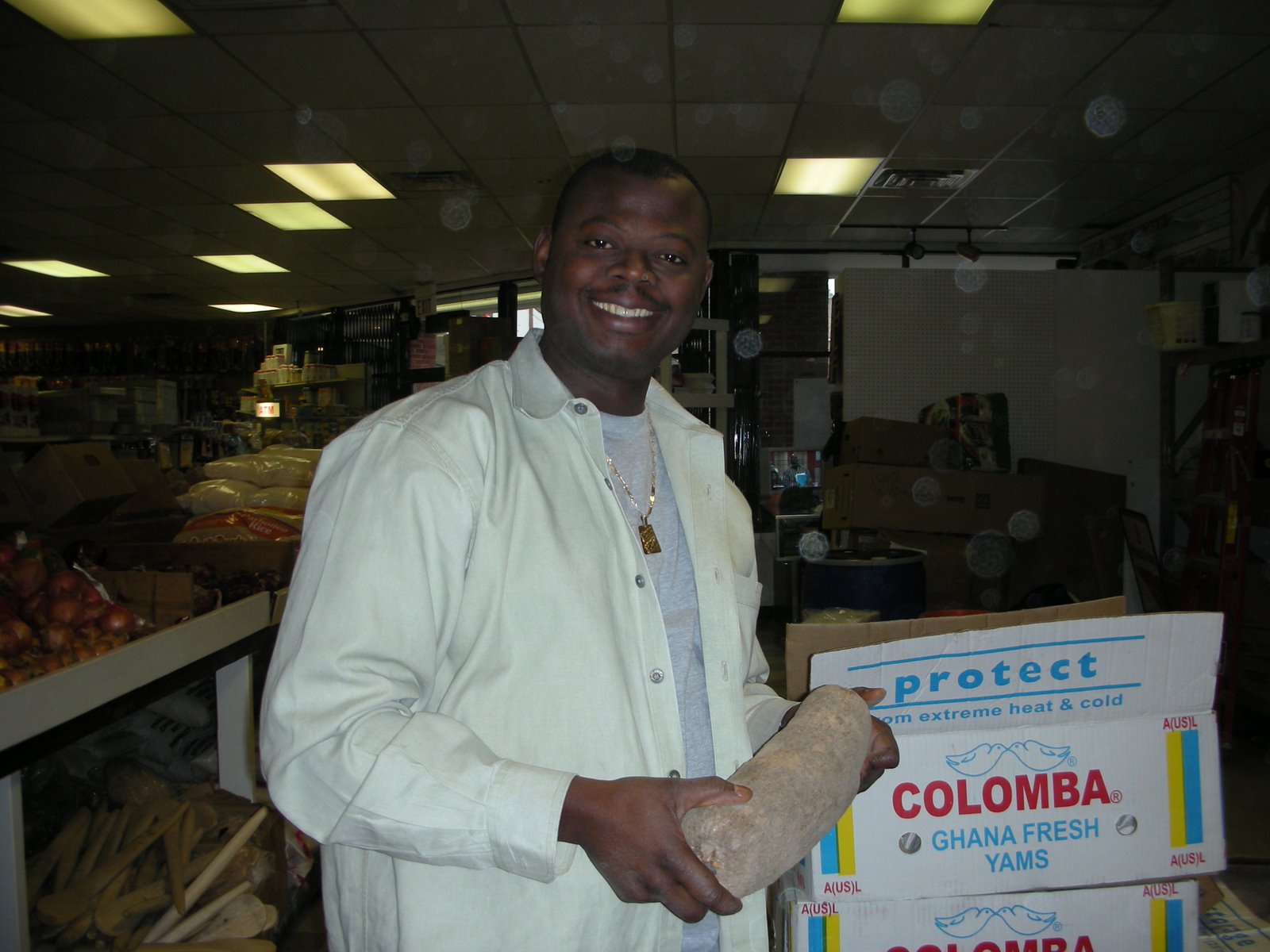
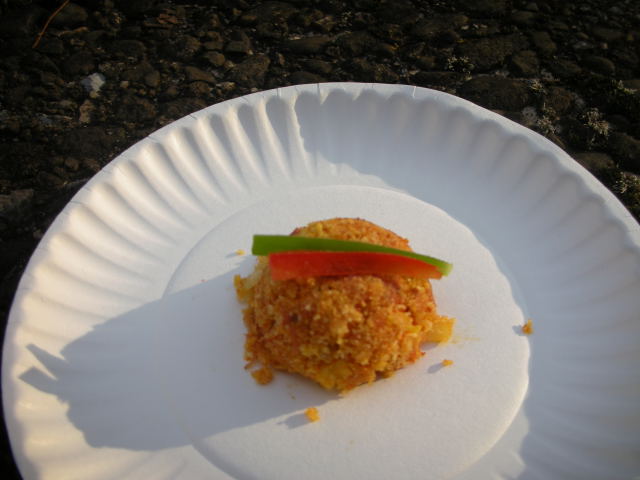
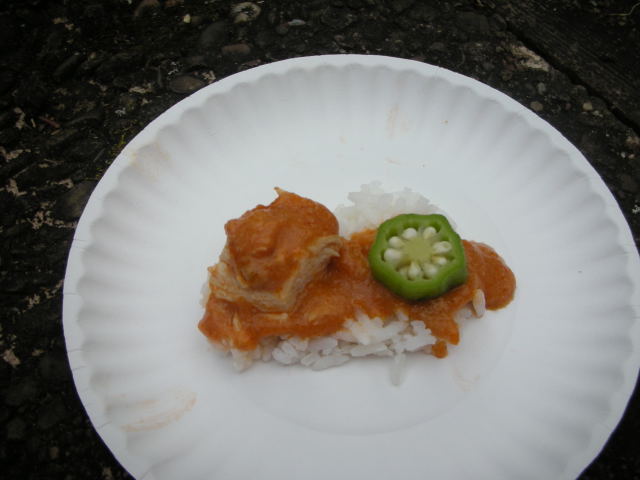
I recently returned from Chicago, where Gloria Mensah and I presented, as promised, an enthusiastically received talk and tasting session (gari foto and chicken groundnut stew with rice, shown below) at the IACP (Intl. Assoc. of Culinary Professionals) meetings. Chicago's large Ghanaian community sponsors an annual cultural festival every year that is said to be the largest of its kind in North America. One of the surprise hits of our talk was our display and passing comments on the spice known as melegueta peppers (Grains of Paradise), which apparently is becoming trendy these days, though Moroccan cooks may know of the seeds as an ingredient in some ras el hanout combinations. (I'll write more about them later.) For now, here are a few photos: the 2 Makola Markets we visited (a few blocks apart) to pick up some true Ghanaian yam, some cassava, cocoyam, sweet potatoes, zomi oil, dried shrimp and various African seasonings (added to some I brought from Ghana, like dried orka and agushi and dawadawa seeds, and a variety of Maggi cubes (shito, dawadawa, shrimp). The proprieter of Chicago's Makola African Markets, which appear to cater especially to Ghanaians and Nigerians, is Nana Adu-Gyamfi, pictured on the right.

Gloria and fellow IACP attender Gisele Perez enjoying fish Friday night at Yassa, where the food was great, but we suffered from not having a car and ended up paying more for our transportation than dinner. Plus, the crowd there overwhelmed their staff and though service was pleasant it was quite slow. (To be picky, I was disappointed they were out of baobab juice.)

On Saturday Gloria and I went to observe the chefs prepare our recipes for our tasting at the conference hotel. I realized once again that chefs unfamiliar with African ingredients, be it gari or tinned corned beef or palm oil, need firm guidance when confronted with something for which they have no context. They had purchased pink pickled ginger (just in case that's what we meant), minced regular corned beef rather than canned, and gotten regular peanut butter rather than natural style we requested. The simple tastings (garifoto on the left; groundnut stew on the right) are pictured below.