Thursday, January 31, 2013

He who brings kola brings life


The Akan adinkra symbol on the left is called "bese saka," or "bag of kola nuts." Like a lucrative sack of such nuts, (in Ghana) it is a very positive symbol associated with affluence and abundance, as well as togetherness and unity.

Kola nuts have played an especially important role in Ghana and Nigeria. As one of Achebe's characters affirms in  Things Fall Apart, "He who brings kola brings life." While in the West we generally only think of "kola" as being part of the original formula for "Coca-Cola," the nuts have often been shared as part of a hospitality ritual in Western Africa. They are also favored by Muslims (such as my driver during one extended trip around Ghana during Ramadan) for their ability to quench thirst, stave off hunger, and increase alertness. For a history of the kola industry in Ghana, see Abaka's 2005 Kola is God's Gift.

Two of my students last semester were attracted to kola nuts. One of them because he found them woven throughout Chris Abani's novel Graceland (e.g., "This is the kola nut. The seed is a star. This star is life. This star is us," another because he was just curious. 

Fortunately, my generous fellow African food blogger and food photographer extraordinaire (also mentioned in my last posting because she also brought us alligator peppers) Ozoz arrived in New York a few days before our final class, which was an  "African cafe" buffet in my home featuring food we'd studied from throughout sub-Saharan Africa. Ozoz included two types of kola nuts (red and white) in her "care package" to us. Thus our final class together we were able to begin with a symbolic "breaking of the kola nut." I found a link describing how to actually "break" it, but I had to ask her for more information about the ceremony. Since she mentioned that she plans at some point to blog about it, I'll simply note that she said "Nowhere in Nigeria is Kolanut more revered than by the Igbo tribe. They are best known for all the traditions around the kola." My students universally agreed about the bitterness of the kola nuts (they found both equally bitter), but our unsophisticated palates couldn't detect the secondary sweetness.


Incidentally, I would also like to thank Ozoz here for all her other gifts in that package:
  • In addition to the alligator pepper and kola nuts, she included  another, more recent copy of the classic Kudeti Book of Yoruba Cookery (one of the earliest African cookbooks I ever discovered)
  • several packets of banga soup spices (we used some to season our palmnut soup)
  • some containers of her preferred brand of curry powder (Lion, from the UK)
  • some suya spice (aka tankora or yagi powder/rub); essential to Nigerian suya (kebabs) or Ghanaian chichinga
  • some "belentientien," a kind of dried leaf used to season palmnut soup
  • several packets of "instant" pepper soup spices (containing: "Monodora Myristica, Tetraplura, Tetrapter, Parinars, Excelsa, Chrysobalanus, Orbicularis"), packaged in Okere-Warri, Delta State (and who says Africans aren't entrepreneurial?)
  • a large bar of Immit's Carnival milk chocolate
I hope I haven't made all the Nigerians away from home too homesick.
Truly, West Africans are generous and hospitable in many, many ways. Maybe the proverb should be "She who brings gifts from afar, brings life." Thank you, Ozoz.


Friday, January 11, 2013

Grains of Paradise or Alligator Pepper?

This past semester two of my students selected "grains of paradise" as a West African ingredient to research. One of the first things they announced in their presentation was that "grains of paradise,"  aframomum (or amomum) melequeta is also known as "alligator pepper," the dried seeds of the same plant. While all  "aframomums"  appear to belong to the ginger family (Zingiberaceae), and more specifically are types of cardamom, there seems to be quite a bit of confusion over the different types of "aframomums."

  My own search for clarity began years ago when I remembered reading  in H. O. Anthonio and M. Isoun's 1982 Nigerian Cookbook (Macmillan) about a spice called "atariko" that sounded like it might be melequeta pepper ("small seeds sold in, or removed from, an alligator pepper-like pod. Highly scented, but not as hot as alligator pepper. It is expensive so use only a few of the tiny seeds to flavor pepper soups, or banga soup. . ." (p. 17). [Incidentally, I notice that this material was appropriated verbatim in a 2008 posting on Nigerialand (http://nigeriandishes.blogspot.com/2008_05_01_archive.html) without any attribution to its source. Sigh.]

In the scientific literature the names "grains of paradise," "alligator pepper," and "aframomum melegueta" are often used interchangeably, especially by Nigerians. For example, 
  • Tolu Odugbemi's Outlines and Pictures of Medicinal Plants from Nigeria, published by the University of Lagos press in 2006, p. 74, where he lists the species name as "Aframomum melegueta, the family name as Zingiberaceae, the local (Nigerian) names as "ata-ire, atare, itaye," and the common names as "alligator pepper, grains of paradise," whose leaves and seeds are both eaten. However, he also lists 2 other Aframomum plants. Odugbemi does not use the name "grains of paradise", though he separately lists a plant as "Aframomum granum-paradisi," whose local name is oburo-wawa, common name "Afromum lillies," and whose roots are eaten rather than seeds. Finally, he lists another Aframomum plant (Aframomum sceptrum), known as "oburo-etu," or "oboro," or "bear berry," whose leaves and seeds are both eaten, too 
  •  Ndukwu and Ben-Nwadibia from the University of Port Harcourt, in a paper on "Ethnomedicinal Aspects of Plants in the Niger Delta," list names for Aframomum melegueta as "grains of paradise, Guinea grains, and alligator pepper," with local names: "Bini - ehin-edo; ehie ado; Igbo - Ose oji; Urhobo - erhie; Yoruba - oburo; ata; ata-ire." 
  • Colleagues Aiyeloja and Bello in a 2006 paper "Ethnobotanical potentials of common herbs in Nigeria: A Case Study of Enugu State" include the name aframonum (sic) melegueta with the simple "common name" of "alligator pepper," and further distinguish the Yoruba, Hausa, and Igbo names as "ataare," "ose-orji or okwa," and "chilla or citta," respectively. Are you confused yet?
  
2 Ghanaian sources I consulted have this to say: 
  • O. B. Dokosi, in Herbs of Ghana, Ghana Universities Press,1998, p. 471-477, lists 8 types of Aframomums, two of which are Aframomum melegueta (he also calls this type Guinea grains, but NOT alligator pepper) and Aframomum daniellii. He explains that except for Aframomum melegueta, the local generic genus name for Aframomum plants is sensam in Twi (He also gives details on numerous other indigenous names for some of the species). In a  detailed discussion of Aframomum (or Amomum) melegueta, he gives names in Twi ("wisa" or "fam wisa" or "ground wisa," to differentiate if from Piper guineese, called "sorowisa" or "sky wisa," that is obtained from "above ground".  
  • Aframomum melegueta is also called "wisapa" (real wisa).  Dokosi lists numerous other indigenous language names for it, but differentiates between 2 types of Aframomum melegueta: "adowa wisa," a type that grows wild and is usually used mainly for medicinal purposes, and "wisa-pa" or "apokuo" (Akim and Ashanti names meaning "proper wisa.") He gives details on both the culinary and medicinal properties of the plants.
  • In the Ghana Herbal Pharmacopoeia, published by Science and Technology Policy Research Institute [STEPRI], revised, 2007) has several pages devoted to "grains of paradise," (pp. 108-111). Here, however, they also list common names of Aframomum melegueta as "Guinea grains, alligator pepper, or melegueta pepper." (And also include the Twi, Fante, Ga-Adangbe, Nzema, Ewe, Dagbani, and Hausa names.)

 Anyhow, online at a Canadian Itsekiri heritage site I finally found Anthonio and M. Isoun's "atariko" listed as "AFRAMOMUM SPP". I went back to the spice entry for cardamom on the Celtnet site I alluded to at the beginning of this long, laborious post. There I found an explanation that says that alligator pepper, while a member of the Aframomum genus, is slightly different from Aframomum melegueta. It appears that there may be a slight difference among these--those known as "alligator peppers" are most likely from the aframomums danielli, citratum, or excapsum (though this last one is less popular).

In the picture at the top of this post, you see some allegedly "grains of paradise" I ordered from the Spice House in Chicago on the right with some "alligator peppers" graciously brought to me from Nigeria by my Nigerian colleague of the fabulous Kitchen Butterfly site on the left. I couldn't tell the difference in taste, nor appearance. I guess my bottom line is, for those of us outside of Africa, it doesn't make any difference. Use whatever you like, and call it whatever you like.

Any food scientists or botanists or culinary types who disagree, just let me know. By the way,  the students were able to find out easily that Alton Brown uses grains of paradise in his apple pie, but it was much harder for them to find authentic West African recipes using them because they didn't know the correct language and name to use when searching.
Aframomum danielli, Aframomum citratum or Aframomum exscapum

Read more at Celtnet: http://www.celtnet.org.uk/recipes/spice-entry.php?term=Cardamom
Copyright © celtnet
Aframomum danielli, Aframomum citratum or Aframomum exscapum

Read more at Celtnet: http://www.celtnet.org.uk/recipes/spice-entry.php?term=Cardamom
Copyright © celtnet

Wednesday, December 12, 2012

Recipe #97: Attiéké and Sauce Aubergine

All semester (August through December) I've been blessed by the generosity of others, especially African/Africanist friends and colleagues. This time of year it seems appropriate to share some of my gratitude.

Today, I want to publicly say "thank you" to Inza Bamba for his recent Thanksgiving gift--a treasure "more precious than gold." He made it clear that the package of tightly packed granules, direct from Côte d'Ivoire, was for me. He knew how special it would be to taste "fresh" attiéké  as opposed to "dried," boxed attiéké  (like that I picked up in Washington DC last month). Attiéké is a bit like gari, but it is steamed cassava granules, and is more like couscous than gari.

I know that he often prepares
attiéké with "sauce aubergine," (eggplant stew) and is partial to lamb, so I decided to prepare the two together a few days ago, Ghana-style. 


Recipe #96: Sauce Aubergine with Lamb and Attiéké (Ghana-style)
  • I took a medium purple eggplant (sorry, no garden eggs around here), peeled and chopped it, added water to cover and put it on the stove to boil for a few minutes, while I
  •  Added a couple pounds of lamb chunks (you can later cut the meat off  the shanks if you like), bone in, and added some seasoning (a couple of chopped onions, a few minced garlic cubes, part of a seeded habanero pepper, some sea salt, and a good tablespoon of freshly grated ginger, plus a little dried ground red pepper for good measure) to it and stirred, well and let it steam in a covered soup pot with a little water.
  • Next, I blended (in an electric blender) a couple of fresh tomatoes and several leftover canned ones I had in the refrigerator (Perhaps I strained out the seeds as I added the blended tomatoes, but that's just picky me), then I
  • removed the softened eggplant with a slotted spoon and added it to the blender, along with a little water (maybe half a cup) to help blend it up. There's no need to blend the eggplant if you like it chunky, but I got into the habit of always blending it since my children preferred the sauce creamy.
  • I added the eggplant to the soup pan with the tomatoes, lamb, etc., along with some more water (a couple of cups), and let the mixture simmer until the meat was soft (Actually, I left it simmer on the stove for around 45 minutes, then cooled it and put it in the refrigerator to finish and serve the next day).
  • The day we ate it, I reheated it and let it simmer for about half an hour, adjusted the seasonings (needed more salt, and I added a heaping tablespoon of tomato paste).
  • While it was finishing, in a separate bowl I prepared some fresh okra (cut off both ends, and sliced it into rounds), cooked it in the microwave with a little water for about 10 minutes (Be careful to use a large bowl because the okra will bubble up as it cooks). I would have cooked the okra right in the stew, but we were having a guest for dinner, and I was not sure if he liked okra.
  • While the soup was simmering, I measured out a cup of the dry attiéké and set it aside. I also measured out a cup of the "fresh" attiéké . I poured an equal amount of water into a small sauce pan (a good cup) for the dried attiéké . I made a "couscousiere" in a small saucepan by putting a strainer in it and lining it with a cheesecloth.
  • Shortly before we were ready to eat, I added a cup of water to the fresh attiéké (big mistake), then tried to drain out the obviously excess water, and put the mixture into the couscousiere to steam for 15 or 20 minutes (I think it needed no extra water, and it should have simply been steamed). It became a glutinous mass (kind of like a gooey eba), and next time I'll totally skip adding any water. The flavor was good, however. Sorry to have messed up, Inza. I'll prepare some more tomorrow night for our "African cafe" potluck with my students, and report back.
  • Shortly before I eating, I boiled the cup of water and poured the dry
    attiéké into it (the same way one normally prepares dried couscous in the U.S., letting it sit, covered, for a few minutes until all the water was absorbed, then fluffed it up with a fork. Very quick, very easy, very tasty (and no gluten, too).
  • The meal was well received, and needed no extra accompaniment, though I did serve a fruit dessert.

Tuesday, December 04, 2012

On my African Cookbook shelf

It's been some time since I've commented on the latest (cook)books I'm reading/collecting, and also since I've thanked contributors  to The Africa Cookbook Project, 
launched at TED Global in Tanzania in 2007. Yes, we're still collecting cookbooks published in Africa and written by Africans.

Rachel C. J. Massaquoi, the Sierra Leonean mother of one of my daughter Abena's  friends from Harvard,  published a book  in 2011 through AuthorHouse. Titled Foods of Sierra Leone and Other West African Contries: A Cookbook and Food-Related Stories, it has been a joy to read through its 159 pages. The book is filled with helpful information, including stories, cultural wisdom, photographs, and a glossary. It is truly a gift to those of us interested in preserving and sharing West African culinary history and recipes. What's more, it's currently on sale through AuthorHouse for $23.51 instead of the $46.28 price available at Amazon.com (use link above). It would make a great, unique, Christmas gift.

I'm especially interested to try her cassava leaf sauce (in Ghana, people favor cocoyam leaves, aka nkontomire or kontomire), plus her recipe for Sierra Leonean "check rice" (also popular in Liberia). She has done us all a great service.
 
In 1993, Ten Speed Press published a cookbook by Ghanaian author and television cooking show host Dorinda Hafner that became a bestseller, A Taste of Africa. The book was published in hardcover and paperback, reprinted, and followed by a revised version in 2002. I recently picked up a copy of the revised edition, only to discover that it has quite a different feel. For one thing, the language has been toned down: "fufu" has been renamed "dumplings," "momone" has gone from "smelly" salted fish to simply "salted fish." Also, there are some additions (such as the recipe for "ham soup with basil and vegetables)," and she has reversed the names, for example, from using Ghanaian names ("shitor din" or "kontomire ne momone," "kubecake," "Tom Brown" in favor of highlighting more understandable English names as headings, with the traditional names usually in small 


type  underneath. Understandable, perhaps, but also a kind of loss. Still, the revised edition stands proudly on my shelf next to the first edition, and Dorinda's delightful 1996 memoir (also published by Ten Speed Press) I Was Never Here and This Never Happened--Tasty Bits and Spicy Tales From My Life.


Several weeks ago, on his latest return from Ethiopia, Prof. Greg Ziegler carried along a donation he correctly guessed was not already in the collection. Published in 2011 by author Teshome Berhe, it is a bilingual introduction to Ethiopian cooking and culture, in both  French and English (en français et en anglais): A table avec la Reine de Saba / Dining with the Queen of Sheba. Several of its 139 pages contain color illustrations, there are numerous historical anecdotes and cultural references, and in place of a table of contents or index it has a 5-page summary at the end. Another contribution to cherish. Thank you again, Greg. There are today many cultural and culinary spokespeople recording their heritages. It warms my heart, and we are all enriched.


I'm sorry to report that due to the political problems in Mali, a much-anticipated photocopied version of a Malian cookbook was not procured, though Penn State doctoral student Kristal Jones is currently in Bamako and attempting again to obtain it for me.

I wish . . .
I wish . . .
I wish it were possible to digitize all these books so that they could have a wider circulation . . . Of course, as an author myself, I'd also like them to be available at a fair compensation to the writers.

Friday, November 30, 2012

Plating Africa's cuisines

Was delighted to open my mailbox today to find the November/December issue of plate magazine there. Each issue of this award-winning industry magazine is devoted to shining a spotlight on a single topic. For the current issue, that means "undiscovered AFRICA." I was pleased to have been able to contribute, and to be included with such luminaries as Pierre Thiam and Marcus Samuelsson (as well as being introduced to several others). I was even more thrilled about the attention focused on the continent's cuisines, and the encouragement to U.S. chefs to embrace them. 

Even if you cannot obtain a copy of this beautiful magazine, you can at least sign up at their online site to view recipes, including one of mine for groundnut soup.

* * * * * * * *
 
Among other things, I was happy that the article in plate recognizes Penn State's pioneering course on African food culture.The course is swiftly drawing to a close: just 2 more weeks, and the students are preparing their final presentations: on food themes in selected West African novels, on kola nuts, injera, indigenous red rice, fermentation, and the social and culinary challenges facing pastoral peoples . . . It has been a privilege to teach these young people, and we're all looking forward to the end of course pot-luck celebration where everyone selects an African recipe to research and prepare (with promises that the quality of the cooking is not going to compromise anyone's grade in the course). Commensality and hospitality are important components of sub-Saharan African food cultures, and it seems only fitting to end on that note. I am very proud of the students who've followed me on this journey of discovery.

Tuesday, November 13, 2012

Field Trip: West and East Africa in Washington DC

Our food culture in sub-Saharan Africa class is in the home stretch. We've completed units on western, eastern, and southern African cuisine, and are now in central Africa. After weeks coordinating schedules, we managed a field trip day in Washington, DC. on Saturday.

At 6:30 a.m. we piled into a Penn State van in State College, PA and drove to Washington DC. It was a good choice, not only because are there many West Africans in the area,  but there are also over 200,000 Ethiopians living there, reportedly the largest concentration in the U.S.

When we arrived at our destination, it was also a "farmers market" day, and extremely congested. Several of us felt like we were back in a crowded West African market. After driving around several times, we finally found a parking space, and entered a West African wholeseller's store. Wendi, from Ghana, felt right at home and took advantage of the trip to stock up, as did I. We stopped at "Divine Unity Foods" first, then went over to nearby Obeng International Wholesale & Retail." Both of these had the same address online, but were actually separate shops near each other.


 Ethel, the cashier at Divine Unity, was cheerful and typically helpful as she rang up our many purchases.

 
A colleague had requested me to pick up some cassava leaves. We tend to eat cocoyam leaves, nkontomire, in Ghana, so I asked a Liberian woman in front of me in the checkout line for advice on the cassava leaves I had in my basket. She immediately said, "no," plucked them out of my hands and returned with a bag of frozen ground cassava leaves. "These are best." Turns out, she was right.


After stopping at another market next door (where we continued looking in vain for any kola nuts), we headed over to Dukem restaurant for some fine Ethiopian food. Prof. Zieglar, who graciously drove us, brought along a visiting Ethiopian colleague, Ashagrie, who had been in the U.S. for only a week, and was ecstatic to finally have a "proper" meal. He ordered the largest combination plate on the menu (with injera, of course), and thoroughly enjoyed himself. He also repeatedly helped us out with information on Ethiopia's food culture.


The students found there was something for everyone, including our vegetarians, and unhesitatingly dived in with their (right) hands. I was proud of them! 

After lunch, we wandered down the street to Habesha market and restaurant) to look at some Ethiopian spices and ingredients, then headed over to Etete for a traditional coffee ceremony. We stopped after the second cup, instead of the traditional three. Everyone was stuffed. Or, as we might say, well "fed up."


[Of course, Eastern African cuisine also includes the foods of Kenya, Tanzania, and Uganda, but there seem to no longer be any easily identifiable restaurants serving ugali and associated recipes like sukuma wiki or irio, or something like Ugandan matoke in the area. Please correct me if I'm wrong.] 

Any of you Penn State (University Park) undergraduat students out there, the course will be offered again in the fall of 2013. Hope you'll join us.

Tuesday, October 23, 2012

Betumiblog Award and update

 I received a pleasant note today that Betumiblog has been selected by a business school as among the "Top 100 Sites for International Business People," (at #23 overall, and 3rd in the Africa list). See the nifty badge they sent me. That spurred me to take a few minutes to stop work and jot off this posting.

It looks like Betumiblog has (in other words, I have) been slacking off. Not so! The problem is that I don't have time right now to write up everything I have on my current list (including new African culinary products via Bim's Kitchen,  another donation to the Africa cookbook collection, and discussion of the linguistic confusion and controversy over alligator/melegueta/malagueta peppers).

Actually, the reason I'm not writing on my blog is a good one: two publishers have expressed interest in the Ghanaian regional cookbook. At last, Africa's time is at hand (for additional support of this statement, see the October video and edition of the World Bank's African Pulse). I am working hard to prepare a convincing proposal to send out. But, as I  recently observed "to do one thing well requires doing many things." The postings will have to wait a few more weeks as I focus on the prospectus. Please keep your fingers crossed. Many of you keep asking when the book will be published. Just remember: "little by little, the chicken drinks water."  I believe it will happen within the next year and a half.


Wednesday, October 03, 2012

African food in literature

Food studies and literature courses rarely consider African food the same way they do other cuisines, apart from the frequent allusions to Igbo food in Achebe's works. In class we're taking a very quick look at food in African literature, including proverbs, poems, short stories, and novels. 

Today we heard two African poets, who graciously included "food poems" in their repertoires
for us: for example, South African Gabeba Baderoon read food poems like "Hunger" and Liberian Patricia Jabbeh-Wesley's poems included images of broken calabashes and scattered palm wine. In class we read Jabbeh-Wesley's poem "Wandering Child." Both of these talented poets' writings often evoke a sharp sense of exile, loss, and/or nostalgia. We've also looked at some writing by Cameroonian author Angèle Kingué. It seems to me that African women write differently--somehow more intimately--about food than African men, but perhaps I have just not read widely enough.

One student is reading Nega Mezlekia's Notes from the Hyena's Belly  and another Chris Abani's Graceland. Earlier we considered Shirin Edwin's "Subverting Social Customs: The Representation of Food in Three West African Francophone Novels." We also talked briefly about Tsitsi Dangarembga's Nervous Conditions. The assignment is to consider the roles food plays in these novels.

I've also been anxiously awaiting the English translation of Cameroonian Calixthe Beyala’s book  How to Cook Your Husband the African Way. It sounds like it might be in the vein of Brazilian Jorge Armado's Dona Flor and her Two Husbands. I'd love to know more about other African works and/or articles that focus on this subject. Please help me grow my understanding. And, if anyone can tell me of African films where food is important thematically, I'd also love to know about them. 


Monday, September 24, 2012

West African cuisine comes to Penn State

Last Friday we finished the Western Africa unit of our class at Penn State, and in a grand finale moved to one of PSU's food labs in the food science building and spent a busy early morning preparing and sampling a variety of West African foods, showcasing different cooking techniques (steaming, baking, deepfrying, stewing, grinding, cutting, steeping) and ingredients (starches like cassava, plantain, and corn; fruits, vegetables, seeds, nuts, herbs, legumes, including coconut, lemon grass, hibiscus, pineapple, groundnuts (peanuts), black-eyed peas, pumpkin, onions, tomatoes, peppers, and a Senegalese tea leaf (Krystal, what's the name of that again?). It made everything we studied seem more real. As I pointed out to the students, there was nary a drop of dairy or wheat in any of the things we ate. As usual, I forgot to take any photos until we were eating, so you cannot see anyone cracking open coconuts or grinding in the asanka. Still, you can see a little bit of the results.


This week we're moving on to Eastern Africa, beginning with the Horn of Africa. Wish you could join us!


Saturday, September 15, 2012

Fall for Garden Eggs (African eggplants) and a question

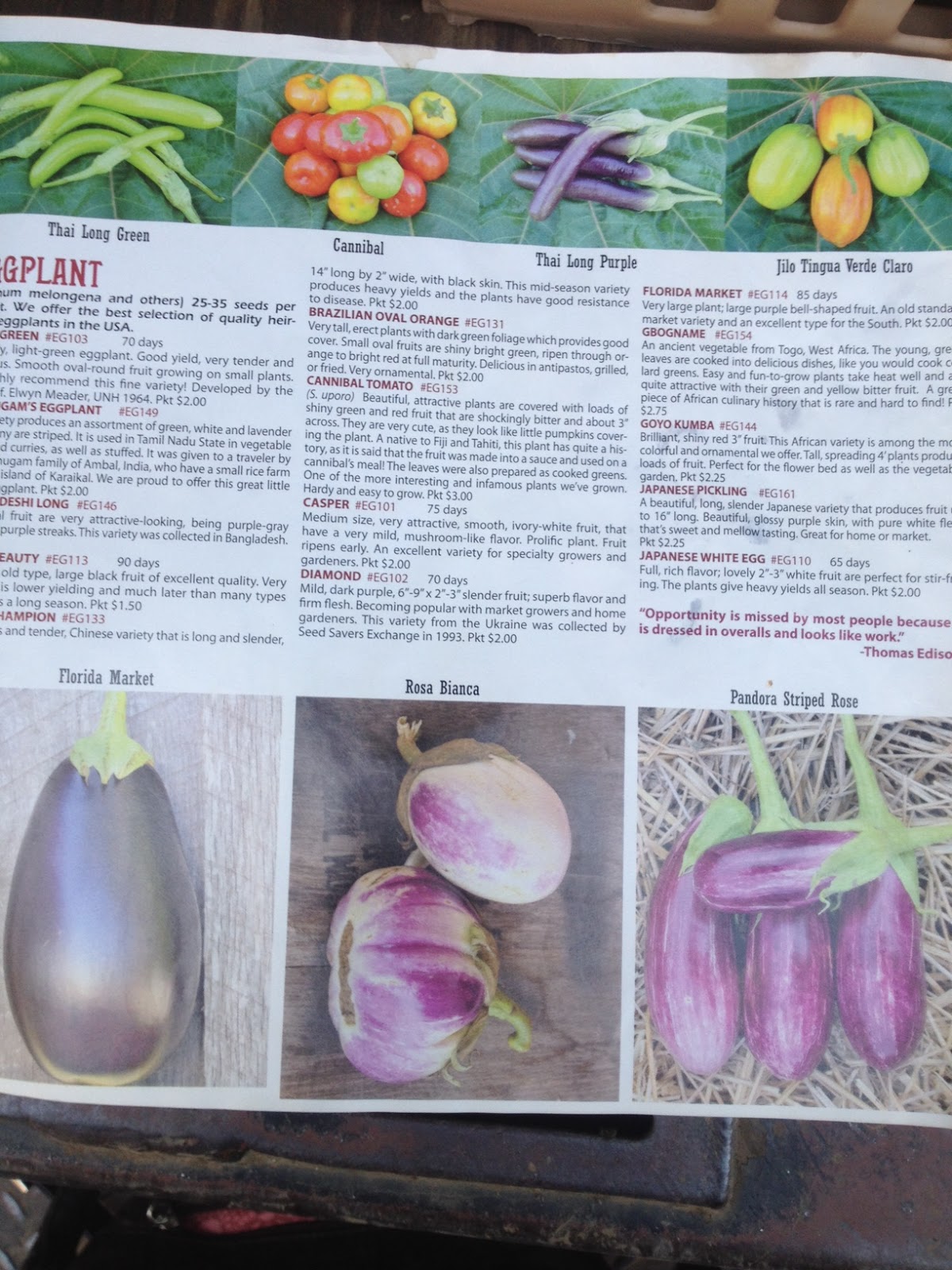
There are numerous farmer's markets in central Pennsylvania this time of year. Last week 2 of my students (one from Ghana) told me one of the markets sells "heirloom" eggplants, that included some that look like the West African versions. The market opens at 11:30 on Fridays, so yesterday I hurried over there and checked stalls until I found the right one, Moser's Garden Produce. As I examined the dozen or so different types of eggplants (Asian, Indian, African, Brazilian, etc.), I struck up a conversation with another shopper beside me loading a large bag. He was from Côte d'Ivoire, and preparing to buy in bulk and freeze the "aubergines" (French for eggplant) for use as needed. Unfortunately, he told me, the best ones were already taken. It turns out a Liberian colleague had beat us to it and called ahead for 4 bushels that she was picking up at 4:00 p.m. Oh, well. I selected several of the ones still available (in the picture above) and brought them home to test out. 

I also had a lovely chat with owner/farmer Barrie Moser, and he let me look through the seed catalog he buys from, Baker Creek Heirloom seeds. It turns out the ones I bought included a new variety (Solanum aethiopicum) from Burkina Faso (the orange ones on the left). Mr. Moser's seed catalog was from 2010, but it also included several "jilo" varieties from Brazil, as well as "gbogname" from Togo (S. macrocarpon), and the African goya kumbo (S. melongena).
 
I'm pretty excited to try them out (one of my American students who bought some said he found them bitter, which was what I had warned them they might think. Can anyone tell me the scientific name of the common variety  of Ghanaian "ntroma" garden eggs?


Thursday, August 30, 2012

Africa Cookbook Project: From Mandela's kitchen


Yesterday I added a welcome volume to the Africa Cookbook Collection: a book by Nelson Mandela's personal chef.

I first heard about Xoliswa Ndoyiya's cookbook (authored with quietly impressive help from Anna Trapido) Ukutya Kwasekhaya ("home food"): Tastes from Nelson Mandela's Kitchen in February, 2012, when it was featured online in the BBCNews. It's not the kind of "celebrity" cookbook that usually makes the news in North America.

I had already heard that Nelson Mandela prefers to eat traditional dishes from South Africa, and was excited to hear that Ndoyiya's cookbook shared over 5 dozen recipes, many of which feature "homestyle" dishes (such as umphokoqo (crumbed maize meal porridge with sour milk), umnqusho (samp and beans), ulusu (tripe), umsila wenkomo (oxtail stew), and isophu (sugar bean and white maize soup). There are also a number of South African dishes with other influences (e.g., paella, lasagne, and strawberry trifle), but the cover, showing two hands holding white maize kernels, captures the flavor of the book. In addition, the 173-page hardcover book is bursting with homespun wisdom ("When I was young I understood that my mother was stirring love into every pot of hot ulusu and, even if I didn't always like it, . . . that my paternal grandmother, MaSitatu, was feeding me her hopes and dreams along with her umkhuphu"), as well as  anecdotes about, and lovely photos with, the famous family she has served since 1992 (2 years beforeNelson Mandela became president). I haven't tried any of the recipes yet, but am thrilled to have Ukutya Kwasekhaya in the collection.


Thursday, August 23, 2012

End-of-summer drink: Recipe #95 Basic Ginger Beer

Ahhhh. The end of summer. Time for a cool drink in a shady spot before classes begin on Monday. In this photo I've paired it with some humble peanuts and the "choco-twemo" I'm working on, a version of atwemo that incorporates chocolate powder and groundnut paste (peanut butter), (or "choc-atriemo" as my son Yaw DK has christened it.)

Last week, along with the bissap, I prepared several liters of ginger beer for my trip to Hershey. It was with a shock that I realized that I've never posted my simple recipe for this soft drink popular throughout sub-Saharan Africa. Ginger beer is often carbonated, and made with yeast, but this version skips that step. I still like the bubbles, so I simply use seltzer (carbonated) water to dilute the concentrate to taste. It's always fun when folks shake their heads and say with awe: "You made this from scratch?"

Recipe #95: Basic Ginger Beer

4-8 ounces of ginger root (1/4 to 1/2 pound, depending on how strong you want it)
2 cups of boiling water
2 cups of cold water
1/2-3/4 cup sugar, or to taste
2 Tbsp lime or lemon juice
6 cloves
a small piece of cinnamon stick (~1/4 of a short stick) [optional]

  • I usually peel the ginger root (unless it's organic). I just learned how easy it is to use the back of a teaspoon (thank you, Ann) rather than a vegetable peeler. The first time you make this, you should probably start with about 4-5 ounces of ginger until you have a sense of how strong you want it. 
  • Grate the ginger into a stainless steel (or glass or other nonreactive) bowl. I've never tried using a blender or food processor for this step, but it might work and would save a lot of grating if you're making a large batch. Use a potato masher, or bottom of a heavy glass or a wooden spoon to mash the grated ginger, then
  • Pour 2 cups of boiling water over the ginger and let it sit for at least 2 hours.
  • Line a strainer or colander with a cheesecloth that has been folder several times, and set it over a large bowl.
  • Slowly pour the ginger-water mixture through the strainer.
  • Pick up the cheesecloth by the 4 corners, then twist and squeeze it to remove as much of the water from the cheesecloth as possible.
  • Discard the ginger in the cloth.
  • Add about 2 cups of cold water to the liquid in the bowl (more or less depending on if you want to dilute it with seltzer water later or not), and up to 3/4 cup of sugar (or more if you like it really sweet), stirring to dissolve it. 
  • Add the lime (or lemon) juice, cloves, and cinnamon (if using) and let the mixture sit for another hour before removing the spices.
  • Carefully pour the ginger beer into a pitcher or covered container. Store, covered in the refrigerator.
  • Variations: increase or decrease the ginger or sugar or replace it with honey, substitute fresh pineapple chunks (including the peel, if organic) for the cloves and cinnamon, and add it with the original grated ginger.
Serve the ginger beer well chilled (over ice cubes if you're North American and like "ice blocks" as in the photo above), and diluted to taste with water, seltzer water, or even ginger ale. I use about 1/2 cup of ginger beer per serving. It's said you can mix in some rum, vodka, or other alcohol, but I've never actually tried it that way.

Come to think of it, this is just as well a spicy, refreshing drink for the fall. Labor Day picnics, anyone?


Sunday, August 19, 2012

African food at Hershey

Last week I spent several days in Hershey, PA, at The Hershey Company. We had fun cooking and immersing ourselves in West African culture, both in larger groups presentation-style, and in smaller groups in test kitchens. To the right are some of the snacks we prepared one day (beef and chicken chichinga [Nigeria's suya]), akara (aka kose), groundnut [peanut] "cakes,"  etc.
On Monday we explored music, fashion and daily life while we tasted a few West African dishes, from groundnut (peanut) stew
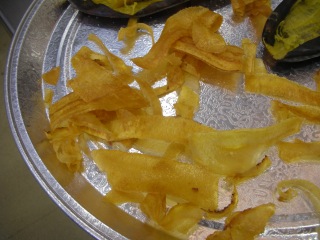
and bissap [aka zobo] to green plantain chips, moinmoin and gari foto. Though my online recipes contain meat and poultry, we  adjusted them and added vegetarian versions as well.

On Tuesday we prepared one of my favorite snacks,  kelewele with peanuts, along with corn and coconut and some atwemo (twisted cakes),  washed down with ginger beer or bissap. The staff were all enthusiastic and helpful, and good sports, and I believe we all had a fun time. I'm still trying to perfect a version of atwemo incorporating cocoa and peanuts, but haven't quite gotten it right yet.


Along the way, I  learned more about Hershey's involvement in Africa and we talked extensively about life in West Africa,  flavor principles, meal formats, cooking techniques, health challenges. It was a hectic time, but quite rewarding.

Betumiblog in Arise Magazine: Just before leaving for Hershey, I received an email from Adhis at Chef Afrik sharing that she was 
". . . featured in the August issue of Arise Magazine which is one of the premier magazines covering African culture. It was a pull-out feature next to an interview article with Marcus Samuelsson about his new book Yes, Chef. I was asked to name the top African food blogs . . ." 
She graciously listed me in her top ten, generously calling me "the godmother of African food blogging." It made my day! Check her August 9 posting out: it lists some of the  best food bloggers writing about African cuisine.

Things continue to heat up here as summer draws to a close. I'm now getting ready for my new class on food culture in sub-Saharan Africa at Penn State, which starts in a week.