Showing posts with label tapioca. Show all posts

Wednesday, November 02, 2011

Back from Brazil: Moquecas to Mandioca

I returned from Brazil a week ago. We spent most of our time in the Central West region (Salvador in Bahia and Fortaleza in Ceará ) and the South East Region (Belo Horizonte in Minas Gerais). My only sadness is that I didn't have a chance to eat any feijoada while I was there. But, the myriad fresh tropical fruits, the seafood dishes, the cassava dishes, and, let's not forget the caipirinhas, mean I have no reason to complain.
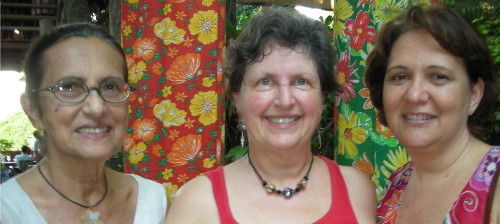
One refreshing aspect of Brazilian cuisine is that everyone eats some form of cassava (mandioca, yuca), where the root is not seen as a food only for poor people. Everywhere in Bahia and Ceará the restaurants served custom-made "tapiocas" as a matter of course (a kind of cassava flour crepe, that can be sweet or savory). Carne del Sol (salted, sun-dried beef) and mandioca frita ("cassava fries" aka aipim frita  or macaxeira frita) where the cassava is first cooked by boiling, and then fried, is popular, and most mornings simple boiled cassava was served as a side dish at breakfast in our restaurants. And of course, in Bahia and Fortaleza along the coast we ate fish (moqueca de peixe) and shrimp (moqueca de camarão) stews every chance we got. The moqueca is Brazil's answer to seafood chowder, and was usually prepared Bahian-style, enriched with coconut milk. Ours were always served in traditional clay bowls. Sigh. . . A dish I think any West African would love: garlic, seafood, tomatoes, onions, coconut milk (or not). . .  with a pot of hot pepper sauce on the side and a variety of side dishes always including white rice, and a form of farofa/farina de mandioca with dendê oil (palm oil),  and/or vatapá, and cooked  chopped okra.  The 2 women above were gracious to allow me to take their photo at Yamanjá restaurant in Salvador (thank you to Luciene Guirra and Josi Roberto). Incidentally, the history of Yemanjá (or Yemajá), an orisha, African goddess of the sea,  originates from Yoruba land and is fascinating.
Of course, we also frequently enjoyed acarajé and seafood balls  (codfish and crab), and on and on. . .
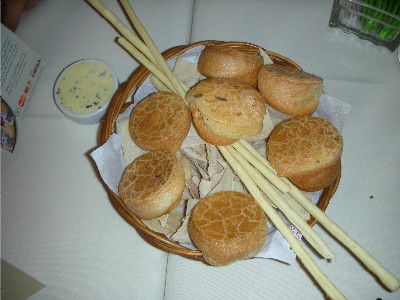
A final word about cassava (mandioca, yuca). In Brazil, we never stayed at a restaurant or stopped an at airport that didn't serve piping hot fresh pão de queijo, an addictive kind of cassava flour popover, or "cheese bread," originally a Minas Gerais specialty that is now popular throughout Brazil. I've been thinking for some time that it should be possible for Africans to make  pão de queijo using cassava flour (kokonte, lafu). Brazilians actually often combine 2 types of cassava flour (one called polvilho azedo, (or "sour," because it is slightly fermented) and one called polvilho doce (or "sweet" because it is unfermented). I was able to find some of the first locally in our town, but have asked my husband (who returns from Brazil tomorrow) to bring me some if he has time, so that I can try several versions. There is a special type of cheese from Minas Gerais that is commonly used, but I'll use a substitute in the ones I try to make. I wonder about cheese in Ghana. . .wagashi? I'll let you know how my experiment works out.

Friday, November 05, 2010

Recipe #50: Ghana-inspired Hot Chocolate

For the record, I'm a confirmed chocoholic. In October I had some fabulous creamy hot chocolate at a little shop in Santa Cruz, California. It made me start thinking about 2 ingredients found in Ghana: chocolate and cassava. This morning I quickly experimented in the microwave with wonderful initial results of what I think of as a rich holiday Ghana-style hot chocolate: thick enough to eat with a spoon, but thin enough to drink. 

Please understand that this is not a traditional beverage in Ghana. Ghana's world-class cocoa, and its cassava consumption, inspired me. I'm not sure how it will work with powdered or evaporated milk but I'll continue experimenting, including a stove-top version, different kinds of milk, using coconut milk/water, different types of chocolate, flavorings like vanilla, mint, etc. Also, I wonder about how to extract the cassava (tapioca) starch directly from fresh cassava. . .

I took a mug of milk (probably 12-14 oz, half whole milk and half organic 1%) and whisked in 2 teaspoons of tapioca starch (aka tapioca flour). I heated it for a few minutes, stirring every 30 seconds or so (not sure if this is necessary, but I didn't want it to thicken unevenly). After a couple of minutes, I added some squares of chocolate I had handy (Lindt's 85% extra dark cocoa, probably 3/4 - 1 oz; the Lotte "Ghana" chocolate  my Berkeley daughter gave me from her trip to Japan was too precious to experiment with), whisked it with a tiny whisk as it melted, and put it back in the microwave for about 30 seconds, then whisked it again. It needed a little sugar . For garnish I used grated chocolate and a little whipped cream.

It was luxuriously rich, smooth, creamy, and very satisfying. I invite you to try it and let me know what you think (and also how to improve it).

Tuesday, May 26, 2009

Conference and Jamaica

It's been a challenge keeping last month's promise to post 2-3 recipes a week. I've managed so far, but now through June 15 are busy with conferences and travel, and I make no promises until I return in the middle of June. The exciting thing is that, barring the unforeseen, I plan to be in Jamaica the second week of June. This is somewhere I've never been before! I'll get to taste some Caribbean things I've only read about or eaten in U.S. restaurants. Since the last few weeks I've been immersing myself in cassava (e.g., manioc, tapioca, mandioca) history, I'm especially excited to taste bammy and cassareep. Also, I've always wanted to see how the dish callaloo compares to Ghana's nkontomire stew. The bottom line is, postings will be irregular at best, and likely will not include recipes. Consider me on vacation for a couple of weeks, but I will post as I am able.

Monday, December 10, 2007

Tapioca Project and Cooking Contest

This week in Rio has been filled with fantastic opportunities to get to know Teresa Corção and Margarida Nogueira and their Manioc Project. The day after arriving I had the great good fortune to attend the 3rd “tapioca cooking contest” (a light, magical cassava “pancake” cooked without oil) held as part of their work with children, especially those from the favelas:


Their project has been so enthusiastically received by the children and the schools that Teresa and Margarida now have a bigger dream: to expand “Projeto Mandioca” to other cities and states in Brazil, beginning with São Paulo. They plan to develop materials to train and equip teams of qualified volunteers to duplicate and replicate the projects on a wide scale. Already they’ve worked in 6 schools and reached at least a thousand children. These dream-makers deserve our support and encouragement. Read (in Portuguese) more about the foundation they have just established, the
Instituto Maniva, to make it possible.

How does this relate to Africa? Teresa and Margarida are acting locally, but they are definitely thinking globally. They want to see the love of and respect for manioc (e.g., cassava) spread everywhere, moving beyond Brazil to Africa. After all, Nigeria is the world’s largest producer of manioc (cassava), and it was Nigerian poet Flora Nwapa who wrote the ode to cassava, Cassava Song and Rice Song. Let’s join them and dream together.


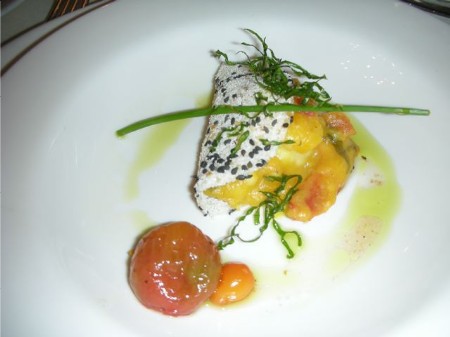
Another joy in Rio was to eat at O Navegador, Teresa’s world class restaurant (with its incredible organic salad bar ,".org") where I enjoyed a highly sophisticated version of a tapioca pancake with black sesame seeds and rock salt (and filled with bobo de camarão, a cassava puree with coconut milk, red palm oil, and shrimp, along with a little cilantro, onions, etc., and garnished with a sauce made of cherry tomato and pimenta biquinho). They also served the best pão de queijo I’ve tasted in Brazil. Now I have all these wonderful cassava recipes I hope to adapt and introduce to Ghana in January!