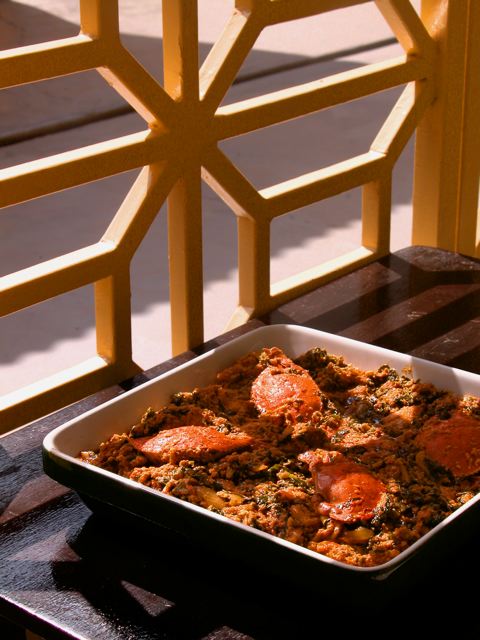
I often hear "Palaver Sauce" called "Nkontommire (Kontomire) Stew" or "Spinach Stew." This confuses me, as in my mind, "Palaver Sauce" often contains both beef and (usually smoked) fish and agushi (melon seed), whereas "Nkontommire (cocoyam leaf) stew is a less complicated version. Of course, as always, there are numerous recipes for either of these, so you should feel free to adapt the recipe to satisfy yourself, including creating vegetarian versions. Just be sure your recipe contains plenty of greens.
There are many stories of how the stew came to be called "Palaver" sauce. My best bet is that it comes from the Portuguese word meaning "word," or "speech," or "talk," palavra. While today's meaning of the word in West Africa is that there has been some kind of trouble arising from an argument, in earlier days it meant "a parley between European explorers and representatives of local populations, especially in Africa."
This is consistent with Alba Kunadu Sumprim's interpretation at her site, The Imported Ghanaian: ". . . when the Europeans came to Ghana and met with the chief in Elmina to negotiate trade, the food served at that Palaver - Nkontommire - took on its name."
Here are two ways to make it in the U.S. True-blue Ghanaians will see that I have unabashedly omitted the seasoning momoni lightheartedly described by Esi Cleland at her delightful "What Yo' Mamma Never Told You About Ghana" blog.)
Recipe #73: Palaver Sauce (time-saving version)
 It was at step 6 today that I discovered that I had barely 1/2 cup of melon seeds to thicken the sauce, and I wanted a thicker sauce. In a pinch, you can substitute a couple of beaten eggs (or even a cup of canned refried beans, or cooked, mashed beans, or a cup of cooked pureed eggplant). I simply added a tablespoon of water to a beaten egg, and added both the liquids to the stew at the same time, let it cook covered for about 10 minutes without stirring to set, and then mixed everything in and let the sauce simmer a few more minutes. It needed a little more red pepper, so I sprinkled in some dried red pepper.
 The resulting stew provides a friendly mix where a lot of interesting ingredients get along very well together without any palaver: a sauce to enjoy with yam, potatoes, rice, or whatever starch you prefer. And now it's time to eat.

- 1/2 pound of stewing beef, fat trimmed and cut into 1/2-inchcubes
- salt (begin with 1/2 teaspoon; smoked and salted and dried fish and shrimp add quite a bit of saltiness and you can always add more salt at the end)
- 1 cup water
- 2 onions (or substitute part or all with scallions), chopped to get about 2 cups
- 1/2 cup palm oil (traditional, dzomi if available, or other vegetable oil like peanut or canola; I often blend palm oil with another oil)
- 1/2 pound fresh or frozen fish fillets (e.g., cod or haddock)

- 2 10-oz packages of frozen greens (spinach, nkontomire, collard, kale, etc) OR greens (several bunches, or a couple of pounds before preparing) Today I had spinach, collards and kale in the house.
- 1 cup fresh grated tomatoes (or a 16 oz can of chopped tomatoes)
- 1/4 cup tomato paste
- fresh hot pepper or dried ground red pepper, to taste (begin with a small amount, like a teaspoon, and add more to taste)
- 1/2 to 1 cup of ground agushi (OR pumpkin seeds)
- 3 cloves of fresh garlic, pressed or minced
- 8 oz of smoked/dried fish (whatever is available, such as smoked whiting (NOTE: substitute smoked ham cubes or turkey if smoked fish is not available). Today I had smoked mackerel and smoked whiting
- 1Tablespoon of dried ground shrimp if available (optional). NOTE: Ghanaians would likely use this more liberally.
- a small piece (~ a square inch) of salted codfish (optional)

NOTE: When we prepared Palaver Sauce in Ghana, we included 4 soft-shelled crabs, as in the picture above. In Central PA these are very expensive, and I usually do not use them, but if they are available, feel free, or substitute shrimp in their shells!
- Wash and prepare the greens (see suggested directions for nkontommire). If using frozen greens, defrost and remove excess water using a strainer. You can save the water to use later in place of water anywhere in the recipe.
- Peel and chop the onions or scallions, de-seed and grate the tomatoes if you are using fresh, and discard the seeds and peelings. It's a good idea to remove the seeds with the tomato over a strainer resting in a bowl so that you can later add the tomato juice without the seeds to the grated tomato), peel and grate the ginger, and prepare the fresh red pepper (if using), and garlic cloves.
- Cut the meat into 1/2 inch cubes and add to a large pot with salt and 1 cup water, 1/4 cup of the onions, and the ginger, garlic and red pepper. Bring the water to a boil, then lower the heat, cover and steam for about 10 minutes to tenderize and flavor the beef.
At this point, there are 2 approaches to making the palaver sauce. The first, and easiest, is simply to add the rest of the onion, the tomatoes, tomato paste, pepper, the fresh fish, (frozen is okay, but cut it into chunks) and the salted cod, if using, and let it cook together a few minutes, then add the chopped greens, stir well, and let the mixture simmer, covered, for 15 minutes. As the sauce simmers, prepare the smoked fish (If you are like me, you'll remove the head, skin and bones, but suit yourself). Stir them into the pot, and let it simmer, uncovered, while you prepare the agushi as described for recipe #70 (or pumpkin seeds). Aften pouring in the melon seeds, let the pot simmer covered for 10 minutes without stirring, then uncover, mix and taste and adjust the seasoning, and let it simmer until most of the water is gone. This stew is good the same day it is made, but also good reheated and can be frozen, too.
The second way, the way we did it in Ghana at Flair, was the classic way to make it, where some of the ingredients are fried separately and then mixed together.
Palaver Sauce (Version B: Classic Fried Version)
- Cook the greens separately in a half cup of boiling water for about 5 minutes, then drain the greens and keep the cooking water to use later as needed.
- Season and steam the meat as in version 1 above, for 10 or15 minutes. Discard the onions and any chunks of chili pepper you have used if you wish.
- Add the oil to a large frying pan or pot, along with a few slices of onion or a couple of bay leaves and fry them on medium until they are brown (this seasons the oil, then remove the bay leaves or onion).
- Stir in the remaining onion slices and the salted cod, if using, and cook for about 10 minutes on medium heat. Stir in the tomato paste, along with 1/4 cup of water (use the water from cooking the greens) and cook, stirring constantly, for about 3 minutes before adding the fresh grated or chopped tomatoes. Add the meat that was steamed, along with any juices remaining in the pan (use a little of the water the greens were cooked in to rinse out the pan).
- Add the ground dried shrimp if using them (this would also be the time to add any cleaned crabs or shrimp if you would like to use them). Stir in the smoked fish in small pieces.
- Mix the ground seeds with an equal amount of water, then add to the stew. Allow it to set for 5 minutes, then stir and adjust any seasonings.
 It was at step 6 today that I discovered that I had barely 1/2 cup of melon seeds to thicken the sauce, and I wanted a thicker sauce. In a pinch, you can substitute a couple of beaten eggs (or even a cup of canned refried beans, or cooked, mashed beans, or a cup of cooked pureed eggplant). I simply added a tablespoon of water to a beaten egg, and added both the liquids to the stew at the same time, let it cook covered for about 10 minutes without stirring to set, and then mixed everything in and let the sauce simmer a few more minutes. It needed a little more red pepper, so I sprinkled in some dried red pepper.
Preview:

Today I decided to try again making my own fermented corn dough. I put some hominy corn on to soak, and I'll try tomorrow or the next day to grind it. Certainly I could use white Indian Head Stone Ground corn, but the flavor is different when using kernels.


