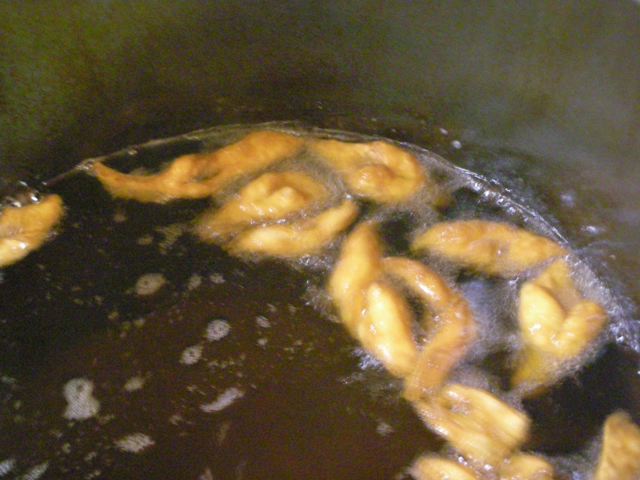
Every time I make
atwemo in Central Pennsylvania, people say it reminds them of Pennsylvania Dutch "funnel cakes," and they want to sprinkle them with powdered sugar. That's definitely a North American idea.
"Twisted cakes,"
called atwemo in Ghana, are a standard holiday/birthday/special occasion treat at our house, and also a popular request at cooking demonstrations. A version is called
chinchin in Nigeria. They are
slightly sweet, crispy treats that are a combination cracker/cookie that don't require an oven to make. In Ghana the richer version given here is eaten at celebrations like Christmas or parties, and a less sweet version has long been sold by street vendors as a snack. Nowadays "atwemo" are found packaged in plastic and sold in grocery stores and small kiosks.
This is a great, fun recipe for assembly-line production with almost any age group. I've done them with K-12 students, teenagers, college students, and adults, including nursing home residents. They cook very quickly, the deepfrying kills germs, and they can be made anywhere there's an electrical outlet. It's important to have a designated adult to do the frying, and oversee rolling the dough out so it's thin enough.
Cutting the dough into diamonds and the twisting process are fun, and even very young helpers can carry plates of twisted dough to the fryer, or loosen the cut diamonds from the board so they can be twisted. The dough can easily be rolled into balls that can be frozen and fried in smaller batches as needed.
That's what I did yesterday, and all those I made were quickly consumed by friends and family. I didn't get proper pictures, and a record-breaking snowstorm (in the middle of October) in central Pennsylvania, knocked down power lines and trees, everywhere, including our house, so it may be several days before I can properly illustrate this posting, but that's no reason to keep from putting it up.
When I make
atwemo I generally make a large batch, but you can easily cut this recipe in half.
Twisted Cakes (
Atwemo)
Ingredients:
4 cups flour
1/2 teaspoon salt
2 teaspoons baking powder
1/2 cup sugar
1/2 teaspoon ground nutmeg
1/2 cup margarine (1 cube) [in Ghana they use margarine; if you substitute butter the dough
will have a slightly different texture]
1 egg
3/4 cup milk (in Ghana I make it with half evaporated milk and half water)
1 teaspoon vanilla flavoring (I always use real vanilla)
vegetable oil for deepfrying (I like canola)
Recommended equipment:
measuring cups
large bowl
flour sifter
pastry cutter (optional)
measuring spoons
small bowl
fork
waxed paper or board
rolling pin
knife
2 plates
electric deep fryer (or large heavy pan or pot)
colander and/or paper towels
long-handled slotted spoon
Directions:
1. Wash your hands well, then assemble the ingredients and utensils.
2. Sift flour, salt, nutmeg and baking powder together in a large bowl.
3. Use a pastry blender or your hands (this is what I use) to rub or cut the margerine into the sifted ingredients.
4. Add the sugar, then mix with a spoon.
5. Break the egg into the small bowl and beat slightly with a fork, add the milk and vanilla and mix together.
6. Add the liquid ingredients to the flour mixture and mix well (after stirring a little with a spoon, I dust my hands with flour and mix the dough together--this works best for me), knead it lightly but not enough to make it tough. Add a little more flour if it is sticky, a little more milk if it seems too dry and will not hold together.
7. Divide the dough into 4 equal parts.
8. I usually sprinkle a few drops of water on my counter, then put a couple of sheets of waxed paper down, add some flour on top of that and a little on the rolling pin, then roll the dough out to between 1/8 and 1/4 inch. I like my atwemo on the hard and crispy side, so I tend to go thin.
9. Cut the dough into strips about 1/2 inch wide. Next, cut the dough diagonally to make diamond shapes about an inch long (I'll put up a picture of this as soon as my scanner is operable again). Cut slits in the center of each diamond.
10. Pick up one diamond, push one end through the slit and pull it through all the way to "twist" it. If you do not pull the dough all the way through you will end up with what my children used to call "birds." These will taste fine, but it's better to learn to twist the dough properly.
11. Continue rolling out the scraps of dough and repeating the process. To prevent the dough from becoming tough, or simply to simplify the process, just cut the dough into triangles or other shapes and skip the twisting (however, cook any untwisted ones separately since the cooking times will vary a bit).
12. While you are cutting and twisting the atwemo, fill an electric deepfryer or pan with vegetable oil (never more than half full, please; it will bubble up when you add the atwemo) and heat it to about 365 degrees Farenheit.
13. Carefully but quickly slip a couple dozen or so atwemo into the hot oil, one by one. Do not drop them and splatter the oil. If the oil is not hot enough the atwemo will fall to the bottom of the pan and stay there. If it is too hot they will bounce up immediately and brown before they are cooked all the way through.

14. Stir them frequently while they are cooking, making sure to turn them over so they brown on both sides. They should be quite golden when they are ready; perhaps a little browner than you think at first. It will only take a few minutes to cook each batch.
15. Remove them with the slotted spoon as they cook, and place into a paper towel-lined colander (or directly onto paper towels) to cool.
Store them covered in an airtight container.
Atwemo freeze beautifully well if you want to make a large batch. They work equally well as a snack or a dessert alone or served with ice cream or a fruit salad. Even children who are more likely to say "yuck" to new foods seem to say "yum" from their first taste.
Variations: instead of nutmeg, use grated orange rind, caraway or aniseed, or leave out the vanilla.
 February 14, 2012: It's now my 6th and final intensive week teaching at the African University of Science and Technology here in Abuja, Nigeria. However, since today is Valentine's Day, it only seemed right to celebrate, so I broke out my last chocolate bar, whipped up some peanut (or groundnut) "cakes" aka, peanut brittle, some "atwemo" (twisted cakes), and popped some corn. That, along with tea and coffee in the faculty lounge (with the room decorated with some lovely bougainvillea from the campus) made for a pleasant mini celebration as our very international staff gathered together during the morning break.