Showing posts with label coconut. Show all posts

Thursday, February 25, 2010

Candy (toffee), Ghana-style: Recipes #44 Groundnut "cakes and #45 Coconut "cakes"

Ghanaians use available ingredients to create simple candies, or "toffees." Here is a version of "peanut cakes" (recipe #44) and a similar "coconut cake" made with toasted dried coconut instead of peanuts (#45).

Recipe #44 Groundnut toffee (peanut cakes)

This relative of peanut brittle requires only 3 simple ingredients:  peanuts (dry roasted, unsalted), sugar and a little water.

The only equipment needed: a measuring cup and tablespoon, a rolling pin (or meat tenderizer or something similar), some waxed paper or sturdy plastic or paper bag (optional), a heavy 2-quart saucepan, a long-handled metal or wooden spoon for stirring, a flat glass surface like a cutting board or a baking pan,  a spatula, knife, or spoon, and a stove.

Measure out:

3/4 cup dry roasted unsalted peanuts
1/2 cup of sugar
2 Tablespoons of water

1. Coarsely crush the peanuts (easiest between 2 pieces of waxed paper or in a plastic or paper bag) with a rolling pin or other heavy object like a meat tenderizer.
2. Wet a glass cutting board or pan (like a lasagna or cake pan) with a little water and set aside.
3. Also wet (or rub a little margarine or butter) on the spatula, spoon or knife and set it aside, too.
4. Put the water and sugar into the saucepan and briefly stir it on medium high heat just until the sugar is mostly dissolved. Turn it to medium and let it continue cooking on MEDIUM WITHOUT STIRRING  it at all until the mixture turns brown (probably around 10 minutes). If crystals form you probably stirred it too long or your heat wasn't high enough.Turn the pan gently if the burner browns unevenly. Be careful once the mixture begins to brown so that it doesn't burn and turn into charcoal.
5. When it is a nice golden brown, remove the pan from the heat (turn off the stove) and quickly stir in the nuts.
6. Immediately turn the toffee onto the wet cutting board and use the prepared spatula or knife or spoon to press the toffee flat. It will be VERY HOT so do not touch it with your fingers.
7. As the candy cools it will harden. You can simply break it into pieces, score it while it is still warm into squares, diamonds or triangles and break them off when it is hard (top row in top photo, right), or take small spoonfuls of  the warm, but not hot candy, and roll it into balls (top left in photo above)

A yummy treat that will also keep well.

Recipe #45: Coconut "cakes" (toffees)

To make coconut candy (aka coconut "cakes"), you will substitute unsweetened dried grated coconut for the peanuts.  

Before beginning, preheat an oven to 350 degrees farenheit (medium heat). Put  3/4 cup dried, unsweetened flaked or grated coconut onto a cookie sheet and toast it in the oven, shaking the pan every couple of minutes. It will probably take only 4-6 minutes to lightly toast the coconut (it smells wonderful, by the way). Immediately remove the cookie sheet and set it aside. Follow the instructions above for making the carmelized sugar syrup, but instead of adding peanuts, add the toasted coconut, then follow the same steps of pressing it onto a wet platter or board to make the crisp "cakes" (the bottom row right in the top photo above). The candy on the left bottom row of the photo at the beginning of this post is made with fresh coconut and makes chewier toffees. I'll describe how to make them another day.

The day I cooked these I sent a batch of both types of candy with my husband to share with his students and colleagues at Penn State. No candy came home with him.

Special thanks to Katie Cochrane for her help in the kitchen and with the camera this week.


Monday, February 22, 2010

Step-by-step: How to Crack Open a Coconut

Last August when I listed Recipe 13 (corn and coconut snack) I  summarized the process of preparing your own coconut. In case you missed that summary, or want more detail, here is is.

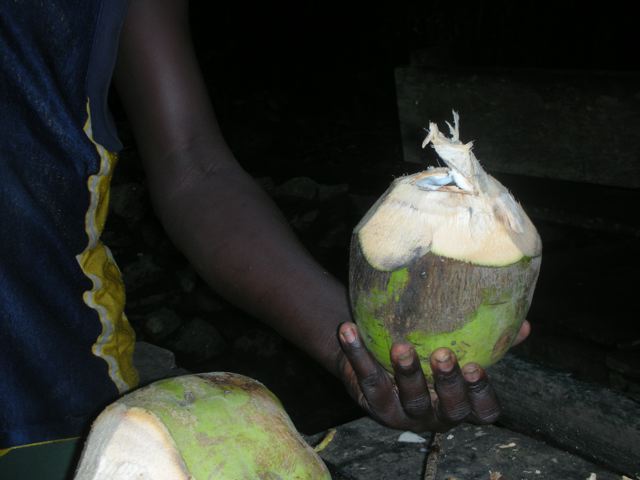
This basic recipe is handy to know for many world cuisines, including African,  Brazilian, Asian and Indian ones. "Fresh" coconuts in North America mean the brown hairy ones with hard shells sold in the produce section. As I've explained before, in Ghana they call those "dried," and when they say "fresh" coconut, they mean the literally fresh green ones right off the trees, often sold with the tops whacked off in front of you with a machete. For those coconuts the inside is soft and melting and you can drink the coconut water right out of it, and scoop the meat up with a spoon or a piece of shell.

The basic equipment I use when preparing coconuts includes:
a hammer, an ice pick or similar sharp implement (I've used screw drivers, clean nails, and today the meat pick from a nut cracker set), newspapers, a cup, a knife and/or vegetable peeler. By the way, this is a fun activity to do with all ages of children and young adults--just be sure that they stand back when someone is pounding the shell in case of flying pieces.

I usually crack open coconuts in my garage where I have a cement floor, but you can also do it inside if you prefer. Spread a few newspapers under the coconut and turn it up so you see the three eyes at one end. Place the ice pick or whatever you are using in the center of one of the eyes, and hammer it through the eye to make a hole. Wiggle it around to enlarge the hole and remove it. Repeat the process with the other 2 eyes. Turn the coconut over a glass, cup, or small pitcher and let the coconut water run into it. It's always good to get a "juicy" coconut (shake them in the store before you buy). Remember that this is NOT the coconut "milk." We'll talk about that another day.

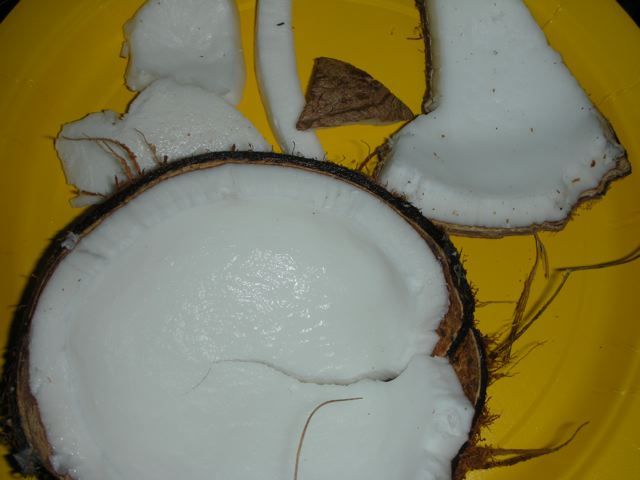
Once the liquid is out of the coconut, move the glass or cup away to a safe place, and begin hammering away at the coconut. Many times there will be a small line around the center of the coconut that has been made to make it easier to crack the coconut open. If there is such a line, aim at it or otherwise at the center (not the end where the eyes are or the other end). When the coconut begins cracking open, keep pounding away until many of the pieces of the white meat have broken off from the shell (they will have a brown coating on one side), and the rest can be pried off carefully with a knife. A vegetable  peeler will remove the brown skin from the coconut, which can be cut or broken into pieces and served that way, or grated or chopped into fruit salads or other recipes.

I needed coconut today when I was making some Ghanaian candy (toffee), including both peanut "cakes" (like peanut brittle) and 2 kinds of coconut "cakes." Those recipes will follow soon.

Thursday, August 27, 2009

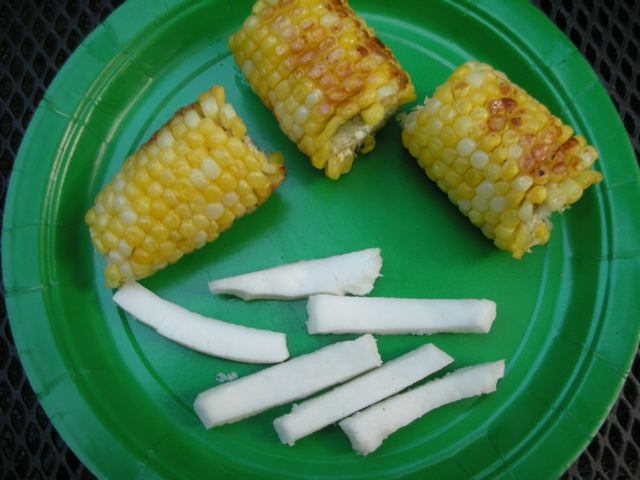
Recipe #13: Small chop: corn and coconut snack

We've been enjoying wonderful sweet corn lately from our local CSA (community supported agriculture) group, Plowshare Produce. Yesterday I prepared a quick and simple, but popular snack (in Ghana known as "small chop"). While North American sweet corn is much softer and sweeter than Ghana's corn, and thus cooks much more quickly, sweet corn can easily be substituted to make what proves to be a delicate and complementary combination of flavors and crunchy and chewy textures, and a hearty snack.

First, prepare a fresh coconut. Actually, the ones usually seen in supermarkets here are the hard, dried ones with a hairy brown covering. The really fresh ones (not the ones we want today) are green on the outside. When shopping for coconuts, I always shake them first to find one that seems full of liquid. If you haven't recently opened a coconut, I recommend some newspapers spread out on the floor under the coconut, a good-sized glass, cup, or bowl, a hammer and an ice pick or sharp object like a screw driver or clean nail, a knife and/or a vegetable peeler.

Hold the ice pick, or screwdriver over one of the 3 "eyes" in one end of the coconut, and use the hammer to make a hole there. Repeat for the other 2 eyes and then invert the coconut over the cup or bowl and drain out the liquid, shaking it if necessary to get all the coconut water out. If the coconut is fresh, this liquid will be very refreshing, and can be drunk by itself, poured into tropical fruit salads, etc.


Next, take the hammer and start whacking the coconut (make sure no one is standing nearby, and be careful of flying bits of coconut shells) until it breaks apart into pieces. Carefully use the knife to pry the coconut away from the hard brown shell. Then use the knife/vegetable peeler to peel off the thin brown coating on the back of the coconut, leaving only the white pieces. Once you can get past the idea that coconut has to be flaked and coated with sugar, this is a delightful combination. Rinse the coconut and cut it into slices or cubes.

To prepare the corn, boil the corn cobs in salted water, grill them over an open fire, or cook them in the microwave. Serve pieces of corn and coconut together. This is a great snack on a hot summer afternoon or evening, especially when accompanied by an ice-cold beverage of your choice, like ginger beer, bissap, puha, or beer.


Tuesday, August 05, 2008

Kakum and Fresh Raw Cocoa

For years I've wanted to visit Kakum National Park in Ghana to walk its rope bridges and get a birds'-eye view of the rain forest. It's billed as only one of four "canopy" (above the rainforest) walks in the world, and the only in Africa. The trouble is, I guess, I never go to Ghana as a tourist.


This time, we managed to get to Cape Coast before our 6 1/2 months was up in mid-July, and as usual I enjoyed the wonderful fresh fish, but this time we traveled the 12 or so miles to Kakum. At the end of our tree-top walk, as we descended to the entrance of the park, we stopped to enjoy juice and creamy pulp from some fresh coconuts.


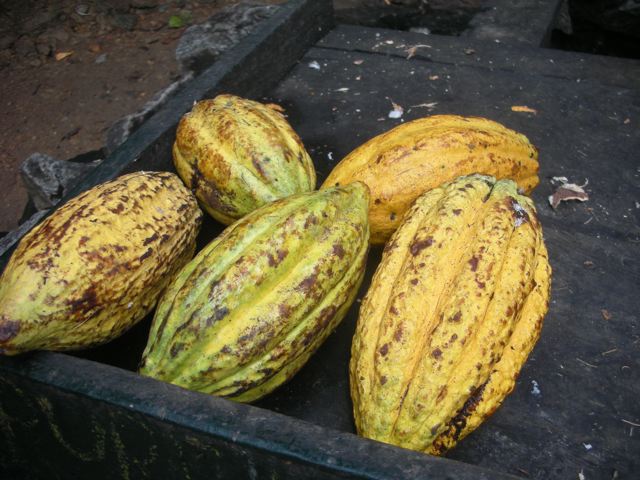
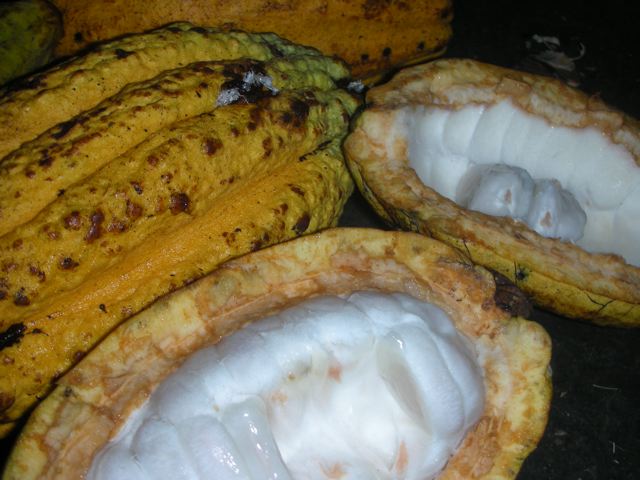
Also, I tasted my first fresh raw cocoa fruit, straight from the pod. We sucked the sweet white pulp from the seeds. The sellers said you can eat the bitter seeds, too (where the chocolate comes from), but others told me to just spit them out, which was my preference. If you're in Ghana, I recommend a trip to Kakum if possible.

I'm now back in central Pennsylvania, but have many stories from our time in Brazil and Ghana this past year to share. I'll soon post about a delightful experience tasting Brazil in Ghana!