It's exciting to see North Americans (and Europeans) embracing West African food! Unfortunately, many of us do not live in large urban areas where we can easily locate some of the unfamiliar ingredients. Last week I made a trip to our local international market here in State College, Pennsylvania, for a spontaneous, quick runthrough of some items locally available. I was rushing, and missed many things (like cream of palm fruit aka palm butter) in the store and also cannot believe some of the words that came out of my mouth, such as saying "coconut paste" when I meant "groundnut (peanut) paste," and holding some Ga kenkey and saying it is fermented corn dough rather than that it is made from steamed fermented corn dough (with a bit of cassava dough, too). I spoke about "dried fish powder" when it would have been better to say "dried flaked fish/shrimp."
Still, I hope you find it helpful, especially if you are exploring recipes from The Ghana Cookbook.
And remember, too, that as North American tastes are changing, it is getting easier and easier to find many of these ingredients in local supermarkets, from millet flour to fresh coconut to red palm oil to taro (Ghanaians call it "cocoyam") to plantains or fresh papaya. I find many of them in our local Wegman's, Giant, Trader Joe's, Weis, or even Wal-Mart.
(Hint: there's a recipe in the book that calls for smoked turkey, which is only available around here at Christmas, so this time of year might be a good time to try it out!)
Note: Thank you to students Nick Weis and Jessica Stefanowiz, both from Happy Valley Communications for running video and helping set up, respectively, and for owner Jin Zhou for allowing us to film in The International Market
Showing posts with label west african food. Show all posts
Showing posts with label west african food. Show all posts
Tuesday, December 15, 2015


Thursday, October 29, 2015
No budget. No publisher. No photographer. No problem!

For years, publishers and agents told me "there's just no market for a sub-Saharan Africa single-country cookbook. Why don't you do a regional Africa cookbook instead?" For years I declined. A writer friend warned me "No agent will pick up a book like that that no one will buy."
I kept saying "that's like doing a regional "Europe" cookbook, or a regional "Asia" cookbook, and lumping Italian, French, German, British, Dutch, Spanish, etc. together, or Chinese, Indian, Thai, Japanese, Korean, etc. all together.
Finally, I started the cookbook myself. Proposals came back, rejected. "There's no market." I didn't give up. I kept working. I learned to photograph food. I kept writing and speaking. I kept blogging. Along the way, many of you found me and urged me on. New African culinary voices arose. The International Association of Culinary Professionals gave me a boost with a pre-contract grant to pursue my dream. Barbara Baeta in Ghana joined the project. We kept working, fueled by belief and love that someday its time would come.
Finally, in 2014, visionary Priti Chitnis Gress at Hippocrene Books decided to take a chance.
Let's all prove those gatekeepers were wrong--may this cookbook open the floodgates to a realization of the vastness and variety of this huge second-largest continent, with over 4 dozen countries, and the culinary riches it has to share.
Incidentally, "betumi" comes from the Akan word "tumi," meaning the ability to do

(p. s. please remember these photos are copyrighted.)
Thursday, April 05, 2012
IACP hightlights: Chef Pierre Thiam and fonio
 A high point for me at this year's
 IACP conference in NYC was attending a session at The International Culinary Center led by Senegalese Pierre Thiam, the fabulous chef/owner of Le Grand-Dakar, and author of Yolele! Recipes from the Heart of Senegal.

Pierre had obvious mastery of his subject, a refreshingly calm and humble demeanor, and kept us all entranced with stories of Senegalese culture and cuisine, all the while preparing and offering samples of several delicious recipes using the amazing tiny millet grain fonio, one of the so-called "lost crops of Africa."

I have fond memories of time spent inTamale in northern Ghana eating a light, delicious breakfast porridge made from fonio, and was happy a few years ago to learn that Sanoussi Diakité, a Senegalese mechanical engineer, had perfected a mechanical husking machine for processing of the tiny grain.
There was much enthusiasm at the IACP conference for discovering new grains, and the cookbook that won the Julia Child award was Maria Speck's Ancient Grains for Modern Meals, published by Ten Speed Press. However, her Mediterranean whole grain focus is on ingredients like barley, farro, kamut, polenta and wheat berries.
One Swiss conference attender enthused to me later that Thiam's session was the best one she had attended so far (this was 4 days into a 5-day conference!) I, too, found it to be quite useful and enjoyable, even though I had to sneak out before the end to set up for the bloggers fair.
I'll post a fonio recipe of my own soon. More to come, too, about the food blogger fair and with lunch with Jessica Harris at Marcus Samuelsson's Red Rooster.

Friday, May 04, 2007
Kelewele: My favorite Ghanaian Snack
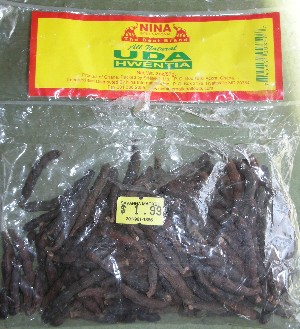
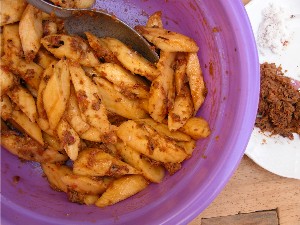
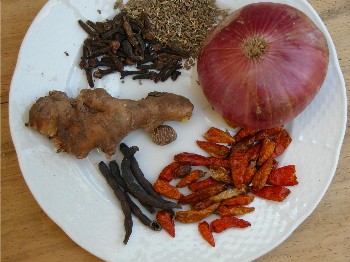
I'm in the midst of packing to spend a year in Brazil and Ghana but just caught sight of a bag of Nina International's "All Natural UDA Hwentia," sitting on my desk. It made me wish for some fresh kelewele, one of my all-time favorite snack foods from Ghana. Western cookbooks generally describe kelewele as something like "spicy fried plantain cubes," but that is like calling a sunset "beautiful." All the recipes I've seen in Western cookbooks are anemic versions of the best kelewele as it's prepared in Ghana. First of all, Western versions only call for salt, ginger, and dried red pepper, but in Ghana in addition to grinding fresh ginger and onion, they also commonly pound and add sekoni (aniseed), hwentia (a kind of long black stick I've yet to name botanically. Can anyone help me out?), and cloves. The plantain should be very ripe and sweet, and nicely coated with the mixture before it is deep-fried. The plantain is generally cut on a diagonal rather than into a straight cube. Kelewele tastes superb accompanied with dry roasted peanuts. The sweet, spicy, and chewy plantain is a perfect counter to the mild crunchy/creamy flavor and texture of the peanuts. Both go well with an ice cold beer or drink like ginger beer or bissap. Nina International distributes many West African foods through its office in Maryland (PO Box 6566, Hyatsville, MD 20789). More information on suppliers is available at African Food Stores
Rest assured, Barbara Baeta and I will include an authentic recipe for gourmet kelewele in our upcoming book.
Subscribe to:
Posts (Atom)