It's exciting to see North Americans (and Europeans) embracing West African food! Unfortunately, many of us do not live in large urban areas where we can easily locate some of the unfamiliar ingredients. Last week I made a trip to our local international market here in State College, Pennsylvania, for a spontaneous, quick runthrough of some items locally available. I was rushing, and missed many things (like cream of palm fruit aka palm butter) in the store and also cannot believe some of the words that came out of my mouth, such as saying "coconut paste" when I meant "groundnut (peanut) paste," and holding some Ga kenkey and saying it is fermented corn dough rather than that it is made from steamed fermented corn dough (with a bit of cassava dough, too). I spoke about "dried fish powder" when it would have been better to say "dried flaked fish/shrimp."
Still, I hope you find it helpful, especially if you are exploring recipes from The Ghana Cookbook.
And remember, too, that as North American tastes are changing, it is getting easier and easier to find many of these ingredients in local supermarkets, from millet flour to fresh coconut to red palm oil to taro (Ghanaians call it "cocoyam") to plantains or fresh papaya. I find many of them in our local Wegman's, Giant, Trader Joe's, Weis, or even Wal-Mart.
(Hint: there's a recipe in the book that calls for smoked turkey, which is only available around here at Christmas, so this time of year might be a good time to try it out!)
Note: Thank you to students Nick Weis and Jessica Stefanowiz, both from Happy Valley Communications for running video and helping set up, respectively, and for owner Jin Zhou for allowing us to film in The International Market
Showing posts with label palm oil. Show all posts
Showing posts with label palm oil. Show all posts
Tuesday, December 15, 2015


Tuesday, January 05, 2010
Recipe #35: Ofam (Ripe Plantain Loaf)

With family arriving home over the holidays I wanted to make ofam, Ghana's challenge to Western holiday fruitcakes: a rich, heavy plantain loaf made from sweet, over-ripe plantains, spices, and red palm (dende) oil. Helplessly, I waited unsuccessfully for my locally purchased plantains to turn black. Then, on December 22nd, my daughter Abena arrived from California carrying 2 plantains perfect for the recipe, which I added to my 2 semi-ripe ones, and was able to serve this special occasion dish in time for Christmas and the New Decade!
It is not difficult to make, but does require some special items, such as the over-ripe plantains and palm oil.
Ingredients:

about 2 pounds of over-ripe (black) plantains, about 3 or 4 good sized ones
3 fresh chili peppers or to taste (I used a combination of part of each of the 3 types in the photo, seeded)
1 onion (enough to get about 1 cup of onion grated; use more or less to your taste)
fresh ginger (enought to get about 3 Tablespoons after peeling and grating it (again, adjust to taste)
up to 1 cup good-quality red palm oil (preferably zomi)
about 3/4 cup of flour (rice or wheat, or use Ghanaian corn dough)
1-2 teaspoons salt (or to taste)
Peel the plantains and mash them. If they are very ripe a fork will do fine, otherwise use a potato masher or ricer or a glass, or whatever you have handy. Traditionally they would be pounded in a wooden mortar with a wooden pestle. Remember, thought, exture is important in Ghanaian dishes, so don't do this in a blender. You want about 2 1/2 to 2 3/4 cups of well-mashed plantain.
Put the mashed plantain in a large mixing bowl and add a cup of medium to finely grated onion.
Add the ground chili peppers (I seeded the peppers and added a couple of tablespoons of water to my mini processor attachment to grind them before adding them to the bowl).
Stir the dough gently, also adding a little salt. In Ghana we used 2 teaspoons, but I used a little less because we're on low-salt diets here. It is not meant to be very salty.
Stir in 1/2 cup of the flour (if you do not have rice flour, you can always grind some rice in a blender to add it, or use wheat flour, or, if you have Ghanaian corn dough, which is much more finely ground than cornmeal, use that).
If the dough seems thin, add up to another 1/4 cup flour to make it thicker, then stir in the palm oil. I balk at using a full cup of palm oil, but used part of it with a pastry brush to grease my pan well on the bottom and sides. Let the batter rest for about 15 minutes, then scrape it into a pan and bake it about half an hour in a medium oven (350 degrees). Let it cool on a rack long enough before removing it from the pan, maybe 20 minutes or so (a little of mine stuck to the pan).

In Ghana we made our ofam in loaf pans (traditionally it used to be wrapped in leaves first). I baked mine in a nonstick bundt pan. Serve warm or cool, in small slices by itself or accompanied by dry roasted peanuts. We ate it as both a dessert and a snack, and it is now long gone until the next holiday. If you have leftover, though, it freezes nicely and is quickly defrosted and warmed in a microwave. When serving, I blot excess palm oil off with paper towels, but that is just me--others might find that akin to scraping whipped cream or frosting off a cake.
Hope you all had a wonderful holiday and are ready for a fantastic new year. This is the year of the book! I plan to have the Ghanaian cookbook drafted by the spring. There are many recipes I've not yet had time to post, but will be diligent in the coming weeks. Next up will be another classic Ghanaian dish I love (both the food and its wonderful name: "mpotompoto," or yam soup).
Tuesday, December 08, 2009
Recipe #33: Flavored Oils AND a cooking teacher request

NOTE: Before posting today's recipe, I have had a request for information on anyone in the Philadelphia who teaches West African cooking, and in particular the cooking of Guinea-Bissau. Please share the information here or send it directly to me to forward to Joseph Dickerson.
Recipe #33: Ghanaian Flavored Oil Sauces
This spicy condiment can be made with either a light-colored oil (like canola, safflower, or peanut), or the classic carotene-rich red palm (aka dendê) oil. It reminds me of Asian chili oil made with sesame oil (sesame is originally from Africa, by the way), but with an African touch. It is easy and quick to make, and might be just the thing for a holiday gift for that African gourmand on your list!

1/2 cup vegetable oil (I made 2 versions, one with palm oil and one with canola)
1/2 cup sliced or chopped onion
several hot chili peppers of your choice (in Ghana we used my beloved much-missed kpakpo shito peppers)
1 teaspoon ground dried chili pepper (or to taste)
1 teaspoon freshly ground/grated peeler ginger
Gather and prepare the ingredients, washing the peppers, slicing off the stem end, then cutting them up or making slits in them. It is not necessary to remove the seeds.


These oils are nice with cooked cowpeas (see my upcoming recipes for abobo and adayi), tomato gravy, shito, gari/or cooked ripe plantain slices.
Tuesday, August 18, 2009
Recipe #9: Okra/Eggplant/Fish Stew
 Banku is often eaten with a stew made from okra and/or garden eggs (a kind of eggplant, which is what is often substituted in the U.S.), and smoked and fresh fish. I especially love smoked mackerel, but my husband was recently placed on a low-sodium (salt) diet, so we had to omit that and go with fresh salmon instead. I confess I missed the lovely flavor smoked fish adds. We tried to compensate for that by serving it with a little bottled chili sauce since I did not have any "black pepper" (shito) on hand.
The ingredients I used included: a medium eggplant (to get several cups, peeled and chopped), a large really fresh tomato (or 2), or substitute canned if you must, a large onion, chopped, a jalapeno pepper (or a hotter variety, more, etc., to taste), about 1 1/2 dozen fresh okra, (or frozen), 4 salmon fillets, 2 large garlic cloves, a couple of tablespoons of red palm oil (or other vegetable oil), a little fresh, peeled ginger (to taste, try starting with an inch or so), and some salt.
Salmon would not be a traditional fish (whereas tilapia, tuna, or red snapper would), but I've often had salmon served in West African restaurants in the U.S., and it works fine, especially the wild type, which are meatier.
First wash and prepare the eggplant. Peel it and chop it into cubes, then put it in a saucepan and
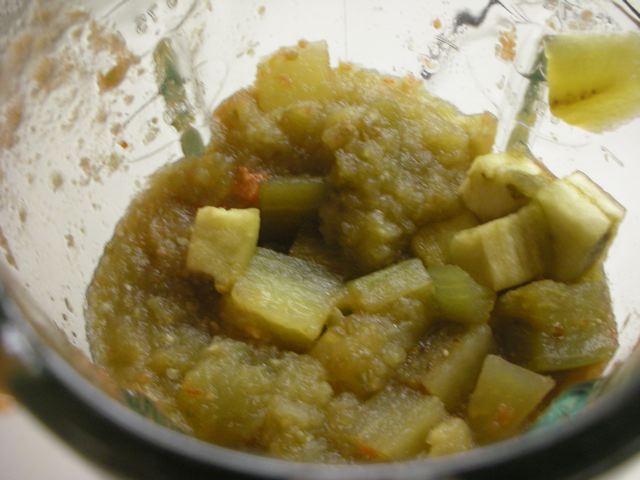 cover the eggplant with water. Cover the pan, bring it to a boil, then lower the heat and simmer it while you prepare the okra. If using fresh okra, rinse it, then trim both ends. According to your preference, you can 1) simply slice the okra into rounds, 2) chop it finely, 3) remove the seeds and slice it horizontally, 4) leave it whole. I generally chop it finely, unless I'm in a hurry, when I just slice it. When using frozen okra, I often leave it whole so it doesn't completely lose its body.
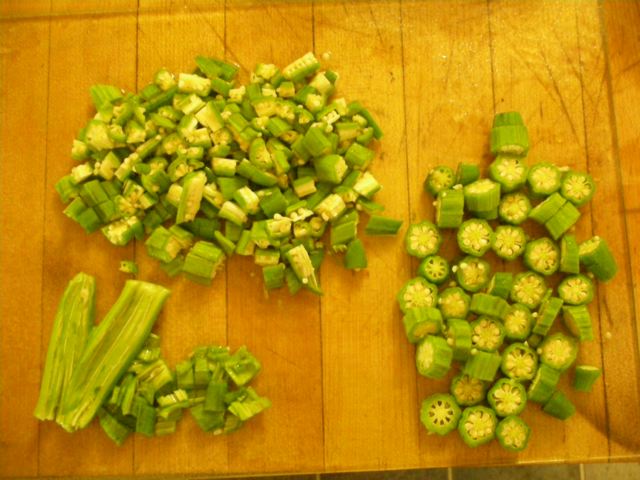
The stew can also be made with only one of the vegetables--either the okra, or the eggplant, but we like them combined, as they often are in Ghana. When the eggplant is soft, remove it with a slotted spoon and puree it in a blender or food processor. Set it aside.
Similarly, peel and coarsely chop the ginger and garlic and tomato and puree them with a little water in the same
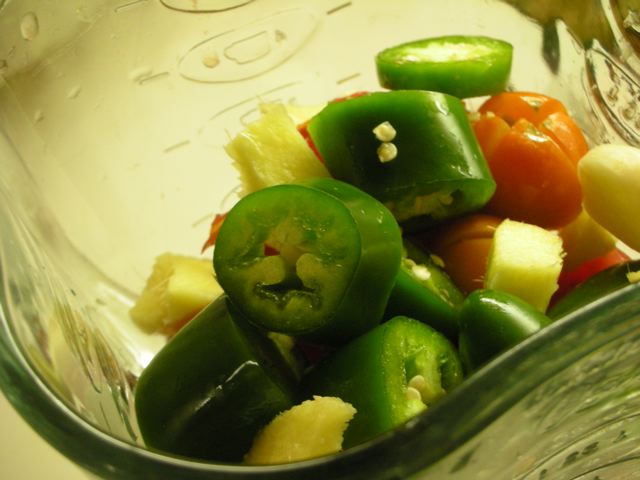 blender container. No need to rinse it first.
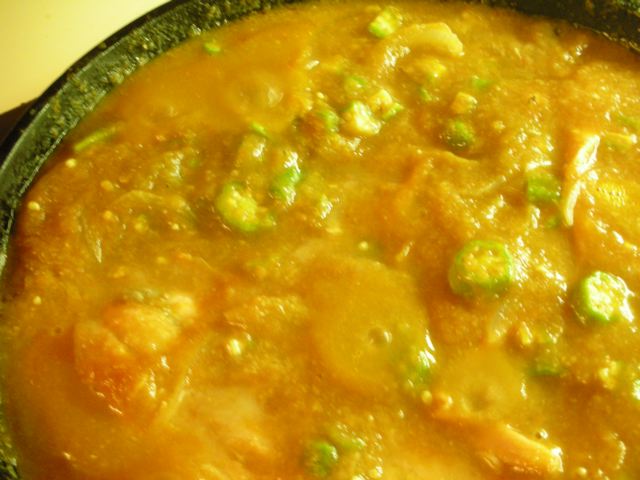
Peel and chop or slice the onion. In a large, heavy pot or pan heat a couple of tablespoons of oil (I used a seasoned red palm oil from Ghana called "zomi") and fry the chopped onion on a medium heat for a few minutes, then add the pureed pepper and tomato and garlic and ginger (if you're a perfectionist like me, you can strain out the seeds, or seed the peppers and/or tomatoes before putting them in the blender). Add the eggplant and fish, turning the fillets to coat them with the spices and vegetables, then add the okra and salt (to taste) and stir. If it's not spicy enough, add a little dried red chili pepper. Add a little water if the sauce seems too thick, cover it and lower the heat and simmer until the fish and okra are cooked. This stew also goes well with plain rice, and should serve 4 people. If you want more tomato flavor, add a spoonful of tomato paste.
Friday, May 15, 2009
Question #7: Isn't the food really unhealthy?
 Let's begin with the negative and work to the positive: The stereotypical image of sub-Saharan Africans is either an emaciated starving African, gaunt and haunted, or else a sweating, corrupt, obese politician. If you've never read Binyavange Wainaina's witty and astute 2005 "How to write about Africa," please do.
"Everybody" knows that, unlike the "healthy" Mediterranean diet, Africans suffer from malnutrition, iron and/or calcium deficiency, parasites of all kinds, goiter (especially caused by iodine deficiency), have very short life spans, etc., etc., etc. Sometimes it's also suggested that "Africans" are lazy, childlike, and/or unresourceful (again, see Wainaina's article). It's important to reflect on these images and unexamined assumptions.
Of course, in many ways colonialism and slavery and other disruptions of the past few hundred years played havoc with the food systems that existed previously in more or less harmony with nature. Things like cash cropping pushed out traditional food crops, forced labor removed workers from their farms to work in mines and on plantations, war and violence decimated normal agricultural cycles. Poverty and powerlessness became common.
I recently came across an interesting article in a 2003 issue of the Journal of Historical Geography ("French beans for the masses: a modern historical geography of food in Burkina Faso") by Susanne Freidberg examining how French green beans entered the diet in Burkina Faso. In addition, Western and Western-trained agricultural "experts" too often made disastrous recommendations to farmers (e.g., eliminating inter-cropping when planting, utilizing crops requiring expensive inputs, neglecting research to improve local varieties of foods, adopting inappropriate technologies, such as irrigated farming or mechanized tractors and straight row planting).
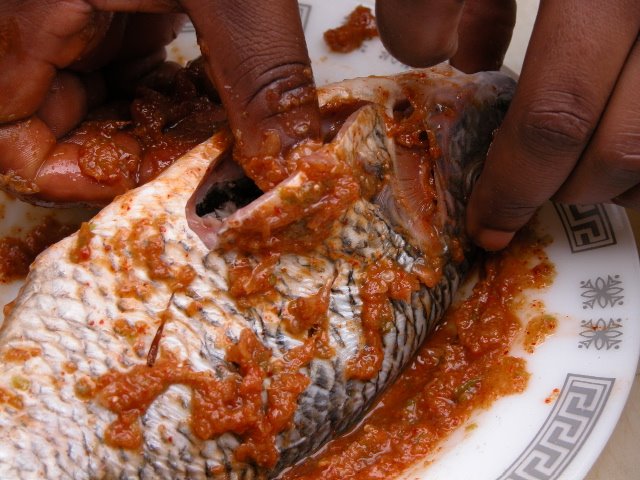
Remember, when sub-African countries first gained their independence in the second half of the 20th century, most were self-sufficient in food production. That situation is completely reversed nowadays. What people can get to eat may not be what they prefer to eat.
Once again, it's necessary to disaggregate the many countries in Africa according to geography and history, economies, religion, natural endowments, etc. Some are arid or semiarid, some are tropical, some are nomadic, some settled, some wetter, some drier, some landlocked, some coastal. The westerners of Victorian England labeled Africa the "Dark Continent" or the "White Man's Grave" because things like anopheles mosquitoes and tsetse flies spread malaria and "sleeping sickness." "Malaria" literally means "bad air," and people thought somehow the wet places and swamps infected the air causing white people to get sick and die there.
Many foods common in African diets, from corn to cassava or peanuts, replaced earlier ingredients like millet, sorghum, fonio or bambara beans, and that is part of the normal change in diets and food migration. However, powerful influences coming from outside of Africa are able to foster and maintain preferences for "elite" foods, such as wheat and rice and seasoning cubes (or, tobacco, coca cola, or baby formula) that may have negative long-term effects on national diets. Multinationals may be able to supply emerging urban markets with their grain surpluses at lower prices than traditional farmers and thus change diets. Ghana, for example, is not able to raise wheat and yet there in high demand for it: in 2002, 90% of Ghana's imported wheat came from the U.S.
Last year I was part of a discussion on health concerns of emerging African diets (which parallel those in many developing and developed countries), such as diabetes.
But let's look at some healthy aspects of many African diets. Here are a few observations:
Many use protein sources like meat or seafood or poultry sparingly to flavor soups, stews or sauces, rather than in excessive amounts. Diets also include nuts, seeds, beans and legumes. Often there is a use of fresh, less processed ingredients.
Steaming and roasting are common food preparation techniques.
Many sub-Saharan country diets are characterized by
a
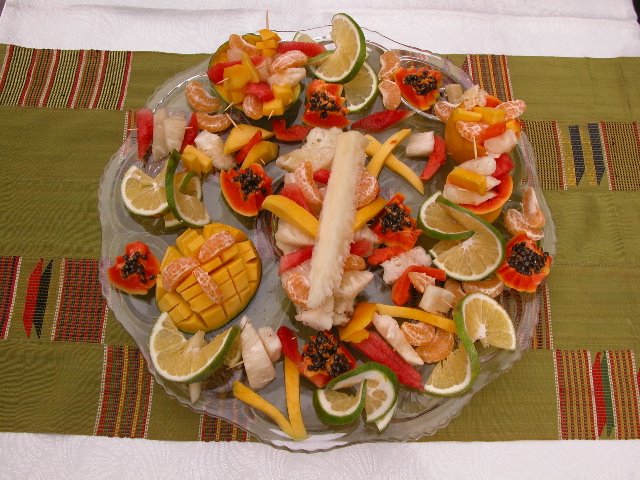
 much lower sugar consumption than in the U.S., with a preference of fresh fruits over fat- and sugar-laden desserts and snacks.
Often, many African countries' diets are gluten-free or lactose-intolerant friendly.
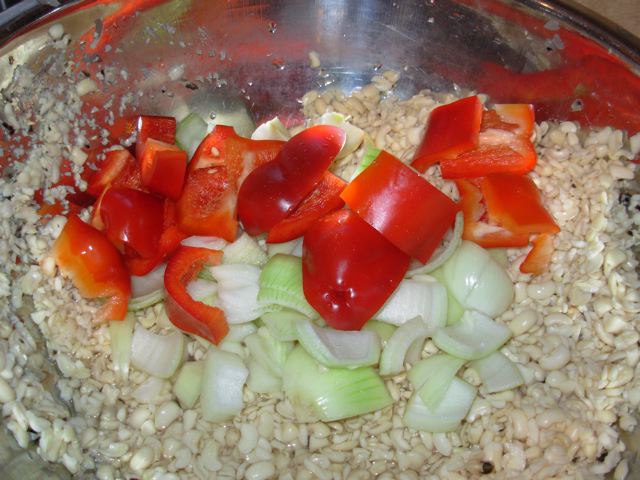
In many parts of Africa, there is liberal use of onion, garlic, and chili peppers, each with health-promoting qualities.
The same is true of many cooked greens and tomatoes and ginger.
Notably, the hunter-gatherer San people of southern Africa are believed to have historically had a very healthy diet, about 80% vegetables, eaten fresh, and including dozens of plant species and about 17 edible animal species. Their young were said to show no signs of malnutrition, and it was through the San people that the ingredient P57, an anti-obesity drug from the hoodia cactus, entered Western consciousness.
Similarly, the southern African herbal teas made from rooibus (Afrikaans for "redbush") are now popular in North America, and the dried hibiscus flower is increasingly becoming common in herbal teas, as are other teas such as North African mint tea or lemongrass tea.
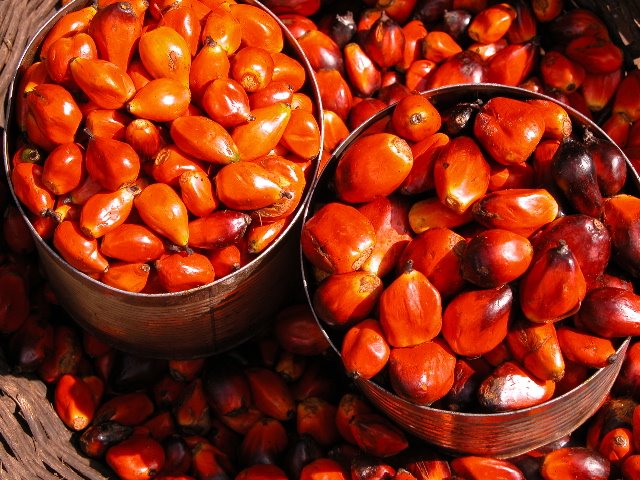
One common complaint I hear is how unhealthy West African palm oil is. As I mention in my article "We Eat First With Our Eyes: On Ghanaian Cuisine" we often confuse palm kernel oil with palm fruit oil, neglect to consider palm oil may be refined or unrefined, and that there are various grades of quality, just as there are with olive oils. We are unaware of the findings reported in the Cambridge World History of Food that ". . .when palm oil is added to a Western diet, the level of plasma HDL cholesterol typically rises, leading to a better LDL:HDL ratio, and this ratio--rather than the total amount of total plasma cholesterol--appears to be the better indicator of the risk of coronary artery disease." That document concludes that ". . . now that the wider nutritional benefits of palm oil’s natural carotenoids are becoming more generally recognized, perhaps it is time to rediscover the fully flavored red oil and promote its use, not only in Africa and Latin America but also in Asia and the West."
When one observes people in the U.S. stuffing down hamburgers and French fries and chips and drinking super-sized soft drinks, or the pastries and mega-size sugared drinks being consumed in coffee shops, one has to wonder about the claims of superiority of the Western diet.
Subscribe to:
Posts (Atom)