Showing posts sorted by date for query Tilapia. Sort by relevance Show all posts

Monday, May 21, 2012

Suya comes to Berkeley

Last week before leaving Berkeley, California, we stopped in at a modest but welcome new addition to the culinary scene, called "Suya." (Located at 2130 Oxford St, between Allston Way and the West Entrance to U.C. Berkeley. They're open every day but Sunday, 11 a.m. to 9 p.m.) The Nigerian owner explained that when he came to the U.S. he always longed for a place to get the popular street/party/kebab-style food in Nigeria called "suya." (pronounced "sooya"). He and his wife decided to make it happen. We should all be grateful to them.


The restaurant is tiny (read "intimate"), and focuses its attention on grilling beef, tilapia, or chicken spiced to order with either the distinctive, vibrant rub called  "yagi"  (aka "suya powder") or Caribbean jerk seasoning--they even set out samples for passers by to taste, and though I sampled the jerked version, my heart belongs to suya (Ghana's chichinga).  While there are actually 3 or 4 types of suya (tsire, for which I've posted a recipe, kilishibalangu and dambu) most people use "suya" to refer to the most popular type, "tsire suya." The spices are exciting and distinctive (especially the powdered peanuts), the cooking lowfat and healthy, and there's no substitute for that freshly grilled taste of vegetables (corn, plantains, zucchini, peppers, etc.). Our grilled ripe plantains disappeared before I could even photograph them! The eating area is quite compact, the service friendly, and there is the advantage that you can watch the chefs grill your meal.

I'm generally not a big fan of tilapia, and I've never had fish suya before, but I found the spices gave it a delightful flavor. If you're in the Bay Area, do stop by and check Suya out.

In my next posting I'll blog about the refreshing Nigerian nonalcoholic drink I had there--a West African challenge to sangria: the Chapman! Who would have thought of adding cucumbers to a cocktail? Hint: note the bright red color of the drink in one of the photos below.


Friday, July 01, 2011

Recipe #70: Agusi Frowee (melon seed) Stew with Fish

I have referred several times in the past to nutritious, delicious agushi (aka agusi, agushie, egusi) seeds.Today's recipe is a classic stew that combines the seeds with fish. There are, of course, other versions using meat or poultry, but this is my favorite.

I'm posting 2 versions of the same recipe: one is a richer, more nuanced, and expensive version. It uses salted cod, smoked fish, real agusi seeds, fresh tomatoes and peppers and palm oil; the other, is faster, cheaper, and lighter and uses canned tomatoes, canned fish, dried pepper, pumpkin seeds, and peanut (or canola) oil. Take your pick, or combine elements of each in your preferred version. The green seeds in the photo below are the pumpkin seeds, the white ones the agushi seeds

Let's begin with the slightly more complicated, fancier one.

Recipe #70: Agusi Frowee (melon seed) Stew with Fish

Version 1: Assemble ingredients
  • 4 oz agushi seeds (about a cup), ground or unground
  • 7-8 ounces of smoked fish (I'm using smoked whiting today), after bones and skin are removed
  • 2 good-sized ripe tomatoes (plus a Tablespoon of tomato paste if you like)
  • 1/2 cup (4 ounces) of palm oil (dzomi if available)
  • a small piece of salted cod (about an inch cube, about 1/3 of an ounce), or koobi (salted tilapia)
  • 1 large onion (about a cup, chopped)
  • fresh red pepper to taste
Prepare the ingredients:
  1.  If the agushi is not ground, grind it in a blender. Mix it with a cup of water and set aside until later.
  2. To remove some of the salt, I rinse and soak the salted fish in hot water while I prepare the other ingredients.
  3. If the fish has bones and skin remove them and discard.
  4. Peel and chop the onion.
  5. Prepare the pepper and garlic (I grind mine together in a blender with about a Tablespoon of water). You will need to judge your preference for heat. You can always adjust the heat later by adding more ground dried red pepper later.
  6. Chop the tomatoes (if you want to be extra fancy, peel and seed them first--drop in scalding water, then cold, to remove the peelings, and grind them in a blender). Mix in a Tablespoon of tomato paste if you like.
  7. Heat a heavy frying pan on the stove top, add the oil and chopped onions, stir well, then add the salted fish.
  8. Fry together on medium heat for several minutes, then add the pepper and garlic and cook a couple more minutes, then add the tomatoes and tomato paste.
  9. Stir in the smoked fish.
  10. Stir the agushi to see that all of the lumps are gone.
  11. Stir the agushi-water mixture into the stew, lower the heat, then cover and allow it to simmer, without stirring, for half an hour.
  12. The cooked agushi will look a little like scrambled eggs.
  13. If you're like me, go ahead and skim off any oil that has risen to the top (or just stir it back into the stew) and check the seasonings. Add some dried red pepper if it isn't spicy enough for you. I cannot imagine it needing more salt, but add some if you must.
This stew goes well with rice, ampesi (plain boiled starchy vegetables like yam, potatoes, plantains, banku, or kenkey. (Note: You can search Betumiblog for recipes for banku and kenkey).

Here is the second, lighter, cheaper, and faster version:

Version 2

Assemble the ingredients:
  • In place of the smoked fish, substitute a 15 oz can of mackerel
  • In place of the agushi substitute raw pumpkin seeds
  • In place of the fresh tomatoes, substitute tomato puree (a cup), OR 2 or 3 Tablespoons of tomato paste mixed with a little water OR a small can of tomato sauce
  • simply slice, rather than chop, the onions
  • Do not bother soaking the salt fish
  • In place of the palm oil, substitute any white oil like canola or peanut of safflower (I avoid olive oil because of its distinctive flavor) and reduce the amount to 1/4 cup (2 oz)
  • In place of the fresh hot peppers, substitute dried ground red pepper to taste (about 3/4 teaspoon to begin)
  • Omit the garlic

Follow the same basic steps as above, omitting any steps unnecessary due to using already processed ingredients:  grind the pumpkin seeds,  mix with a cup of water in a small bowl, chop the onion, open the can of mackerel. Heat the oil in a frying pan on medium heat and add the onion and salt fish. Cook a few minutes, then add the tomato puree (or paste, sauce), cook a couple more minutes, then add the canned fish and dried red pepper. Stir the water-pumpkin seed mixture into the stew, lower heat and cover and allow to simmer for 30 minutes without stirring.

My nephews Sam (left) and Ernest (right) stopped by at the beginning of this 4th of July holiday weekend, and sampled both versions. I topped some leftover coconut rice with the stew, and steamed a little fresh spinach on the side.

Sam added salt to the first version; Ernest found it a little too salty. Ernest added red pepper flakes to his; Sam found it spicy enough.

Both found either acceptable, but preferred the richer version (as do I).  Sam said of the second one "This is lighter. Americans will love it."


    Friday, June 24, 2011

    Recipes #61 Fish Cakes and #62 Fish Balls

     Are you hungry for a delicious snack or looking for some great, elegant (but easy-to-make) party appetizers? Or something different to make for a breakfast or brunch? Consider whipping up some Ghana-style fish balls or  fish cakes.


    Recipe #61 Fish Cakes

    To make about 16 fish cakes (8 servings), you'll need 
    • about 1 1/2 pounds of fresh fish, such as red snapper, grouper, halibut, or any fleshy fish, to yield about 2 cups of flaked cooked fish. Any leftover cooked fish will work (I used part of the grilled tilapia I cooked the day before, and some perch fillets). In a pinch, canned tuna would work.
    • 1/4 cup (preferably white) bread crumbs, or cooked mashed African yam
    • 1 egg (optional)
    • 1/2 teaspoon salt or to taste
    • 1/2 teaspoon ground dried red pepper or to taste
    • 1 teaspoon fish spice (I used an Indian fish masala)
    • 1/4 cup of finely grated or minced onion (optional, I omitted this)
    • 1/4 cup of water
    • vegetable oil for frying (like canola), not palm oil
    • waxed paper (optional)

    1. Wash the fish, season it if desired  and bake it in a moderate oven ( 350º F) for half an hour or until it flakes easily. Make sure to grease the bottom of the pan lightly to keep it from sticking. Remove and allow it to cool enough to handle it.
    2. Remove the skin and carefully remove all the bones and discard them. Put the fish into a bowl and flake and mash it with a fork or your fingers or a wire whisk until it looks like bread crumbs.

    3. Prepare the starch that will serve as a binder: if bread crumbs, put a couple of pieces of preferably slightly stale bread in a blender and pulse briefly. If you are using African yam (please, NOT sweet potatoes), peel and chop it and cook in boiling salted water, drain, and mash). I had the ends of some lovely San Francisco sour dough French bread that I used.

    4. Add the pepper, fish spice, salt, water, and egg (if you are using it) and mix thoroughly.

    5. I put a piece of waxed paper onto my work surface, and put on it about  2 T of the mixture (use more or less, according to the size you wish). Then, using a table knife, flatten it into a patty about a half an inch thick, and use the blade of the knife to shape the 4 sides of the patty.
    6. While these can be deep-fried, I prefer to use a large heavy frying pan to shallow fry them in about 1/4 to 1/2 inch of oil at a medium high temperature, frying one side until brown, then gently turning them over with a slotted spoon or turner, and draining them on paper towels. If you prefer deep-frying, heat several cups of oil in a deep fryer or deep pan on the stove to about 375º F. Make sure never to fill the oil over half full since it could bubble over when adding the fish.
    7. Serving suggestions: Serve with hot pepper sauce or shito or even ketchup. These patties can also be made larger and served as a main dish with sautéed onion rings and eaten with yam, rice and Ghana-style gravy, or even as a first course with cucumber, tomato, onion, lettuce and vinaigrette dressing.


    Recipe #62  Fish Balls

    This  recipe is very similar to #61. The ingredients require a couple of additional things:
    • about 1 1/2 pounds of fresh fish, such as red snapper, grouper, halibut, or any fleshy fish, to yield about 2 cups of flaked cooked fish. Any leftover cooked fish will work,  including canned tuna
    • 1/4 cup bread crumbs
    • 1 egg
    • for 1 cup of white cream sauce
                 1 cup milk
                 1 Tablespoon corn starch
                 2 Tablespoons margarine or butter
                 salt and pepper to taste (about 1/4 teaspoon salt and 1/8 teaspoon red or black pepper)
    • vegetable oil for frying (like canola), not palm oil
    • waxed paper (optional)
    1. Follow steps 1 and 2 as for Recipe #61.
    2. Prepare bread crumbs as in Recipe #61. Put them in a small shallow bowl.
    3. Break the egg into a small bowl and mix it with a fork.
    4. Prepare the cream sauce: Mix together the milk and corn starch in a small pan, stir it until smooth and add the salt, pepper, and butter or margarine. Heat on the stove top over  medium heat, stirring constantly. When it comes to a simmer, simmer for 1 minute to thicken it, then remove it from the stove and add  it to the fish. Note: I found that I needed to add a little extra fish for mine to hold together, so you might want to begin with 3/4 cup of white sauce and then add the rest if you determine it will not make the balls too soft to hold their shape.
    5. Put a sheet of waxed paper on you work surface.
    6. Shape about 2 Tablespoons of the fish mixture into a ball in you hands, dip it into the beaten egg, and roll it in the bread crumbs. Continue until all of the mixture is used up. 
    7.  These balls are best deep-fried as explained in recipe #61 ("heat several cups of oil in a deep fryer or deep pan on the stove to about 375º F. Make sure never to fill the oil over half full since it could bubble over when adding the fish."). Drain them on paper towels after cooking.
    Serving suggestions:  These balls have a milder, moister flavor than the cakes, and make delicious appetizers. They can be served the same way as fish cakes. At Flair catering, they are sometimes served in gravies, with or without curry powder, and gently set into the pot just before serving and shaken to coat them.


    NOTE: While I prefer these freshly prepared (I feasted on them yesterday with some of the fresh pepper sauces!), they can also be kept warm in an oven, or reheated quickly in a microwave or oven just before serving.


    .


    Thursday, June 23, 2011

    Recipe #60: Fresh pepper sauces

    Previous posts have described how to make Ghanaian  shito, or "black pepper." Today the focus is fresh pepper sauce. It is summertime here in Pennsylvania, and tomatoes are beginning to ripen. As they say in Ghana, "The good soup comes from the good earth." That holds for good pepper sauces, too. Truly fresh ingredients are the secret to good cooking, and today I'll explain how to prepare the Ghanaian answer to salsa. 

    Give almost any homesick Ghanaian one of these simple-to-make sauces (requiring only 4 ingredients), along with a can of sardines or  Exeter corned beef, and some gari  or a ball of  kenkey, and he or she will likely be very happy. Fresh pepper sauces also go especially well with  Ghana-style grilled tilapia  or with eggs or  fried fish (kenan or kyenam, another recipe to come).

    The "proper" (and easiest) way to make the sauces is to use an asanka
    and the wooden mashing tool (called tapoli? apotowaiwa? could someone held me out?). That's what I used today, but you could also be creative and grate some of the tomatoes, onion, and pepper, briefly pulsing part of it in a processor or blender and combining them in the end. You definitely do not want to end up with a watery, bland, uninteresting mess, however. Remember, texture is very important in Ghanaian cuisine! (If you plan to do much Ghanaian cooking, I recommending  investing in an asanka.) It's also good to scald the asanka with boiling water before and after use. Barbara Baeta cleans hers using a little lemon juice as well).

    Recipe #60 Fresh pepper sauces (red and green)

    The "red" sauce uses red peppers, the "green" sauce green peppers. As I have mentioned before Ghana's kpakpo shito would be my first preference for the green sauce, but you can use any green pepper, with any degree of hotness that you like. Today I used a green  jalapeno for the green and a red Fresno chile for the red sauce. (Plus, I only made a half version to illustrate the technique).

    Ingredients (Remember ,the proportions are quite flexible. After you make it once, you can adjust according to your tastes):
    • salt (about 1 teaspoon or to taste)
    • 1 large onion, any type, chopped
    • Plum or other tomatoes (I used Campari because they taste more like real tomatoes), a little over 8 oz, or about 1 1/2 cups when chopped
    • red or green chili peppers, about 2 Tablespoons (adjust to taste), minced
    1. Wash the peppers (and remove the seeds and membranes if you wish) and carefully chop them (remember they are hot peppers!) Helpful hint: the finer you chop any of the ingredients, the easier it is to grind them in the asanka).
    2. Peel and chop the onions.
    3. Wash the tomatoes, cut them in half and remove the seeds, then chop them.


    Put the chopped ingredients in the asanka with the salt. Using a rocking motion, crush a little of the ingredients, and continue working your way around the bowl until everything is well mashed, but small pieces of pepper, tomato and onion still exist. This takes a lot of energy, and about 10 or 15 minutes. (If you have a Ghanaian friend/spouse around, they can probably help you with this. Once again, it's not as easy as it looks.)


    The sauce can now be eaten, but Barbara Baeta suggests adding another step to make it less watery and raw tasting: simmering it over low heat for about 20-30 minutes. 

    That's all there is to it! The one on the left (using green peppers) has been simmered and the one on the right is uncooked. If not eaten immediately, refrigerate and use within a day or so.


    Wednesday, June 22, 2011

    Great Grilling: Recipes #58 (Grilled Tilipia) and #59 (Grilled Prawns/Shrimp), and a plea to African entrepreneurs

    Grilling over wood or charcoal is a basic cooking technique in much of Sub-Saharan Africa, and Ghana is no exception.  Today's recipes features 2 favorites.

    But first, an aside for all of you African culinary entrepreneurs, including farmers in or out-side of the U.S. seeking ideas for the next big thing: I spent a good part of yesterday trying unsuccessfully to locate several ingredients that are not available locally, and that stimulated me to offer some more ideas for new products ( I'd be happy to serve as a consultant):

    1. A bottled dry spice mixture for authentic kelewele (just add fresh grated ginger and onion).
    2. A frozen version of the complete kelewele spice mixture that could be defrosted and used directly with ripe plantains.
    3. Kpakpo shito seeds: I've already had several offers from local organic farmers to grow them for me if I can find any that have been legally exported). Kpakpo shito refers to the small green roundish peppers located in the center of the photo to the left, which features peppers common in Ghana. This pepper's spicy yet sweet flavor is impossible to duplicate with the chiles readily available in the U.S. There is one online company that markets and lists these as a variety of capsicum chinense, but I'd rather trust a Ghanaian to know a proper kpakpo shito. BTW, this is the Ga name. I've also seen it called a "scented" or "krona pepper," or a variation of mako ("mako" means pepper in Twi and Fanti: opapomako or makohuam, or ghatadi in Ewe) Also, I'm looking for a traditional one that is not a hybrid. Please let me know how I can buy some to grow in the U.S. (and not just sneak possibly contaminated seeds into the U.S. without declaring them!)
    4. Same thing for agushi (egusi) melon seeds. I substitute pumpkin seeds in North America when I cannot get to an African market, but wish we could grow our own.  As I've mentioned before, the book on the so-called Lost Crops of Africa, Volume II, has a wonderful section on  egusi/agushi (pp. 154-171). Also, see the most recent issue of John Hopkins Magazine for an update of the books and their impact.
    5. Same thing for bambara beans (pp. 52-73).


    Okay, now for the recipes:

    Recipe #58: Ghana-style Grilled Tilapia

    As I explained in "We Eat First With Our Eyes: On Ghanaian Cuisine," the most common fresh-water fish in Ghana is tilapia, and Ghanaians have also practiced small-scale fish farming for many decades, harvesting  fish from streams, rivers, lagoons and fish farms. Tilapia consumption has also been growing in popularity in the U.S.

    Perhaps the favored way to eat grilled tilapia in Ghana is with banku (for more information and recipes, see 1 and 2), shito, and fresh pepper sauce (I'll post some recipes as soon as I recover from my grief at not having any kpakpo shito), as in this photo I snapped at the African Village restaurant at La Palm in Ghana. You'll notice that the head and tail are both left on the fish. As Barbara Baeta explains: "Ghanaians feel cheated if you don't leave the head on. . . We eat all bones--fish bones, chicken bones, meat bones. Maybe that's why we have such healthy teeth."


    For 4 medium-sized tilapia

    equipment you'll need:
    • a grill and charcoal, obviously
    • a fine grater [or grinding stone ;-)]
    • a sharp knife
    • a brush for basting
    • a cutting board or plate
    • a blender,  food processor,or grinding bowl (asanka
    • a fish basket for turning the fish, if you have one (optional)
    ingredients you'll need:
    To season 4 medium tilapia (about half a pound each, or about 2 pounds total), mix together in a bowl:


    • 2 Tablespoons grated shallots or onion
    • 1 Tablespoon vegetable oil, like canola (plus you will need several more Tablespoons for basting)
    • ~a teaspoon of salt (Note: people in Ghana will often use a crushed shrimp-flavored seasoning cube as in the photo on the left, but I omit this. I use a little extra seasoning salt and spice mixtur
      e (e.g., some dried ground crayfish and/or garlic, no-salt seasoning mixes).
    • 1/2 teaspoon hot ground cayenne pepper or to taste
    • about 1/4 cup (4 Tablespoons) of fresh chili pepper (kpakpo shito if available), ground. To reduce hotness, use a mild chili.
    • ~ 1/2 teaspoon peeled, grated fresh ginger
      Either before you make the seasoning, or while you are preparing and seasoning the fish, light the charcoal (about 2 pounds) and allow it to burn down for about half an hour, fanning it if necessary.
      To prepare the fish:
      •  Clean and wash the fish, and descale it if necessary. Leave on the heads, but remove the gill covering and hard fins. Please note that this, like pounding fufu, is not as easy as many Ghanaian women make it look. It requires a very sharp knife, patience, and care. Even so, I often end up defacing (can you deface a fish?) the fish head and removing the gills, fin, and numerous bones while I'm preparing an already scaled and gutted fish. Not to worry. It will still taste great.
      • Cut 2 diagonal slits of each side of each of the fish.
      • If you have "strong" hands, use them to stuff and rub the seasoning mixture all over the fish, rubbing it into the slits and also inside the fish. Otherwise, you may need to use a spoon or gloves. Do not discard the dregs left in the bowl.
      • Leave the marinade on the fish for at least 5 to 15 minutes (5 minutes only for a milder flavor)
      • Brush the grill with oil, and place it almost directly on top of the coals (about an inch above them). Baste the fish with a little oil to keep it soft and moist. After 3-5 minutes, turn over the fish and baste this side with a little oil as well.
      • Add a couple of tablespoons of oil into the bowl that held the seasoning mixture. Using your hands or the brush, shake the oil over the fish (don not try to brush it on, however) until all the seasoning mixture is used, as you continue to turn the fish every few minutes. Depending on the thickness of the fish and the heat of the fire, it should cook in about 10 to 15 minutes. Be careful not to burn the tail of the fish (a little foil on it near the end of the grilling might be in order).
        Voila! Ghana-style grilled fish.  Enjoy. In the interests of full disclosure, and because I think we can learn from our mistakes, let me confess that I was breaking in a new grill today and failed to properly oil it, so the skin on my tilapia stuck to the grill and burned (that's it next to the grilled fish on the plate below). Also, please notice that these recipes are quite flexible, as is much Ghanaian cooking: I could only find one large tilapia, weighing about 1.5 pounds, so I substituted that for 4 small ones, so I made 3 slits in it instead of only 2. Also, it had already lost most of its tail to the butcher.
        Recipe #59: Ghana-style Grilled Prawns/Shrimp     
        Many delicious crustaceans are found along West Africa's coast and in its rivers, including Ghana's. And grilling is a favored way of preparing them, as in this recipe which is reminiscent of southern Africa's peri-peri (or piri piri) prawns or shrimp.
        One tends to see a lot of grilled prawns being sold along the roadside near the coast in Ghana. They may also be served in buffets with other dishes, or, as an upscale party appetizer.
        The photo above was taken in Ghana, where fresh prawns  are abundant, but today I've had to substitute frozen tiger shrimp. In Ghana, one leaves the head and tail on, but unfortunately the only large shrimp I could find in State College have all been beheaded. This detracts from the fabulous presentation, but, as my husband is fond of saying "such is life."
        Allow 2- 3 of these shrimp per serving (I'm cooking  6 today). As with the recipe above, remember to start the charcoal ahead of time (about  30-45 minutes before you need it) so it will be ready by the time you have the prawns/shrimp prepared for the grill. Also, if you are using wooden skewers, put them in water to soak for an hour or so before you use them on the grill.
          
        To prepare about 2 pounds (or a kilo, which is 2.25 pounds) of large shrimp or prawns in a bowl prepare a mixture similar to the one used with the tilapia above, but with garlic and fish spice:
        • 1/4 cup grated shallots or onion
        • 1 heaping teaspoon fresh ground or grated ginger
        • 1 teaspoon fresh garlic ground/grated/crushed
        • 1 teaspoon salt or seasoning salt (or more to taste)
        • 2 teaspoons of dried ground red pepper (more or less to taste)
        • 1 heaping teaspoon fish spice (may include salt, pepper, celery, thyme, sage, etc.) {I like to use  a fish masala}
        • 4 Tablespoons white vegetable oil (canola or similar) 

          Prepare the shrimp by deveining them (that means make a cut along the back and remove the thick vein. I find I sometimes I need to devein the underside as well.) You may need to rinse them as you go along).  Leave the head on (if you can get shrimp or prawns with them still attached) and the tail.  Leave the last piece of shell next to the tail so that it stays attached. If the head falls off while grilling, it can simply be slipped back on. (Another way to prepare them is to butterfly some or all of them, which increases the surface coated by the spicy seasonings.)
          You also need
          • a lemon or two
          Rinse, then cut the lemon(s) in half and squeeze the juice into a bowl (I use an asanka), straining out the seeds with your hands or a strainer. Add about 3 cups of water to the bowl. Put the shrimp/prawns into the water, mixing them well to coat all parts of them. Set them aside to drain (I use a paper towel.) Stir the marinade, then gently add the shrimp/prawns to it, making sure all parts of them are well coated. Leave them in the marinade about 10 minutes. Remove and place them on skewers, beginning at the tail and working up to the head (if there is one). This prevents the shrimp/prawns from curling up as they cook. Brush the grill well with oil and have it close to the coals. Drizzle a little oil over each skewer, turning it over so both sides are coated. Turn the skewers every couple of minutes so they do not burn. Add more oil if necessary.
              They should cook in about 5-8 minutes, depending on the size of the prawns.
                These grilled shrimp/prawns can be eaten with plain boiled (or coconut) rice, a standard tomato gravy (a basic staple of Ghanaian cuisine), vegetables, yakayake (another recipe to post later), yam, abolo (yet another recipe coming) or served as an appetizer.
                Here are the shrimp I grilled today:
                Now it's time to eat.

                Thursday, May 26, 2011

                Ghana regional cookbook update 2

                Hello, faithful followers:


                It's been 3 months since I've posted here. The time was to be spent working hard on the Ghanaian regional cookbook. It worked well--for a week or
                two. . .

                Then the "tyranny of the urgent" took over. I won't bore you with the details, but have decided to start posting again, and continue working on the cookbook at the same time. You all keep me motivated. The picture on the right shows my original thoughts on a cover, but as the book evolves, so has the title. Today I'm thinking of using another Ghanaian proverb ("The good soup comes from the good earth"). As you may recall, my first African cookbook (Pelican, 1993) was called A Good Soup Attracts Chairs.

                The book's format is pretty well designed now. Feel free to look over the summarized table of contents below and let me know if you see something I've left out that ought to be there, or any errors. And if any of you are a potential publisher, or know of any, pass that information along.

                Table of Contents (drafted)
                Preface          Something for Everyone (drafted)
                Introduction:  From Brisbane to Accra--Fran's story (drafted)
                                       From Ghana with Love--Barbara's story(drafted)
                Part I: The West African Kitchen
                                       1. Background, languages, map  (drafted)
                                       2. Ingredients (partially drafted)
                                          Herbs, spices, seeds and oils
                                          Staple foods: roots, grains, plantains and legumes
                                          Meat, poultry, fish, shellfish and snails
                                          Vegetables and fruits
                                      3. Equipment (traditional and modern)
                Part II: Essential flavors and techniques: the building blocks (partially drafted)
                                      Flavor principles: texture, tastes
                                      Seasoning techniques
                                      Basic gravy for stews
                                      Doughs (corn, cassava, fermenting)
                                      Coatings: batter for squid, octopus, yam, groundnuts
                                      Basic stocks
                                      Removing skins from black-eyed peas
                                      Opening coconuts, coconut milk and water
                                      Toasting and grinding corn flour
                                      Tankora powder/rub (yaagi, chichinga powder)
                                      Drying (fruits, vegetables, fish and seafood)
                                      Cooking and food processing techniques
                                      Garnishing
                                      Substitutions
                Part III: Recipes (w/information on regional variations, specialties)
                                     A. Snacks, street foods, and appetizers: includes green plantain chips or strips; cocoyam chips [mankani); fresh corn and coconut; sugar cane; cheese straws; octopus/squid appetizer;meat/fish pies/turnovers, kelewele [seasoned ripe plantains cubes], tubaani [steamed bean balls]; grilled prawns; chichinga [kebabs with a rub called yaagi]; tatale [ripe plantain pancakes]; akla [deep-fried bean balls, aka akara, kose, acara]; kaklo [plantain balls w/corn dough, 2 versions]; fish balls; coated groundnuts; "Kofi brokeman"[roasted ripe plantain];  roasted peanuts; boiled peantus; savory pastry chips; Ghana-style doughnuts [togbei, bofrot]; kuli-kuli [peanut snack]; yam balls [yele kakro]
                                  B. Soups
                                      1. Light soups (nkrankra [from meat, fish,vegetables, or all]: with lamb, eggplant, mushrooms and zucchini; fisherman's soup; pepper soup; Fante-Fante; dried vegetable soup; kontomire (greens) soup; egusi (melon seeds) soup; okro soups Ewe style (fetri detsi and fetri ma)
                                     2. Groundnut (peanut), palmnut and sesame soups: chicken groundnut soup; vegetarian groundnut soup; groundnut soup with turkey and okra; groundnut-palmnut soup; classic palmnut soup; palmnut and bean soup; benne (sesame) soup with Guinea fowl or game hens)
                                 C. Stews: browned flour and meat stew; groundnut (peanut) stew with chicken and condiments; groundnut stew with meat; sardine stew; corned beef stew; simple bean stew; crock pot bean stew with smoked fish (aka, ase abom or frow, asedua yoo flo, bobo, eduwa forowe, in various languages in Ghana); palaver sauce, garden egg (eggplant) stew with beef, crab and fish; detsi fifi (an Ewe dish between a light soup and gravy); ayikple (coconut and bean stew); okra/eggplant/fish stew; aprapransa or akplijii (seafood and toasted corn stew)
                                D. Protein main dishes: grilled tilapia; grilled prawns; kenam (fried fish); abobo (cooked cowpeas); aboeboe (boiled bambara beans); adayi (pureed cowpeas); domedu (roast pork); Ashanti fowl
                               E. Miscellaneous sauces and seasonings: fresh peppers sauces (green and red); shito; gravy; flavored oils
                               F. Starchy/carbohydrate accompanimentsakpele (corn and cassava dough, simple gari (toasted fermented cassava meal), pino (also from gari), ampesi (boiled starchy vegetables), fried ripe plantain, kenkey, banku (from fermented corn and cassava doughs), oto (a mashed yam and palm oil dish). coated yam; acheke (manioc [cassava] couscous);  TZ (tuo zaafi) from millet, fonio, and/or cassava flour; coconut rice, omo tuo (rice balls); fufu (3 types: cassava, yam, plantain; pounded, microwaved from commercial fufu power, or potato starch and potato buds); yam chips
                              G. One-pot cooking: Gari foto w/corned beef; vegetarian gari foto; jollof rice with chicken; jollof rice with beef; vegetarian jollof rice; jollof rice with shrimp; mpotompoto/nyoma, mpihu (yam pottage/soup); waakye (rice and beans)
                              H.  Beverages and breakfast porridges and meals: rice water, koko (porridge), Hausa koko, Tom Brown (ablemamu), koklui, iced kenkey, gari potowye (soaking);  ginger beer; lemon grass tea; coconut water; sobolo or bissap (hibiscus iced tea); puha (tamarind drink); shandy; fruit juices; beer and wines with Ghanaian food; contemporary: fruit smoothies, Ghana-inspired hot chocolate
                              I. Desserts and baked foods: atwemo (twisted cakes); tiger nut pudding (atadwe milkye, from chufa); sugar bread (loaves and rosca); tea bread; ofam (ripe plantain loaf); caramel custard; fried ice cream; pawpaw fool (papaya); mango fool; groundnut toffee/cake; coconut toffee/cake; fresh papaya with lime fruit salad
                Appendix A: Glossary of Ghanaian terms (drafted)
                Appenndix B: Suppliers, online resources, restaurants, and bibliography
                Appendix C: Akan Day Names

                I must admit, this particular labor of love has turned out to be a huge project. Those of you who pray, please keep me in your prayers, that I'll have the stamina and determination to finish this book. I believe my dream will come true, and will become the comprehensive step-by-step guide to cooking Ghanaian (and much of West African) foods that I kept looking for over the past 30 years!


                Wednesday, January 26, 2011

                Goodbye snow, hello fruit; plus musings on customer service

                This week finds me in Ghana checking up on my son DK as he recovers from typhoid (in Tema) and greeting my niece's newborn son (in the Eastern Region). Already the snow and ice of central Pennsylvania are ebbing from memory like a bad dream.

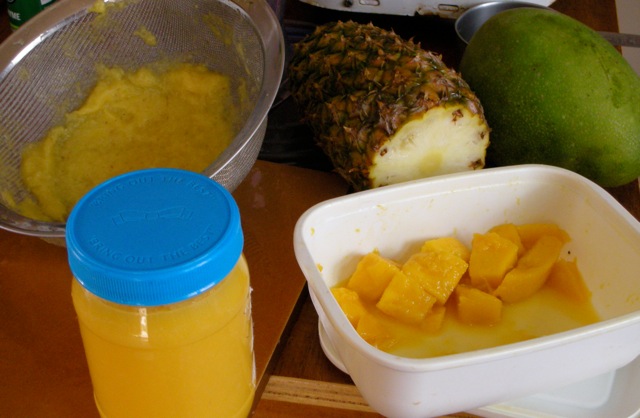
                Coconuts are readily available here, along with pineapples (they call the wonderful sugar loaf pineapple the "Cape Coast" type), sour sops (custard apples), avocados and large mangoes (not the smaller traditional type yet). We've been feasting on them, along with oranges, tangerines, watermelon, and bananas. Yesterday I chopped up some mango and pineapple, threw the pieces into a blender, then strained some of the pulp out to make a nectar. Creamy and refreshing. DK said adding watermelon juice would have thinned it without any need to strain it. Today I mixed in orange juice with some of the nectar for breakfast. Yum.

                It's also a treat to have fresh African yams. Speaking of yams: a few nights ago DK and one of his co-TEDFellows (Nina Dudnik of SeedingLabs) plus Sharon B. Stringer, my  friend  from Pennsylvania newly arrived to teach at Legon on a Fulbright, went out to dinner at a lovely seaside restaurant in Jamestown. Nina was leaving for Boston the next day and wanted to try some yam chips and pepper sauce, which she duly requested. She made sure the server understood she didn't want potato chips ("I can get those in the U.S. I want real yam chips and pepper sauce"). I ordered palaver sauce and boiled yam, and DK had banku and tilapia. However, when the food arrived and Nina began eating (it was dark by the time we got there and visibility was very poor), she discovered they'd served her potato "chips" (French fries) and ketchup! And her fried "chips" were obviously imported frozen ones that were tasteless and spongy.

                Amazing. It seems obvious that freshly  made yam chips with fresh pepper sauce are far superior to imported "obroni aduane." Nina did not say anything then, but when the server returned to collect the plates, she told her of the problem and the server was apologetic. Meanwhile, from my boiled yam it was clear there was plenty of yam available.

                If we file that experience under "customer service," here's another one. In the U.S., the mantra is "the customer is always right." In Ghana, that is reversed to "the management is always right" and "If in doubt, ignore the problem until it goes away." 

                Earlier the same day as the potato chip (French fry) fiasco, I  experienced another version of this way of thinking. As many people know, the serving sizes in Ghana tend to be several times the sizes in the U.S. DK and I went to a small restaurant he frequently eats at. He wanted jollof rice with chicken and I wasn't very hungry so we decided to order a takeout version and share it. However, when we asked  to put one order in 2 "take away" boxes, we completely upset the balance of the universe. The server insisted she could not do that, even though we offered to pay for 2 boxes. Here's the math: the jollof rice was 4 cedis, plus 1 cedi for the takeout container, or 5 cedis total. The server went away from our table and never returned. The customers who arrived after us were served and we were still sitting there. When DK finally went to ask the owner what was going on, it appeared they were prepared to just ignore us for the rest of the day. Then they said it would cost 2 cedis for an extra container, and when he objected, they said it would cost 10 cedis for one serving of jollof rice in 2 containers. Ghanaian mathematics! 

                At that point we left and bought some roasted plantains and groundnuts (peanuts) at the roadside instead. Apparently the restaurant was short on "take away" boxes and the employes were afraid the owner would give them a hard time if they let us use two for one portion of food. This beautifully illustrates how powerless servers often feel, and their inability to deviate even slightly from a rigid set of rules.

                TEDGlobal: I mentioned TEDFellows above. I was a TEDFellow invited toTEDGLOBAL in Tanzania in 2007, and my son DK  to TEDGlobal in Oxford in 2010. If you want to change the world and are already working to do so, check it out. Applications are now being accepted until 11 March 2011. For more information:

                Individuals can apply online at 
                www.ted.com/fellows/apply (short: http://on.ted.com/8qco)
                Press release: http://www.prnewswire.com/news-releases/ted-opens-application-process-for-fellows-program-114141589.html

                Thursday, September 03, 2009

                Breakfast menu for the Obama visit to Ghana 11 July 2009

                Below is the menu provided to me by Barbara Baeta Bentsi-Enchill, the Executive Chairman and founder of Flair Catering Services in Ghana, of the breakfast buffet served to President and Mrs. Obama and their entourage at the Presidential Castle on 11 July 2009.

                I've unsuccessfully scoured the Internet trying to locate ANY photos of the food or buffet lines. This omission seems to indicate a glaring lack of curiosity about or interest in Ghanaian cuisine displayed by the myriad photographers--all of the breakfast pictures show only the important dignitaries present, and I've not been able to find one that shows the food.

                What an opportunity missed.


                Menu

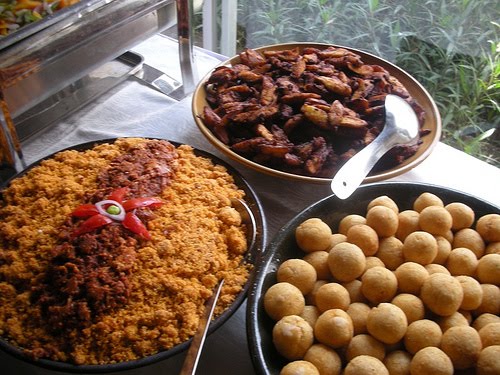
                Tropical Fruit Juices (NOTE: I assume this would have included orange, pineapple, mango, papaya or similar juices). All of the items in bold will be found in our upcoming cookbook, and some are things I've already blogged about. I've included a couple of representative photos I've taken at Flair, but these ARE NOT from the July breakfast.

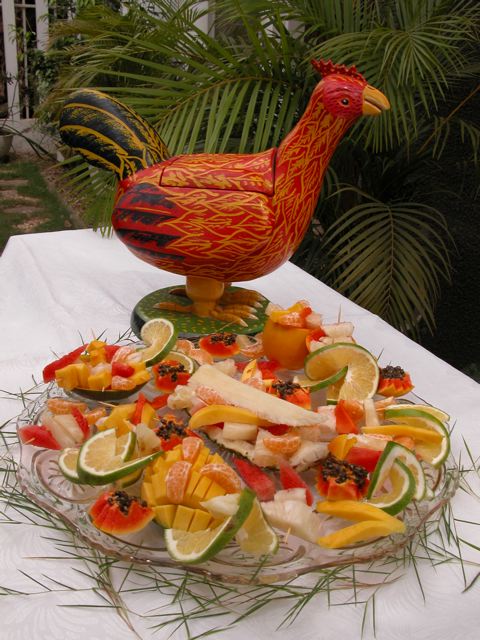
                Variety of Tropical Fruits (Again, probably Ghana's fantastically sweet pineapples, along with papayas, mangos, soursop, melons, oranges, etc.).

                Tom Brown (porridge made from toasted corn flour)
                Hausa Koko (a spiced millet porridge)
                Akra (a black-eyed pea fritter, aka kose, akara)
                Beans Stew (a stew often made with smoked fish and red beans or black-eyed peas and eaten with ripe plantain)
                Fried Plantain (probably ripe or "red" plantain slices)
                Waakye with Meat Stew (rice and black-eyed peas with a meat stew made with tomatoes, onions, probably beef, etc.)
                Galifoto (also known as "gari foto," a one-pot made from cassava meal similar to Brazil's farofa)
                Oto with Boiled Eggs (a traditional dish made from mashed yam, onion and palm oil garnished with hard-boiled eggs)
                Individual Steaks of Fried Fish (while Ghanaians often eat tilapia, Barbara said they used grouper steaks for this meal)
                Abolo (a baked corn dough and flour or sweet potato dough; another version omo abolo is made from rice) & Kenkey (steamed soured corn dough balls)
                Shito (pepper sauce)
                Scrambled Eggs with Bacon
                Grilled Tomatoes & Sausages
                Brown & White Rolls
                Butter
                Assorted Jams & Marmalade
                Tea
                Coffee
                Hot Chocolate