Making Ghana-style Microwave Fufu, Parts 1 and 2
Here's our first "how to" video demonstrating step-by-step how to make microwave fufu using readily available ingredients. Part 1 (about 5 minutes) is the introduction
and Part 2 (almost 11 minutes) is the actual demonstration
Here's the recipe:
Microwave Fufu Recipe (Ghana-style)
Using Instant Mashed Potatoes and Potato Starch Flour
1 U. S. cup (16 tablespoons, or 250 ml) instant mashed potatoes
½ U. S. cup (8 tablespoons, or 125 ml) potato starch flour
2 U. S. cups (32 tablespoons, or 500 ml) water
• Put the instant mashed potatoes and potato starch flour in a 1-quart or 1-liter microwave safe container (Naana and I both use round ones, which are easier to stir). Add 1 ¾ cup to 2 cups (about 440 to 500 ml) of the water, and stir well for about a minute with a sturdy spoon (wooden stirring stick or wooden spoon, if available).
• Place the bowl, uncovered, in the microwave for 3 minutes on high.
• Remove the bowl, and stir well, pressing against the side of the bowl to remove any lumps
• If necessary, and you did not use all of the water, add the rest, simply pouring it on top of the fufu, but not stirring it, and return the fufu to the microwave for another 3 minutes.
• Remove the fufu, pour off any standing water, and stir it again, pressing hard against the side of the bowl, until all the remaining water is mixed in and the fufu is smooth.
• Put a small bowl of water near the fufu, and wet another bowl. Place a handful of the fufu into the wet bowl, wet your hands, and turn the fufu ball until it is a smooth, almost oval shape, occasionally using the water in the other bowl to wet your hands and keep the fufu from sticking to it, and until the surface of the fufu is smooth.
• The individual balls of fufu may be served on a platter dampened with water to keep the fufu from sticking (we always put a bowl of water near our fufu to allow us to wet the serving spoon if it is being served into a bowl, or to allow diners to wet their hands before serving themselves.
• Enjoy with a nice Ghanaian soup (palmnut, groundnut, or light soup)!
• To serve: place the fufu into a bowl, and spoon the soup over and around it. Eat with a spoon or your hands.
Incidentally, exploring YouTube, I found 4 little clips of fufu being pounded in Ghana, and one of (definitely nonGhanaians) eating fufu, and 3 clips of someone making fufu on the stovetop:
eating fufu
pounding fufu 1
pounding fufu 2
pounding fufu 3
pounding fufu 4
making fufu on the stovetop, part 1
making fufu on the stovetop, part 2
making fufu on the stovetop, part 3
Showing posts sorted by relevance for query fufu. Sort by date Show all posts
Showing posts sorted by relevance for query fufu. Sort by date Show all posts
Tuesday, February 13, 2007


Wednesday, April 12, 2006
Microwave Fufu Recipe
Just before I left for Seattle at the end of March to attend the International Association of Culinary Professionals' annual meeting, a visitor from Australia, Jonas Addai-Mensah, kindly agreed to come to my kitchen and help me perfect my microwave fufu-making technique. We used Mama's Choice Plantain Fufu Powder, and it actually made about a third more fufu than the identical amount of the same brand of flour used on the stove top. I'll include some photos as soon as I get them back (my digital camera just broke).
I haven't had time to fine-tune the recipe, but I shadowed him, and copied down his every step. I'll try it out tonight with some groundnut soup.
1. In a large nonmetal bowl, mix 1 cup fufu flour with 2 cups water, stirring with your hand or a spoon to dissolve all the lumps.
2. Cover the bowl with a plate and microwave on high for 3 minutes.
3. Remove the bowl using potholders. Use a potholder to lift the cover away from your face and stir the fufu vigorously with a strong wooden spoon for about 2 minutes, gradually turning the bowl and mixing the fufu on the outside towards the center. Sprinkle 1/3 cup of the reserved water over it as you stir.
4. Recover the fufu and return it to the microwave oven for 3 minutes
5. Remove the bowl and repeat step 3 (stirring and sprinkling).
6. Recover the fufu and return to the microwave oven for another 3 minutes.
7. Remove the bowl of fufu, sprinkle only half the 1/3 cup of water remaining, and sir once again.
8. Recover and return the bowl, but only microwave it for 1 minute.
9. Allow the fufu to sit briefly, then use the remaining water to wet a bowl, spoon, or your hands, and form fufu balls the desired size onto a dampened plate or platter. Enjoy with your favorite soup or stew!
I'd love to hear what your favorite fufu powder is, and whether you prefer making it on the stovetop or microwave, and prefer adding water first and then cooking it or boiling water first and then stirring in the flour. We also did a taste test on a couple of different kinds of plantain fufu powders. I'm partial to plantain over cocoyam. What do you like?
Just before I left for Seattle at the end of March to attend the International Association of Culinary Professionals' annual meeting, a visitor from Australia, Jonas Addai-Mensah, kindly agreed to come to my kitchen and help me perfect my microwave fufu-making technique. We used Mama's Choice Plantain Fufu Powder, and it actually made about a third more fufu than the identical amount of the same brand of flour used on the stove top. I'll include some photos as soon as I get them back (my digital camera just broke).
I haven't had time to fine-tune the recipe, but I shadowed him, and copied down his every step. I'll try it out tonight with some groundnut soup.
1. In a large nonmetal bowl, mix 1 cup fufu flour with 2 cups water, stirring with your hand or a spoon to dissolve all the lumps.
2. Cover the bowl with a plate and microwave on high for 3 minutes.
3. Remove the bowl using potholders. Use a potholder to lift the cover away from your face and stir the fufu vigorously with a strong wooden spoon for about 2 minutes, gradually turning the bowl and mixing the fufu on the outside towards the center. Sprinkle 1/3 cup of the reserved water over it as you stir.
4. Recover the fufu and return it to the microwave oven for 3 minutes
5. Remove the bowl and repeat step 3 (stirring and sprinkling).
6. Recover the fufu and return to the microwave oven for another 3 minutes.
7. Remove the bowl of fufu, sprinkle only half the 1/3 cup of water remaining, and sir once again.
8. Recover and return the bowl, but only microwave it for 1 minute.
9. Allow the fufu to sit briefly, then use the remaining water to wet a bowl, spoon, or your hands, and form fufu balls the desired size onto a dampened plate or platter. Enjoy with your favorite soup or stew!
I'd love to hear what your favorite fufu powder is, and whether you prefer making it on the stovetop or microwave, and prefer adding water first and then cooking it or boiling water first and then stirring in the flour. We also did a taste test on a couple of different kinds of plantain fufu powders. I'm partial to plantain over cocoyam. What do you like?
Monday, March 25, 2019
Evolution of Instant Fufu
There are several exciting signs in the culinary entrepreneurial world in Ghana. Here is one of them.
RE contemporary twists on traditional foods
 FUFU: Making fufu the traditional way is wonderful, but strenuous and time-consuming. For a long time people have been trying to find ways to get the same taste and texture, but without all the pounding.


The same day I saw her video I rushed out and bought some cassava (commonly called yuca in our stores here) and green plantain. The result was enthusiastically approved by my husband.
5. Early in 2019, during a trip to Ghana, he stopped in at the CSIR Food Research Institute store and picked up a few items, including a plantain fufu flour with NO preservatives or coloring, best prepared on a stovetop by adding water and stirring. Very convenient if it is difficult to get fresh cassava, as it is in Pennsylvania. And I'm thrilled to get rid of those preservatives, and extra ingredients.

RE contemporary twists on traditional foods
- When I was married in Ghana, I carried a mortar and pestle back with me to the U.S. in a shipment, determined to continue to prepare my beloved groundnut and palm nut and light soups with fufu. Alas, the temperature and humidity changes caused the mortar to crack and with it my dreams of home-made fufu in the U.S.
- But I discovered how to make American-style fufu using instant mashed potatoes and potato starch flour, and in February, 2007, convinced my friend, Dr. Naana Nti, to demonstrate proper technique for cooking it in a microwave, using my camera to create BETUMI's first video.
- I also discovered actual "fufu powder." BETUMI's initial post on it was back in April, 2006, when I did a podcast with the Ashanti chemical engineer Yaw Adusei, who travelled to State College to introduce me to his Mama's Choice fufu flour (and incidentally, conduct a taste test with another leading brand).

- Over the years I experimented unsuccessfully with making fufu using plantain and cassava with a blender, or mashing it and stirring it. Last year I stumbled on Obapaa's terrific video demonstrating her technique of making microwave using a smoothie maker and raw cassava and green plantain! It was revolutionary, and soooo simple. I had always tried cooking the ingredients BEFORE blending them in a food processor or blender. She has given me permission to share it here:


The same day I saw her video I rushed out and bought some cassava (commonly called yuca in our stores here) and green plantain. The result was enthusiastically approved by my husband.
5. Early in 2019, during a trip to Ghana, he stopped in at the CSIR Food Research Institute store and picked up a few items, including a plantain fufu flour with NO preservatives or coloring, best prepared on a stovetop by adding water and stirring. Very convenient if it is difficult to get fresh cassava, as it is in Pennsylvania. And I'm thrilled to get rid of those preservatives, and extra ingredients.

Wednesday, December 17, 2008
Mama's Choice Fufu Flour
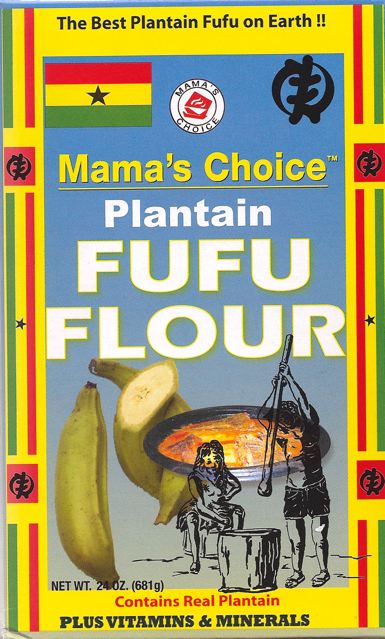
One of the ongoing dilemmas for those outside of Africa is how to reproduce "homestyle" flavor. Last February I mentioned Elisha P. Renne's article in American Anthropologist: "Mass Producing Food Traditions for West Africans Abroad (Dec. 2007, Vol 109, Issue 4, pp 616-625).
For many Ghanaians, soup and fufu is a classic meal in their culinary repertoire. In April, 2006 I posted a blog about and interview with a Ghanaian chemical engineer living in New Jersey, Dr. George (Yaw) Adusei. Dr. Adusei set out to develop a high quality fufu flour in the U.S., using plantain, cassava (manioc), and cocoyam (taro) imported from Ghana. I recently received several boxes of his improved fufu powder requesting me to taste test them and give him feedback.
He has, among other things, changed the design of his boxes and added vitamins and minerals to the plantain fufu flour. One of the things I like about Mama's Choice flour is that in Ghana there is often the issue of quality control. I trust that Dr. Adusei has had his nutritional facts tested by a reputable independent lab, and the portion sizes, calories, etc. make sense, which is not always true with the numbers on boxes from Ghana. Also, I know that he is working to limit and/or eliminate the use of preservatives in his flour.
I like the taste and texture of his product (second only to freshly pounded fufu), though it does seem that the plantain fufu may take a little more water and a few minutes longer in the microwave to cook than the previous brand I was using.
Mama's Choice is the new kid on the block. As a relatively new, small, independent company, it faces a huge challenge in developing its market share in a field currently dominated by a
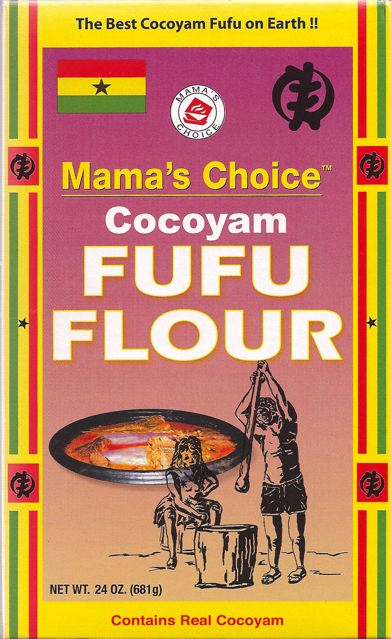 couple of well-known brands and distributors. I encourage you to check out Mama's Choice fufu if you see it in stores, or request that your suppliers order some and give it a chance.
More information is available from George Adusei of Adusei Corporation via e-mail at mamaschoice@aduseicorp.com, by phone at 908-757-7530, or on the web at www.aduseicorp.com or www.mamaschoicedistributors.com. Mama's Choice is also available in Ghana. Call 024 444 9440/ 0234 468 3147 or 024 440 1098.
Wednesday, October 24, 2007
Fufu in Brazil?
We've been in Brazil for 3 months. We're getting really tired of omo tuo (rice balls) in all our Ghanaian soups. I decided this week to attempt to make fufu with what is available when one does not have a mortar and pestle for pounding it from fresh cassava and plantains or cocoyams. At the market I picked up some polvilho (manioc, or cassava, starch). It seems to be the same thing as tapioca starch in the U.S. There're 2 kinds: doce (sweet) and azedo (acid). I also bought some farinha de mandioca, torrada or toasted, (a cassava meal that's like a really, really fine unfermented gari).
I spent a couple of hours last night trying to make Ghana-style fufu. You don't want the gory details. Suffice it to say that, with a great deal of trial and error, I produced a semblance of fufu that we managed to eat with our chicken light soup with okra. It was kind of a cross between that paste you use to stick wallpaper on the wall and fufu. Next time I need to drastically reduce the amount of starch, increase the amount of water, and figure out how to keep it from clumping up. Help! Have any West Africans lived in Brazil who can tell me what to do? We still have 2 more months here.
On a more hopeful note, I'm going to use some of the polvilho, along with a special cheese from Minas Gerais, to practice making a delightful type of puffy Brazilian cheese ball known as pão de queijo (bread of cheese), but that's another story.
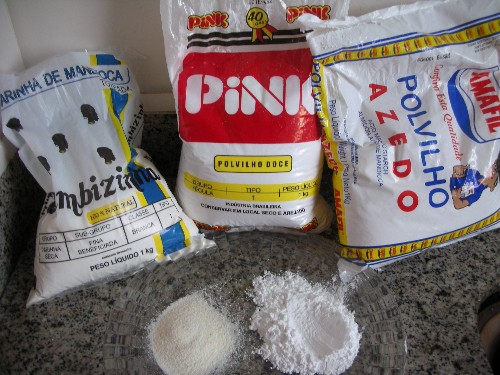 the same thing as tapioca starch in the U.S. There're 2 kinds: doce (sweet) and azedo (acid). I also bought some farinha de mandioca, torrada or toasted, (a cassava meal that's like a really, really fine unfermented gari).
I spent a couple of hours last night trying to make Ghana-style fufu. You don't want the gory details. Suffice it to say that, with a great deal of trial and error, I produced a semblance of fufu that we managed to eat with our chicken light soup with okra. It was kind of a cross between that paste you use to stick wallpaper on the wall and fufu. Next time I need to drastically reduce the amount of starch, increase the amount of water, and figure out how to keep it from clumping up. Help! Have any West Africans lived in Brazil who can tell me what to do? We still have 2 more months here.
On a more hopeful note, I'm going to use some of the polvilho, along with a special cheese from Minas Gerais, to practice making a delightful type of puffy Brazilian cheese ball known as pão de queijo (bread of cheese), but that's another story.
Thursday, April 13, 2006
Chemical engineer Dr. Yaw Adusei, talks about fufu and fufu flour
Dr. Yaw Adusei, an Ashanti, a chemical engineer trained in Ghana, Holland, Israel, and the United States, and the founder of Mama's Choice Fufu Flour, talks about his background, fufu, and the Ghana-style fufu flour produced by his New Jersey, USA-based company Adusei Corporation. He discusses issues of quality, nutritional analysis, consumer preference, and convenience.
Wednesday, September 05, 2007
Chart of African Carbohydrates/Starches

Here's the chart I mentioned that I put together to try and organize my understanding of some of the most common starches/carbohydrates I've run across. I'm sure there are many omissions and maybe some errors, so please help me to update and expand this listing.
| (from "Food and Foodways (see July 18, 2007 posting)," in The Greenwood Encyclopedia of Popular Cutlure, Sub-Saharan Africa Vol. 5, p. 101-2, © Fran Osseo-Asare, 2007) | |||
| Food Name | Region | Country | Typical Ingredients |
| kenkey/dokono | West Africa | Ghana | fermented corn dough steamed in corn husks or banana leaves |
| banku | “ | Ghana | fermented corn dough, stirred and cooked (soft) |
| koko/akasa | “ | Ghana | fermented corn dough porridge (thin) |
| tuo zaafe | “ | Ghana | thick sorghum or millet porridge |
| ogi | “ | Nigeria | fermented porridge from sorghum, millet, and/or maize |
| gari (farine de manioc) | West/Central Africa | various | dried, grated, fermented cassava meal |
| fufu (1) (in Nigeria, also called iyan or pounded yam) | West/Central Africa) | especially Ghana/Nigeria, Cameroon | peeled, boiled, pounded stiff but elastic dumpling, generally not chewed (yam, cassava, cocoyam, ripe or green plantain, single or combination) |
| fufu (2) | Central Africa | especially DRC, CAR, Cameroon | a stiff porridge made from white corn flour, cassava flour, or a combination (similar to ugali, sadza, pap, nsima) |
| lafun | West Africa | Nigeria | a fibrous, powdery form of fermented cassava similar to, but coarser than, fufu |
| attiéké | West Africa | Côte D’Ivoire | steamed fermented cassava granules |
| miondo, (myondo) bobolo, bâton de manioc | “ | Cameroon | (miondo is a Duala word, bobolo is Ewando) cassava roots soaked and fermented, peeled, mashed, drained, ground, wrapped in banana leaves and boiled or steamed |
| chickwangue (chicouangue) | Central | Congo, Gabon | similar to miondo |
| bidia | “ | DRC, CAR | (Tshiluba) See fufu (2) |
| injera (enjera) | Eastern Africa | Ethiopia/Eritrea | fermented crepe/pancake commonly made from a type of millet called tef (teff), but also with sorghum or wheat |
| canjeero | “ | Somalia | see injera |
| obusera | “ | Uganda | fermented millet porridge |
| uji | “ | Kenya, Tanzania | Swahili word for porridge, thin to thick, made from maize, millet,and/or sorghum |
| ugali | “ | Various, esp. Kenya, Tanzania | Swahili word for a thick porridge (or dumpling) commonly made from cornmeal, but also made with cassava flour |
| posho | “ | Uganda | see ugali |
| atapa (atap) | “ | Uganda | ground dried sweet potato porridge, with ground millet/cassava and flavorings |
| pap | Southern Africa | South Africa | Dutch word for porridge made from cornmeal flour or other staple grain |
| bogobe | “ | Botswana | see pap |
| sadza | “ | Zimbabwe | stiff porridge (or dumpling) made from white field corn flour or red millet flour |
| nsima/nhsima | “ | Zambia, Malawi | see pap |
| xima | “ | Mozambique | corn pap (see pap) |
| amarhewu | “ | South Africa | thin porridge made from slightly fermented cornmeal |
| putu/phutu | “ | South Africa | (Zulu) a crumbly version of pap (see pap) |
| umphokoqo | “ | South Africa | (Xhosa) a crumbly version of pap (see pap) |
Friday, April 09, 2010
Recipe #47: Light Soup with Lamb, Eggplant, Mushrooms and Zucchini

I was wondering what to cook for dinner last night that would be fun, healthy, simple, and delicious, when I realized I had lamb shoulder (on sale the week after Easter), portabella mushrooms, zucchini squash, jalapeno peppers and eggplant all on hand. Plus, I always have tomato paste/sauce/canned tomatoes, garlic, onions, salt, dried red pepper and fresh ginger in the house.

Voila! Everything I needed for a wonderful “light soup.” That’s the English name in Ghana for a light stock-based soup, named that long before the West started talking about “light” foods. A light soup can be contrasted with heavier “groundnut” (peanut) or palmnut (palmfruit pulp-based) soups. Light soups have infinite variations, and are easy to adjust according to what you have on hand: but remember to include onion, pepper and tomato!
Anyhow, here are the proportions and ingredients I used:
1 3/4 pounds of lamb round shoulder chops (mine had bones), fat trimmed and cut into chunks
6 cups of water
1 1/2 teaspoons salt (or to taste)
1 cup chopped onion (1 large)
1 cup tomato sauce (1 small can)
a few spoonfuls of tomato paste (optional)
6-8 ounces of eggplant, peeled and cut into quarters (a whole small Japanese eggplant, or a third to a half of a larger regular eggplant)
one medium zucchini (about 4 ounces), cut in half
1 small jalapeno or other chili pepper (or use dried red pepper to taste, if desired, beginning with 1/8 teaspoon). If you like things spicy, use the whole pepper; if not, cut it in half and carefully remove the seeds and membranes first
about 6 ounces of fresh mushrooms (I had portabella on hand, but any mushroom will work)
(optional seasonings: a 1-2 teaspoons fresh grated ginger, a couple of tablespoons chopped onions, 3 peeled, crushed cloves of garlic, a sprinkling of ground red pepper)
Trim the fat from the lamb, and cut it into chunks. Put the meant in a soup pot with a cup of water. The next step is optional, but I almost always season and “steam” my meat before making the soup, so if you want to follow tradition: on top of the meat, sprinkle a couple of tablespoons of fresh, peeled, grated ginger, a few cloves of peeled, crushed garlic, a couple tablespoons of chopped or minced onion, and sprinkling of dried ground red pepper and salt or seasoned salt. Cover the pot, bring it to a boil, then lower the heat and let it simmer while you prepare the other ingredients.
Chop the onion. Open the can of tomato sauce (and paste, if you want to use it). Rinse and trim the zucchini and cut it in half. Peel the eggplant and cut it into quarters. Prepare the mushrooms (rinse, wipe dry with a paper towel, and slice in thick slices, or, if they’re small leave them whole or cut them in half or quarters).
Set the mushrooms aside to add near the end.
Add the other vegetables, except the mushrooms, to the pot, along with another 5 cups of water. Add the salt, stir well, bring it back to a boil, then let it simmer, covered, until the vegetables soften (about 10-15 minutes).

Use a slotted spoon to remove the eggplant, pepper, zucchini (and I also usually spoon out some of the chopped onion floating in the soup) into a blender or food processor container. You may need to add a little broth from the pot, or to do this in 2 batches. Blend the vegetables until they are smooth and return them to the soup.
Add the mushroom slices (at this point I tasted the soup and decided it needed more tomato flavor, so spooned in a couple of tablespoons of tomato paste), stir, cover, and allow the flavors to blend for another 10-15 minutes. Before serving, adjust the seasonings to taste, and skim any fat from the lamb that may have risen to the surface.
While the soup finished simmering I made some fufu to go along with it, but you could serve it with rice, or bread, or whatever you like. If you want to try an American version of microwave fufu using easily available ingredients, you might like to check out BETUMI's YouTube video
Bon appétit.
Wednesday, November 03, 2010
Recipe #49: Abe Nwkan (Palmnut Soup), Part I

Palmnut soup has many names. For example, it is commonly known as abe nkwan in Ghana, mbanga soup in Cameroon, and banga in Nigeria.
 |
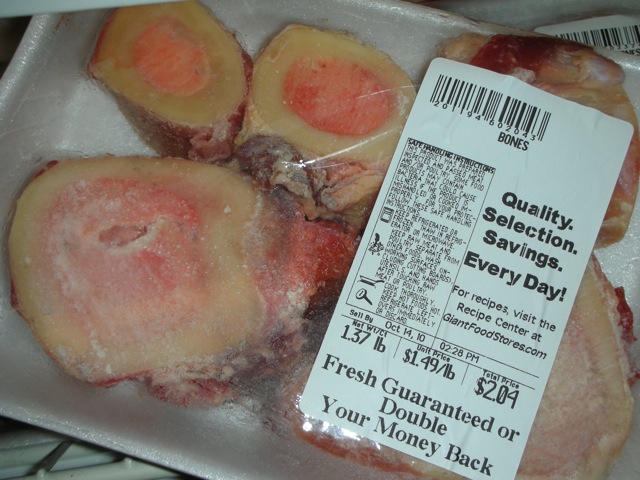
 canned cream of palm fruits, cocoyam fufu flour, smoked mackerel (Duckpond), fresh crabs (and king crab legs) and shrimp, habanero peppers, lamb and beef and soup bones, fresh ginger, mushrooms, eggplant, (frozen) okra, etc. While I was preparing his special meal the thought flitted through my head that I ought to take some photos for my blog, but things were too hectic and I forgot about it.
But, while trying to remember if I'd ever posted a recipe for palmnut soup (no) I was poking around on the Internet and was dismayed to see several recipes that described using palm oil ("no substitutes") to make it. As one (obviously Ghanaian) person pointed out on one of the sites "You are so wrong. Ghanaian palm nut (soup) is very different from what you described." Perhaps in some countries they use the oil, but in Ghana, the oil is strictly for stews or frying, and using the pulp or "cream" of the fruit is imperative.
Since I hadn't taken any photos while preparing Sam's soup I scanned one above from my cookbook A Good Soup Attracts Chairs. I also went to the grocery store and photographed the ingredients I used (except our local store was out of the Duckpond Smoked Mackerel, the type I prefer). There are several authentic Ghanaian recipes for palmnut soup available on the internet and if you try one, just be sure it calls for using canned cream of palm fruit (or, if you're lucky enough to be in a place where you can buy fresh palm nuts, and have a mortar and pestle for pounding and straining them, that's even better, but a lot more work).
Palm nut soup is also a family favorite at my house for ringing in the New Year. Here is the extra special rich birthday version I prepared for Sam who came home from college and his brother Ernest, who came up from Philadelphia for the event. It's loaded with seafood, meat, and vegetables, and adapted to our Pennsylvania environment. It's also not cheap to make but you can simplify it if you're making an "every day" version. Just remember to use the freshest ingredients available.
Other Ingredients (besides the canned cream of palm fruit, aka. sauce graine) and the fufu flour:
 |
 |


  | |||||
 |
 |

Thursday, February 14, 2008
West African Convenience Foods and Inter-African Culinary Influences

Ghanaian Convenience foods
Since arriving in Ghana I’ve been dealing with some food challenges. The first one is getting/making fermented corn/cassava dough for banku and koko (porridge). With our minimalist kitchen in Legon and no car or household help, I’m ill-equipped to get involved in the time- and equipment-consuming tasks of preparation (e.g., soaking, then grinding the corn or cassava). It’s not a simple task of running to a market to have things ground or pick up what I need. Plus, the big supermarkets (Koala in Osu, Shoprite in Accra Mall) do not sell these types of Ghanaian foods, either. There are “instant” powdered versions on the market, but so far my husband and I have tossed out all of them we’ve tried. However, we have found shito (a special Ghanaian hot pepper sauce) and groundnut paste (peanut butter) made locally that we like.
In the U.S I use fufu powder to prepare and eat “make-do” fufu, and I make banku and kenkey from stoneground cornmeal and cornstarch, even though the dough lacks the proper flavor and texture. Here in Ghana I haven’t yet found any trusted small producers who can reliably supply me. Of course, I can eat many of these dishes in restaurants, but it would be nice to be able to prepare them at home. I’ll keep looking.
This conversation reminds me of an interesting article by Elisha P. Renne in a recent issue of American Anthropologist: “Mass Producing Food Traditions for West Africans Abroad” (Dec. 2007, Vol. 109, Issue 4, pp 616-625). It talks about how West Africans who are abroad and thus away from home turn to processed, prepared foods that use production processes that are “ideologically similar . . .but technologically very different” from traditional techniques. She illustrates with examples of palmnut concentrate, fufu powder, attiéké, and Nigerian chin-chin, It strikes me as an accurate and timely look at the diffusion of West African ingredients and culture into North American markets, with explorations of how memory, taste, and social identities interact. There are a few minor errors in the article, but it’s well worth reading.
Renne's article reminded me of an interesting paper presented by Tulasi Srinivas at the Joint 2006 Annual Meetings of the Association for the Study of Food and Society (ASFS) and the Agriculture, Food, and Human Values Society (AFHVS) at Boston called “'As Mother Made It': Global Food, the Indian Family and the Construction of Cultural Utopias," which explored how a whole industry has emerged in India to reproduce the labor-intensive meals craved by well-to-do but time-strapped Indian professionals in places like the U.S. I wonder if the same thing will happen for West Africans? I think of the individual-sized portions of Indian food being sold, and think of West African portion sizes, and I wonder. . .
Shoprite and Inter-African culinary influences

There was an article a few years ago about how supermarket chains from South Africa are beginning to spread into other African nations (Weatherspoon and Reardon, “The Rise of Supermarkets in Africa: Implications for Agrifood Systems and the Rural Poor,” Development Policy Review, 2003, 21 (3): 333-355.) Recently South African-based Shoprite, the biggest retailer in Africa, has opened a store in Accra. It reminded me how increasingly countries on the continent are being influenced by the foods of other African nations. For example, for the first time in Ghana I see canned South African chakalaka salad and butter beans on the shelves, along with numerous curry and periperi seasonings. Similarly, restaurants on campus here at Legon cater to Nigerian students and visitors (like the hundreds of Nigerians who came to see the African Cup of Nations matches) by preparing some of their specialties, such as eba (from gari), iyan (pounded yam) and Nigerian-style egusi (melon-seed) stew. Also, the newly opened branch of Maquis Tante Marie at the Accra Mall provides, as does its North Labone branch, upscale West African cuisine from a variety of both Francophone and Anglophone nations.
Friday, September 08, 2006
Cool African Food T-shirts

I just discovered http://www.cafepress.com/buy/fufu/africa, a great site to order African food-related t-shirts. I ordered "got fufu?" and "I (heart for love) African Food." There're dozens of others, depending on your favorite: jollof rice, cassava leaf, palava sauce, acheke, potato greens, cous cous, plantains, moimoi, gari, torborgee (I know that's Liberian, and it includes palm oil, but could somebody help me out with the details?), fufu and soup, roasted meat, okra, pepper soup, check rice and gravy, yams, etc.
Also, there's a new website in the U.K. that says they'll eventually specialize in African foods:
The African There's not much there now besides music, but you might check them out later.
Monday, February 27, 2012
Oatmeal fufu from Nigeria

I arrived back in the U.S. last week and have been slowly catching up on my sleep and my correspondence. Last night I attempted a dish I first tasted in Abuja a couple of weeks ago: "oatmeal."
Not your every day breakfast cereal, though. It was interesting to see William Penn's face greeting me on boxes of Quaker Oats in the grocery shops in Abuja, but even more interesting to know that Nigerians have appropriated the oats to make a contemporary version of a starchy accompaniment to soup, similar to fufu.
I was first treated to this dish in the home of Godwin and Felicia Chukwu. When I asked for the name, I was told, simply "oatmeal." "No other Nigerian name?" I asked and was assured there is not.

Unfortunately, I had no time for Felicia to demonstrate its preparation to me, but she did show me the heavy duty grinder she uses to grind the oats to flour, and she explained the basic process: bring water to a boil, gradually stir in the oats and mix well for a couple of minutes, then spoon into a serving bowl. She assured me I could just as easily use an electric blender to make the flour, as you see I did.
I believe she also said no added salt, and I remember Godwin mentioned to keep a little boiling water on the side to add if the oatmeal gets too dry.

Last night I made a Ghanaian "light soup" with beef and okra and shrimp, and whipped up some "oatmeal" to go with it. I remember Felicia used "instant" oatmeal, but I had old fashioned rolled oats here in Pennsylvania. At any rate, my first effort was semi-successful: I remember the version in Abuja as being lighter and somehow fluffier, while also dense. I think I may not have ground the flour fine enough, and I may have added too much water as well. I used 2 cups of oatmeal and probably 1 cup of boiling water. Anyone out there who can fine-tune this recipe, please let us know.

Subscribe to:
Posts (Atom)