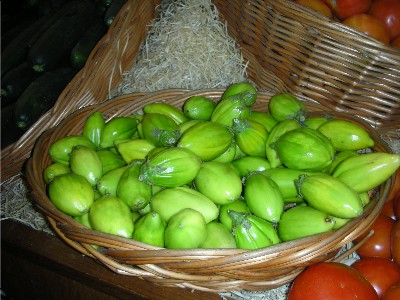
 A few weeks ago, a Brazilian friend and I went to lunch at an award-winning cafe in Belo Horizonte, Minas Gerais. One of the featured items on the menu had "jiló" (pronounced zhee-LO) in the name. "What's that?" I wanted to know. "Oh, it's a vegetable especially popular in Minas Gerais. It tastes wonderful" she assured me. She held her thumb and forefinger almost together to make an oval, and said "It's shaped like this, and about this size."
I decided to order a different dish for lunch, but the next time I went grocery shopping I picked up a "jiló" to try. When I cut it open, I was surprised to realize it was an unripe garden egg, the beloved little egg-shaped eggplant vegetable used in Ghana and other places in West Africa. I added it to whatever stew I was making that night, and found it more bitter than I remembered the garden eggs in Ghana. Interestingly, Brazilians find the ripe fruit bitter and the market will only accept the "young, sweet" green jiló. It's true that's the only kind I've seen here in the 3 months I've been in Brazil. I generally substitute eggplant in the U.S. because I don't have access to fresh garden eggs, though I have seen some Japanese eggplants in the stores that look similar. Jiló, too, can be used interchangeably with eggplant.
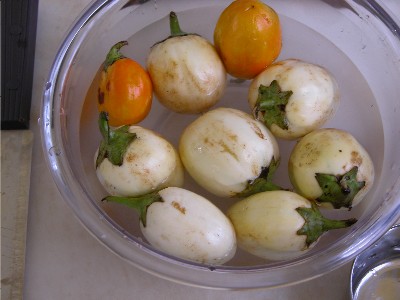
It turns out that there are 2 kinds of jiló (Solanum gilo), both from the Solanaceae family: the kind popular in Belo and other parts of this region (comprido verde claro, or "long light green") and a rounder, more bitter type called morro redondo). Jiló is originally from Africa and found its way to Brazil, though not other Portuguese-speaking countries, via the slave trade.
It never ceases to amaze me how interconnected the world is!

