Showing posts with label Ghana. Show all posts

Friday, July 12, 2019

Biscuit Project Update

I feel kind of like that old saying "all dressed up and nowhere to go," except it should be "all set up and no way to start."

After a several day delay (due to United and South African airlines), I arrived in Ghana determined to discover why the solar panels and inverter were not working at my house. It's a long process, and the power has been off twice in the interim.

I'm reluctant to go ahead with the workshop until I know we have reliable power for the refrigerator and oven, so . . . someone is coming again tomorrow  (Saturday) to take the 8  batteries to be charged (at least a 3-day delay) and we can investigate further. I'm still here for 2 more weeks, so IF we get the power issue fixed, will schedule the workshop sometime during the week of the 22nd of July to the 27th. Let me know if you have a preference for the day and time. Right now, I'm very flexible.

The house is in Community 18, Tema (Baatsona), and I can send you my phone number if you give me yours. I'm planning on about only 5 or 6 people, so let me know if you are still interested.


As you know, two of my favorite proverbs are: "the road doesn't stop the bird," and "little by little the chicken drinks water." Here's to innovation paired with culture!

Friday, February 02, 2018

Dwennimenn: The Ram's Horns (humility with strength)

The 3rd adinkra cookie stamp I chose to work on (after "gye name" (the omnipotence of God) and "sankofa" (go back and fetch it to remember the past), was "dwennimenn" the ram's horns, a symbol of strength with humility. Am still improving it, and also  the vanilla and chocolate shortbread cookies (biscuits), using only vegan and gluten-free ingredients that are found in Ghana. "Little by little, the chicken drinks water."

Here's today's attempt:


Sunday, December 10, 2017

What's under your Christmas tree this year: also sankofa and gye nyame tea biscuits

What's under your holiday tree this year? Consider The Ghana Cookbook.


On another front:  I'm finally also almost (~11 tries later) there on the development of a Ghana-friendly gluten-free tea biscuit using only cassava flour, brown rice flour, tigernut flour, tapioca starch, corn starch, sugar,  salt, vanilla, ripe plantain, and coconut oil (plus a little xantham gum). Hope to share soon. Plus, I'm finalizing  3-D printing of those cookie stamps of adinkra symbols. Very excited! The rating are going up and up with my taste testers. Really getting in the holiday mood.


Saturday, September 30, 2017

2nd, 3rd, and 4th attempts . . .little by little

As you may remember, I'm trying to develop a Ghana-style gluten-free shortbread cookie recipe.

I first tried using a couple of recipes from gluten-free friends/sites, but substituting coconut oil for the butter, and various blends of rice/millet/tapioca flours, etc. first for the main replacement of wheat flour and adding proportions of various gluten-free flours as indicated. Won't go into the specifics here, just say that the sugar didn't blend the way it does with butter, and the "tapioca flour," being tapioca starch, turned the dough either into a solid brick that I had to throw away and couldn't even roll out, or the cookies/biscuits were so gritty and crumbly they were not worth keeping.  I tried once with xantham gum and that still didn't work. Also, I was mixing the dough with a wooden spoon.

Yesterday, I tried substituting half powdered sugar for the sugar, and used a mixer, plus just cassava flour from Brazil (not the tapioca starch), and chilled the dough before rolling it out on parchment paper. This was the best yet, but according to Kwadwo, my reliable tester (and to myself, too), they still tasted gritty, and dry, and still were very fragile.

I'm going to keep experimenting and will keep you in the loop, but I'm wide open to suggestions: just remember I don't want to use things that aren't easily and cheaply available in Ghana. I'd like shortbread, because it uses only flour, sugar, butter substitute (like coconut oil--please no margarine), a little salt, and possibly a little flavoring like vanilla. If I can perfect this, I'll next try a gluten-free sugar cookie.

Wednesday, June 01, 2016

West African Cuisine at the Global Table


News Flash. Sunday, May 29, 2016: The Ghana Cookbook placed 1st

in the 2016 Gourmand World Cookbook awards for "Best African Cookbook published outside of Africa"!  Pierre Thiam's Senegal: Modern Senegalese Recipes from the Source to the Bowl, tied for 3rd place. 


These awards are listed on pages 185 and 184, respectively of the global awards booklet.

As Publishers Weekly noted back in August last year  with The Ghana Cookbook and Senegal: Modern Senegalese Recipes from the Source to the Bowl,  "This season, West Africa comes into focus." It's been a long wait, but Africa's time is coming.


Wednesday, September 15, 2010

Chocolate and child labor in West Africa

It's been a while since you've heard from BETUMIblog.  After I returned from Nigeria in August the logic board on my computer died, and I've been dealing with that, along with a backlog of work. . .

Enough excuses. When my husband joined me in Nigeria in August he carried along a chocolate bar to show me another example (this one from Japan) of the fame of Ghana's "black gold."  I kept meaning to write about it, but ended up with the package back in Pennsylvania. . . until last week when I had a chocolate attack. But before eating, I dutifully took a couple of pictures.

Then a few days ago I read something about child trafficking in the cocoa industry in Côte d'Ivoire and Ghana.  That made me sad. However, after a quick online search of child labor in Ghana, and the results were not so scary. It seems it's more a question in Ghana of smallholder farms where family members are all involved in production.
I'll be able to enjoy my cocoa more if that's the case.

Wednesday, September 02, 2009

Flair Cooks for Obamas in Ghana

I telephoned my colleague Barbara Baeta of Flair Catering in Ghana (and my collaborator on our upcoming Ghanaian cookbook, the recipes of which are appearing in development on Betumiblog regularly) to find out if she could help me discover what the Obama family was served during their stay in Accra in July. It turns out the one State meal catered for them was breakfast, and her own Flair Catering was selected to provide that meal (for 600 people)! She's sending me the menu tomorrow (Thursday), so check back to find out what was served. Barbara was quick to point out that she knows what Flair served, but not what the Obamas themselves actually ate.

She compared the security there in 2009 to that when she cooked for President Jimmy Carter (pre 9/11)--then it was much looser, and she was able to chat with the President; this time, though she was a few yards away from President Obama, and saw his wife come down, she was unable to meet them and security soon hustled everyone away. Plus, there were meetings going on upstairs, where Flair also set up a buffet table, but she doesn't know if President Obama actually tried any of the food or not. A combination of Ghanaian and European food was served.

Barbara commented to me that some of the culinary
reporting was inaccurate. Among other things, they got her name wrong and called her "Henrietta." Also, while kenkey was part of the buffet, tilapia was not ("I wasn't going to take a chance on all those bones."). Instead, she said, they prepared grouper fillets. I hope she'll be able to get some pictures of the tables, too. She said everything looked lovely, but security was so tight there was no way for her to photograph anything herself. For some photographs I took at Flair's 40th birthday party in 2008, go to BETUMI's flickr account.

Tuesday, October 16, 2007

Jiló in Brazil, garden egg (ntroma) in Ghana

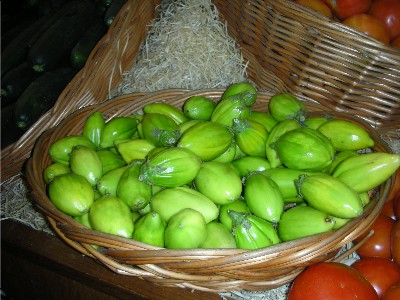
A few weeks ago, a Brazilian friend and I went to lunch at an award-winning cafe in Belo Horizonte, Minas Gerais. One of the featured items on the menu had "jiló" (pronounced zhee-LO) in the name. "What's that?" I wanted to know. "Oh, it's a vegetable especially popular in Minas Gerais. It tastes wonderful" she assured me. She held her thumb and forefinger almost together to make an oval, and said "It's shaped like this, and about this size."

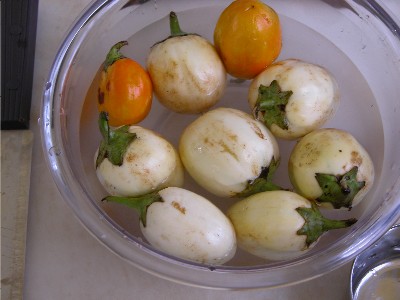
I decided to order a different dish for lunch, but the next time I went grocery shopping I picked up a "jiló" to try. When I cut it open, I was surprised to realize it was an unripe garden egg, the beloved little egg-shaped eggplant vegetable used in Ghana and other places in West Africa. I added it to whatever stew I was making that night, and found it more bitter than I remembered the garden eggs in Ghana. Interestingly, Brazilians find the ripe fruit bitter and the market will only accept the "young, sweet" green jil
ó. It's true that's the only kind I've seen here in the 3 months I've been in Brazil. I generally substitute eggplant in the U.S. because I don't have access to fresh garden eggs, though I have seen some Japanese eggplants in the stores that look similar. Jiló, too, can be used interchangeably with eggplant.

It turns out that there are 2 kinds of jiló
(Solanum gilo), both from the Solanaceae family: the kind popular in Belo and other parts of this region (comprido verde claro, or "long light green") and a rounder, more bitter type called morro redondo). Jiló is originally from Africa and found its way to Brazil, though not other Portuguese-speaking countries, via the slave trade.

It never ceases to amaze me how interconnected the world is!

Monday, September 10, 2007

Refogado in Ghana

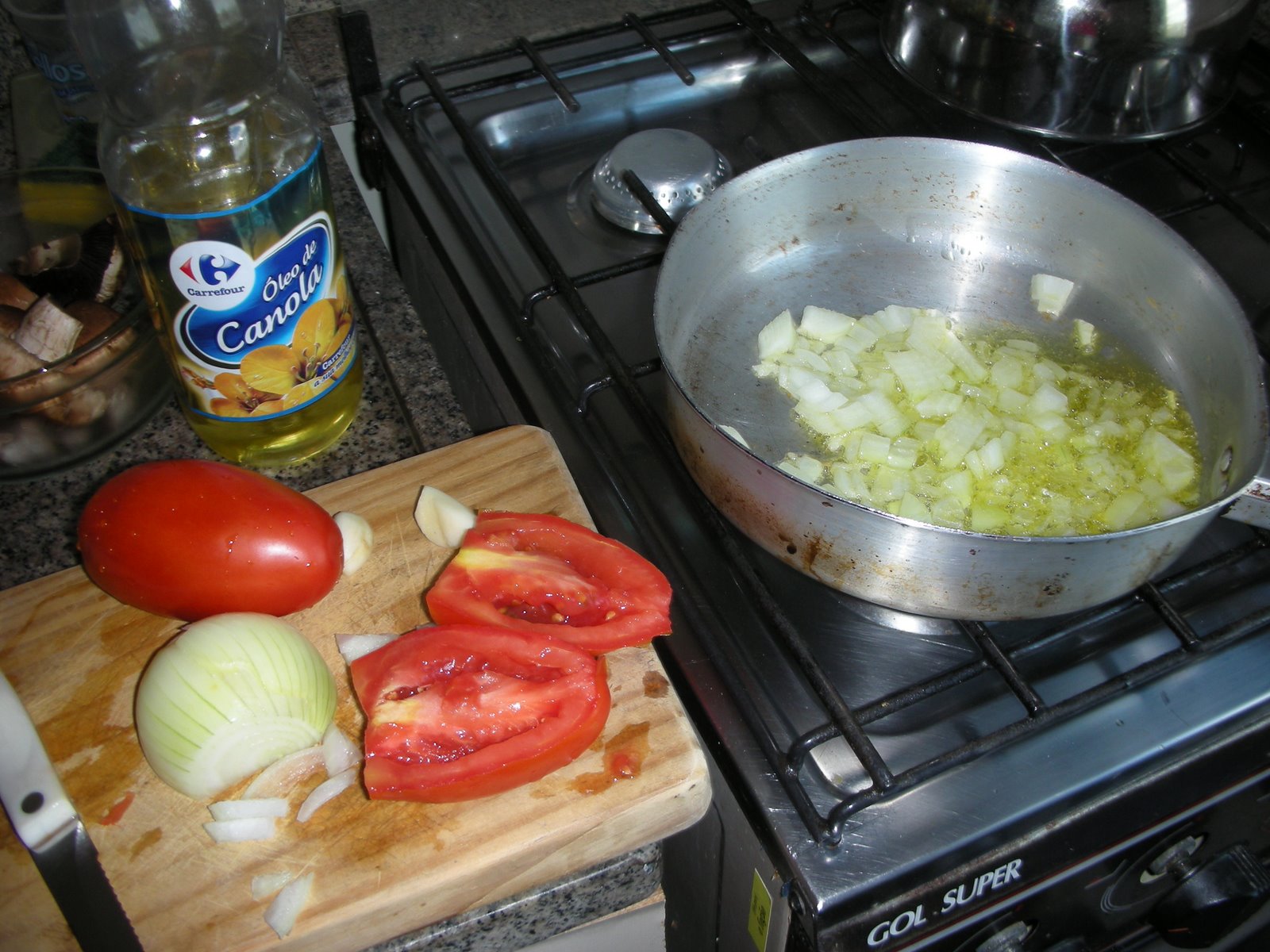
I've learned a great Portuguese culinary word: refogado. The book Barbara Baeta and I are writing on Ghanaian regional cuisine has a section on the ABCs of cooking in Ghana. It includes a discussion of one of the basic building blocks of most Ghanaian stews: a sauce/stew base made from oil, chopped or sliced onions, and tomatoes, as well as other ingredients like garlic or peppers. The "correct" way to prepare the base is to heat the oil, saute the onions first, then stir in the tomatoes, etc. This is what they call "refogado" in Brazil, and is, likewise, a basic technique for beginning many dishes in Brazil. As my husband is fond of saying "travel and see!"

Monday, April 09, 2007

Ghana in Chicago


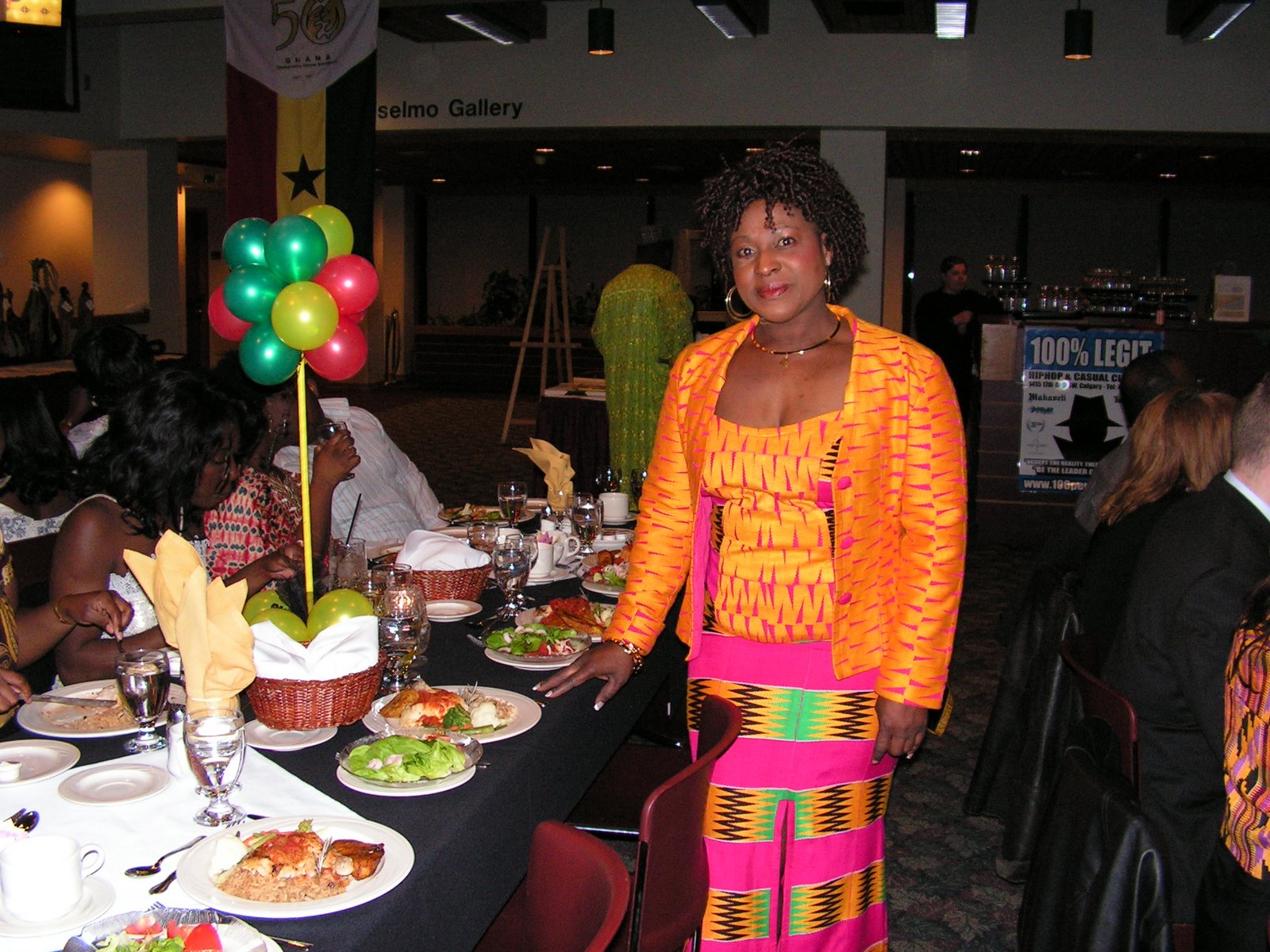
I'm off to Chicago in two days for the International Association of Culinary Professionals' (IACP) annual conference. Gloria Mensah and I will be doing a presentation on Ghana's food and foodways, featuring tastings of gari foto and groundnut stew. Our session is called "The Good Soup Comes from the Good Earth: Cooking of Ghana, Gateway to West Africa." Gloria will join us fresh from the Ghana Jubilee celebration held in Calgary, Canada, where she helped oversee a culinary (and cultural) feast enjoyed by some 600 folks.

There're still a lot of loose ends to tie up, so it'll be a few days before I'm able to blog again. While in Chicago, some of us plan to dine at Madieye and Awa Gueye's newly enlarged Yassa African Restaurant restaurant, and I hope to pick up supplies for our presentation at Chicago's Makola Market. I'll be sure to report on the trip, and will have my trusty digital camera in hand.

Wednesday, March 28, 2007

Ghana-style Kenkey


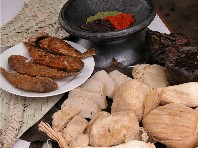
Italy has polenta, Ghana has kenkey. This steamed fermented corn dough dish from Ghana has several versions. The two most well-known include Ga and Fanti styles, the former dough including salt and made of balls wrapped in corn husks before steaming, the latter without salt and wrapped in plantain leaves. It is also called komi in Ga, dokono in Twi, or dokon in Fante, kokui or tim in Ewe (sorry, I'm missing the correct orthography to insert special Akan characters in several of these words).

There are numerous other versions of kenkey, including a type where the skins of the corn are removed before grinding it. A sweet version is called dokompa, and it is one of the few instances where sugar is added to a main carbohydrate (sweet potatoes or yam are also added). Kenkey can also be made from plantains, where very ripe plantains are pounded and mixed with green plantain meal (amada kokonte). Plantain kenkey is known as brodokono in Twi, afanku in Ga, and ahyenku or asenku in Fante.

The preparation of corn-based kenkey involves souring the dough, then cooking half of it slightly to make aflatta, (a.k.a. ohu, or half-cooked banku), then mixing the partly cooked dough with the uncooked dough and wrapping and steaming the mixture. Banku is a smooth, softer dough that is cooked and stirred, rather than steamed.

Kenkey fascinates me, and I hope to continue tracing its history when I'm in Brazil later this year. Apparently some of the
peoples in Amazonia, such as the Tupi-Guarani, also ferment corn to make dough. Many parts of sub-Saharan Africa have thick corn-based porridges (pap, bidia, ushima, sadza, ugali, etc.), but Ghana's fermented dough seems different. It is also difficult to duplicate in North America, where we are usually forced to ferment Indian Head or other (white) cornmeal. This disappoints on several counts: the corn should be soaked before being ground and fermented (something to do with how the starch changes to sugar, a food scientist in Ghana once tried to explain to me), it should be white (harder to find in the U.S.), and it should be finer than our stone ground cornmeal. I've also tried soaking dried Indian corn, and grinding it myself, but have not identified the correct types (flint, dent?) and been unsuccessful. Ga-style kenkey is wonderful with crisply fried fish, a spicy pepper sauce/sambal such as Ghana's "sheeto," and a fresh tomato, pepper, and onion "gravy."