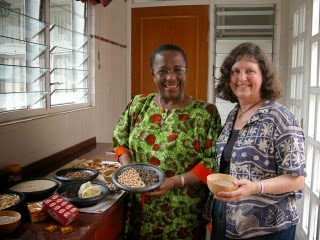
The International Association of Culinary Professionals Conference (IACP) in Los Angeles California April 1-3, 2016 was a celebration of good food from around the world, and focused on changing communications in the culinary world. I was happy to represent Ghana (Note the Made-in Ghana-apron). For the first time since I've been attending, I met a sub-Saharan African (Nigerian) colleague!
My next signing event will be at the University Club on the Penn State Campus from 8 a.m. to noon, Saturday April 23, 2016 at a half day conference sponsored by State College's own Smart, Creative + Interconnected women's group. See the website for more information. I'd love to see you there. Finally, I'm happy to announce that some of the speeches from January's Ghana launch of The Ghana Cookbook are now available online. Here's the first one from BETUMI's playlist.
All of the videos Barbara Baeta had uploaded from that day (including among others Barbara's remarks about the fascinating history of Flair Catering, my irrepressible husband, Prof. K. Osseo-Asare making outrageous remarks, journalist and former minister of state, Elizabeth Ohene, and Rev. Dr. Joyce Aryee [also a former minister of state]), are available at http://bit.ly/1Wnwm5x (Incidentally, I still can't believe I said some Akans might claim they eat soup and fufu "for breakfast," when I meant "every day." Oops.)
In my previous post I promised to share about what's happening with BETUMI's "mountain moving" projects.
BETUMI's Original Africa Cookbook project: In2007 at the TED Global conference held in Arusha, Tanzania, BETUMI launched the
Africa Cookbook Project--we now have collected well over 120 books written by Africans and published (mostly) in Africa. They range from mimeographed (yes, before the 1960s, before photocopying or scanning, there was mimeographing) informal collections of recipes to sophisticated full-color print books. They are in English, French, Portuguese, Amharic, Malagasy. . . We have also collected dozens more cookbooks published outside of Africa and/or written by non-Africans, along with dozens of African-food-related reference books.
The earliest books in the collection were originally published in 1933 (The Gold Coast Cookery Book, by the Government Printing Office in Accra, reprinted in 2007 as The Ghana Cookery Book by Jeppestown Press in the U.K. AND the 1934 The Kudeti Book of Yoruba Cookery by J. A Mars & E. M. Tooleyo--we have the 3rd (Revised) Edition (1979) and the reprinted and repackaged 2002 edition, all from Lagos.
The most recently published additions are: from South Africa, Ukutya Kwasekhaya: Tastes from Nelson Mandela's Kitchen by Xoliswa Ndoyiya with Anna Trapido, published in 2011; from Ghana, Florence Sai's Aunty Mama's Cook Book launched in Ghana in December 2011, and from (Côte d'Ivoire (via France), Marguerite Abouet's Délices d'Afrique, published in 2012 by Editions Alternatives.
A huge thank you to everyone who has contributed so far to this
project. One immediate mountain that needs moving is getting all of the
books into the fledgling data base. We need help to do this. Maybe the next step after that is getting some of the earlier works digitized and available to everyone, while ensuring that there is fair compensation to authors and publishers. The Newest Africa Cookbook project:
As many of you already know, for over a decade (when the photo on the left was taken), Barbara Baeta and Fran Osseo-Asare have been collaborating on compiling an ambitious Ghanaian cookbook designed as a basic cooking course. It will feature regional variations and step-by-step
instructions for a wide range of Ghanaian recipes (roughly 150), along with Ghanaian
artwork, scenic shots, and anecdotes from both of our lives.
We're thrilled to report
that in August 2013 we signed a contract with Hippocrene Books,
respected for over 40 years as a publisher of ethnic cookbooks. The manuscript will be completed by the end of August 2014, and the
book is expected out 9 months later, around May 2015. Thank you to all of you who have been supportive of this unfolding dream. We trust that, like all truly great things, it will prove worth the wait.
We're very excited!
P.S. Those of you who have offered to help (or would like to) with the final recipe testing, stay tuned. We welcome your involvement, and will soon give more details on how you can be a part of this project.
I'm having a lot of cooking lessons these last few weeks before I leave Brazil. This month I learned the basics for making feijoada, that wonderful bean and meat stew that's practically synonymous with "Brazilian food" (note: I first blogged about it on August 15).
Here is a quick summary:
On Friday, Nov. 9, 2007, Claudia Lima, her co-worker friend Ilda De Sousa Batista and I went to downtown’s sprawling, lively Mercado Central (Central Market) to buy the ingredients for Sunday’s feijoada party.
Our first stop was at what they assured me was THE BEST place in Belo Horizonte to buy the meat: O Rei da Feijoada Ltda. (the King of Feijoada). This was the first step in untangling the mysteries of all the smoked and salted meats that are integral to this dish.
Upon arriving at O Rei da Feijoada, they hand you a paper over the counter with a chart that lists 19 ingredients to choose from (in Portuguese, of course). We took 9 items, including a special sausage for an appetizer (tiragosto) There we picked, taken from the receipt, as well as I can tell:
Next Ilda went and bought some special Minas cachaça (Joao Mendes, or JM) for the caipirinhas while Claudia and I went to by the long grain rice (arroz), some vegetable oil (oleo) and salt. Then we went for fresh produce and fruits. Some couve (this is usually referred to as kale or collard greens).
Ilda spent Saturday de-salting and cooking of the salted meats, and pounding the garlic and salt and generally doing the prep for much of Sunday's work, when we actually cooked the beans and meats together (sautéing each of the sausages and smoked meats separately before adding them to the beans and salted meats), prepared the side dishes, etc. On Sunday Ilda and her sister Inesia de Sousa Batista and I arrived early at Claudia's apartment with cooking equipment and ingredients. We set up in the huge but private indoor-outdoor space for parties and people began arriving beginning mid-morning to early afternoon. There was a lot of fellowship, snacks and drinks to get people in the mood. Throughout the afternoon, Sonya Rocha played a few songs on her guitar, and by the end of the fun, relaxing (if busy) day, I felt more connected to Brazil than ever before.
Here are some pictures and a couple of video clips I took:
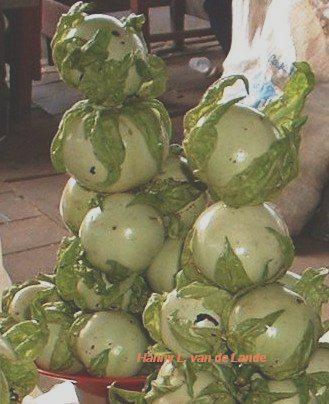
Suriname is a country in South America, about the size of Georgia in the United States, and one of Brazil's northern neighbors. Prof. H. L. van de Lande (h.vandelande@uvs.edu) biologist and plant pathologist, and department head of biology and chemistry at ADEK University, Leysweg/Paramaribo - shares a photo from the market in Paramaribo, along with information on garden eggs in Suriname, where they are known by the local Sranan Tongo name antruwa, and are also from the Solanaceae family (and thus related to eggplant, or aubergine), but it seems a different type, Solanum macrocarpon.
Interestingly, Ramon Finkie from the same university tells me that many Surinamese people descended from slaves originally from Ghana.
According to Prof. van de Lande:
"Antruwa is used in a variety of ways: as a vegetable, stewed with onions, sometimes pieces of salted beef, or with dry shrimps, or, as it is. it is also used in okra soup, or it can be cooked in water, and then some vinegar, sugar maybe some pieces of hot pepper added. It is then eaten as a side dish, pickled antruwa, mostly with a mixed rice dish, which we call moksi aleisi. Moksi aleisi (also the Sranan Tongo name) or mixed rice, can be very variable depending on who is making it; you can make all kinds . . . depending what ingredients (or, leftovers) you have available and in which cultural environment you were brought up. The mixed rice made by the Chinese is much different from the mixed rice made by the Javanese or by the Creole or by the Hindu people. But when one says: "moksi aleisi", then one generally refers to the mixed rice dish made by the Creole or the Negroes."
She further explains that "Sranan Tongo is the local Surinamese language, which is spoken by practically everyone; it can be considered the bridging language between all cultures and etnic groups. The official language is Dutch, which is spoken by the majority of people in Suriname. Still, especially older people in the rural area or in the interior speak either their language of their culture/ethnic group of origin (this can be the local Javanese language, different from the one in Java, Indonesia, the local hindi language which is again slightly different from Hindi in India, local Chinese, or the various languahges spoken by the descendants of the Maroon people or the differen languages spoken by the indigenous people, the Amerindians etc. etc. for all other cultural/ethnic groups."
I love all the Afro-Latin links I'm discovering during my stay in Brazil. Another day I'll share what I've learned about cassava/manioc in Suriname!
At TEDGLOBAL in Arusha, Tanzania in June, 2007, we launched the "Africa Cookbook Project," whose goal is to archive African culinary writing and make it widely available on the continent and beyond. A database is being developed and copies of hundreds of cookbooks are already being catalogued at BETUMI: The African Culinary Network. Google has offered assistance in eventually digitizing some of the information.
The enthusiasm and tangible support both at and after the conference is wonderful. Issa Diabate has already e-mailed that he's sending an Ivorian book, Dominique Bikaba that he's searching for one from DRC, and Jens Martin Skibsted has scanned the covers of several books in his collection. People have promised to send books from Angola, Mozambique, Zambia, etc. I'm thrilled that others recognize the urgent need to protect these books, whether for their value as a record of popular culture, social history, or, my specialty, culinary creativity.
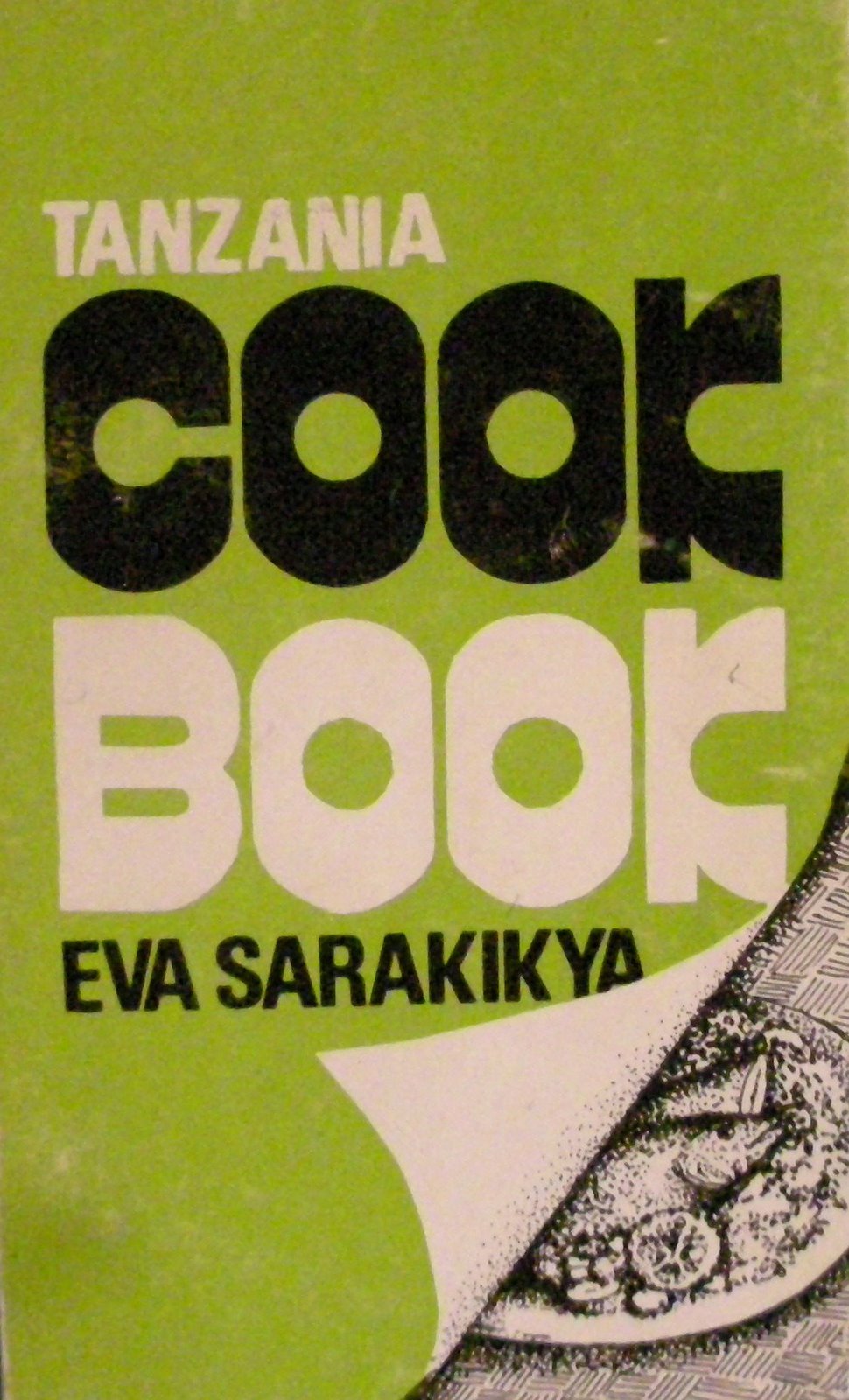
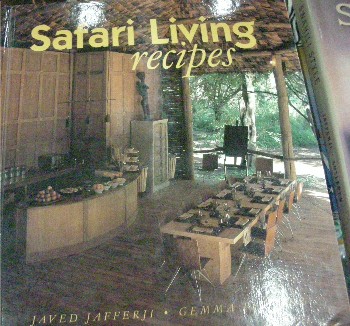
In an all-too-typical experience, I visited the gift shop at Ngurdoto Mountain Lodge and asked if they had any Tanzanian cookbooks. The staff were sure no such books existed, and were excited and surprised when I showed them Sarakikya's book: When I stopped in both gift shops at Kilimanjaro airport, they confidently showed me several glossy books published in Zanzibar like Safari Living, which showcased what I call "cuisine for Westerners," and were unable to produce a single "black Africa" cookbook. There's work to be done. Help spread the word, and also help us build up this data base and archive.