I returned from Brazil a week ago. We spent most of our time in the Central West region (Salvador in Bahia and Fortaleza in Ceará
) and the South East Region (Belo Horizonte in Minas Gerais). My only sadness is that I didn't have a chance to eat any feijoada while I was there. But, the myriad fresh tropical fruits, the seafood dishes, the cassava dishes, and, let's not forget the caipirinhas, mean I have no reason to complain.
I returned from Brazil a week ago. We spent most of our time in the Central West region (Salvador in Bahia and Fortaleza in Ceará
) and the South East Region (Belo Horizonte in Minas Gerais). My only sadness is that I didn't have a chance to eat any feijoada while I was there. But, the myriad fresh tropical fruits, the seafood dishes, the cassava dishes, and, let's not forget the caipirinhas, mean I have no reason to complain.

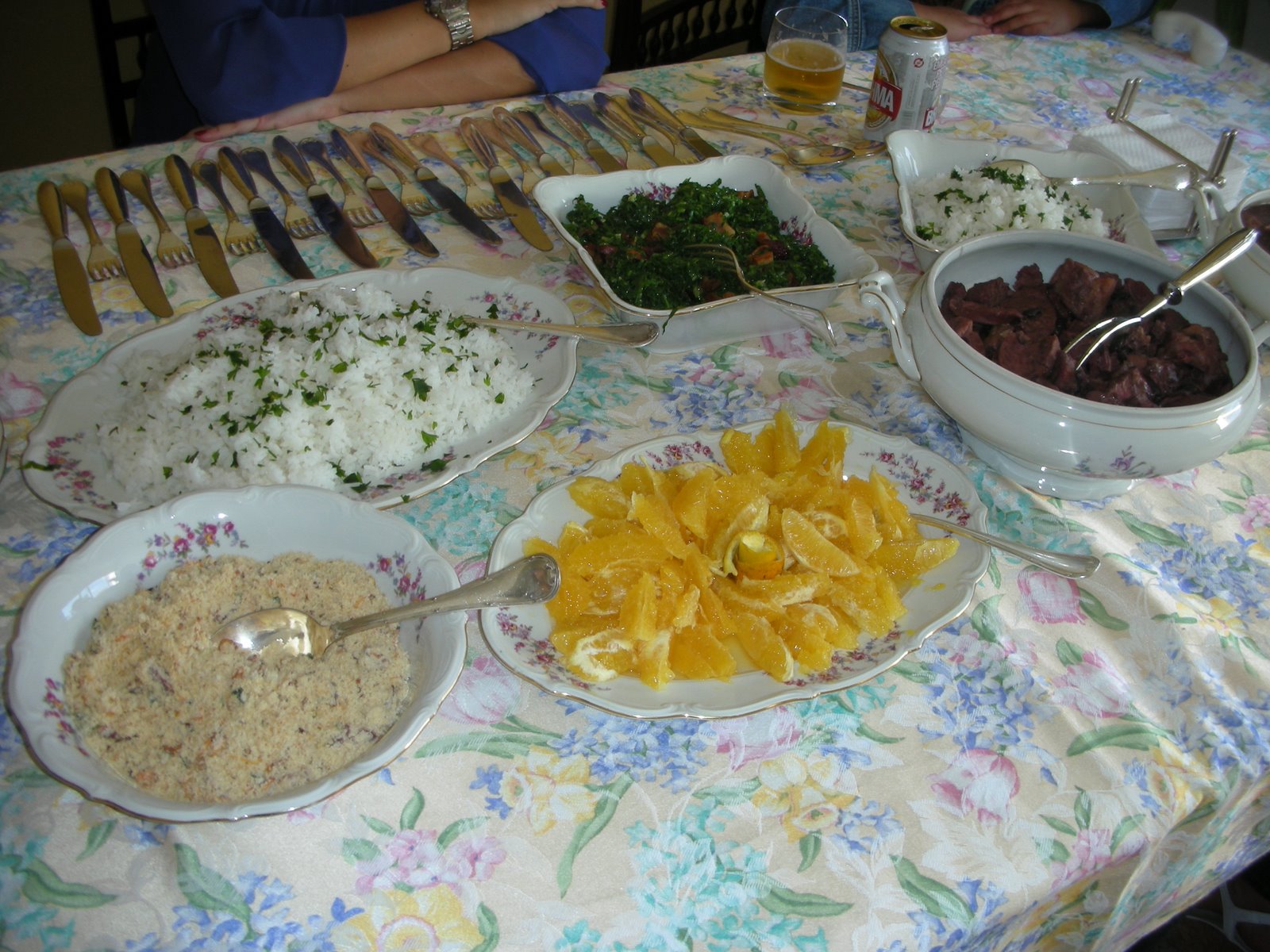
 milk. Ours were always served in traditional clay bowls. Sigh. . . A dish I think any West African would love: garlic, seafood, tomatoes, onions, coconut milk (or not). . . with a pot of hot pepper sauce on the side and a variety of side dishes always including white rice, and a form of farofa/farina de mandioca with dendê oil (palm oil), and/or vatapá, and cooked chopped okra. The 2 women above were gracious to allow me to take their photo at Yamanjá
restaurant in Salvador (thank you to Luciene Guirra and Josi Roberto). Incidentally, the history of Yemanjá
(or Yemajá), an orisha, African goddess of the sea, originates from Yoruba land and is fascinating.
milk. Ours were always served in traditional clay bowls. Sigh. . . A dish I think any West African would love: garlic, seafood, tomatoes, onions, coconut milk (or not). . . with a pot of hot pepper sauce on the side and a variety of side dishes always including white rice, and a form of farofa/farina de mandioca with dendê oil (palm oil), and/or vatapá, and cooked chopped okra. The 2 women above were gracious to allow me to take their photo at Yamanjá
restaurant in Salvador (thank you to Luciene Guirra and Josi Roberto). Incidentally, the history of Yemanjá
(or Yemajá), an orisha, African goddess of the sea, originates from Yoruba land and is fascinating. 

Of course, we also frequently enjoyed acarajé and seafood balls (codfish and crab), and on and on. . .


A final word about cassava (mandioca, yuca). In Brazil, we never stayed at a restaurant or stopped an at airport that didn't serve piping hot fresh pão de queijo, an addictive kind of cassava flour popover, or "cheese bread," originally a Minas Gerais specialty that is now popular throughout Brazil. I've been thinking for some time that it should be possible for Africans to make pão de queijo using cassava flour (kokonte, lafu). Brazilians actually often combine 2 types of cassava flour (one called polvilho azedo, (or "sour," because it is slightly fermented) and one called polvilho doce (or "sweet" because it is unfermented). I was able to find some of the first locally in our town, but have asked my husband (who returns from Brazil tomorrow) to bring me some if he has time, so that I can try several versions. There is a special type of cheese from Minas Gerais that is commonly used, but I'll use a substitute in the ones I try to make. I wonder about cheese in Ghana. . .wagashi? I'll let you know how my experiment works out.