Showing posts with label yuca. Show all posts

Sunday, June 02, 2013

Cassava: beyond tapioca pudding

In graduate school back in the 1980s, "cassava" was pretty much  a dirty word: empty calories, starchy, toxic, starvation/subsistence food, nutrient-deficient. etc. Not a food for the future, I was advised. Everyone seemed consumed by rice research and the "green revolution."

I vaguely knew there was an International Institute of Tropical Agriculture, based in Nigeria, that did something with cassava (aka yuca, manioc, mandioca), and had heard somewhere in Colombia there was a group (the International Center for Tropical Research) working with cassava, too. But this, anyway, was apparently unrelated to "cuisine."

How the times have changed. There is today a burst of enthusiasm about this tuber (and its leaves), both within African countries and around the world. Cassava is periodically featured in this blog. For example, I have written about the widespread consumption of  cassava in Brazil, and work of some of my colleagues to further respect for it. I have also included recipes using cassava flour, such as Brazil's popular pão de queijo as well as how to make cassava (yucca) dough or cassava (gari) biscuits.

Ghana is a huge wheat importer (estimated in 2010 to be about 270,000 million tons). Periodically, African governments encourage (or require by law) bakers to substitute cassava flour for part of this amount (e.g., in Ghana, in Nigeria, in Tanzania. However, there is still higher status attached to using (expensive) imported wheat flour, or using (expensive imported) rice (see my comments on Flora Nwapa's Cassava Song and Rice Song)

In 2001, an influential book was published, called The Cassava Transformation: Africa's Best-Kept Secret. The book challenged a number of myths about cassava, while also recognizing its growing importance in Africa and other parts of the tropical world. There have also been major research advances in improving varieties of cassava. Today cassava's image has been largely rehabilitated, and there is renewed interest in using it to replace part of the wheat flour commonly
imported into places like Ghana, Nigeria, or Tanzania. A few years ago I was delighted to see a factory near our house near Tema producing tasty Obama biscuits (cookies) from cassava flour.

I was reminded of the subject of cassava flour in May by a news announcement lauding one of Nigeria's former presidents, Obasanjo, on exporting cassava bread to Tanzania. I hope the rhetoric is matched by government and public support in Africa to raise the stature of cassava, not just for economic, but also culinary reasons.
 

Wednesday, November 02, 2011

Back from Brazil: Moquecas to Mandioca

I returned from Brazil a week ago. We spent most of our time in the Central West region (Salvador in Bahia and Fortaleza in Ceará ) and the South East Region (Belo Horizonte in Minas Gerais). My only sadness is that I didn't have a chance to eat any feijoada while I was there. But, the myriad fresh tropical fruits, the seafood dishes, the cassava dishes, and, let's not forget the caipirinhas, mean I have no reason to complain.
One refreshing aspect of Brazilian cuisine is that everyone eats some form of cassava (mandioca, yuca), where the root is not seen as a food only for poor people. Everywhere in Bahia and Ceará the restaurants served custom-made "tapiocas" as a matter of course (a kind of cassava flour crepe, that can be sweet or savory). Carne del Sol (salted, sun-dried beef) and mandioca frita ("cassava fries" aka aipim frita  or macaxeira frita) where the cassava is first cooked by boiling, and then fried, is popular, and most mornings simple boiled cassava was served as a side dish at breakfast in our restaurants. And of course, in Bahia and Fortaleza along the coast we ate fish (moqueca de peixe) and shrimp (moqueca de camarão) stews every chance we got. The moqueca is Brazil's answer to seafood chowder, and was usually prepared Bahian-style, enriched with coconut milk. Ours were always served in traditional clay bowls. Sigh. . . A dish I think any West African would love: garlic, seafood, tomatoes, onions, coconut milk (or not). . .  with a pot of hot pepper sauce on the side and a variety of side dishes always including white rice, and a form of farofa/farina de mandioca with dendê oil (palm oil),  and/or vatapá, and cooked  chopped okra.  The 2 women above were gracious to allow me to take their photo at Yamanjá restaurant in Salvador (thank you to Luciene Guirra and Josi Roberto). Incidentally, the history of Yemanjá (or Yemajá), an orisha, African goddess of the sea,  originates from Yoruba land and is fascinating.
Of course, we also frequently enjoyed acarajé and seafood balls  (codfish and crab), and on and on. . .
A final word about cassava (mandioca, yuca). In Brazil, we never stayed at a restaurant or stopped an at airport that didn't serve piping hot fresh pão de queijo, an addictive kind of cassava flour popover, or "cheese bread," originally a Minas Gerais specialty that is now popular throughout Brazil. I've been thinking for some time that it should be possible for Africans to make  pão de queijo using cassava flour (kokonte, lafu). Brazilians actually often combine 2 types of cassava flour (one called polvilho azedo, (or "sour," because it is slightly fermented) and one called polvilho doce (or "sweet" because it is unfermented). I was able to find some of the first locally in our town, but have asked my husband (who returns from Brazil tomorrow) to bring me some if he has time, so that I can try several versions. There is a special type of cheese from Minas Gerais that is commonly used, but I'll use a substitute in the ones I try to make. I wonder about cheese in Ghana. . .wagashi? I'll let you know how my experiment works out.

Monday, May 11, 2009

Recipe #3: Pot Luck Gari foto

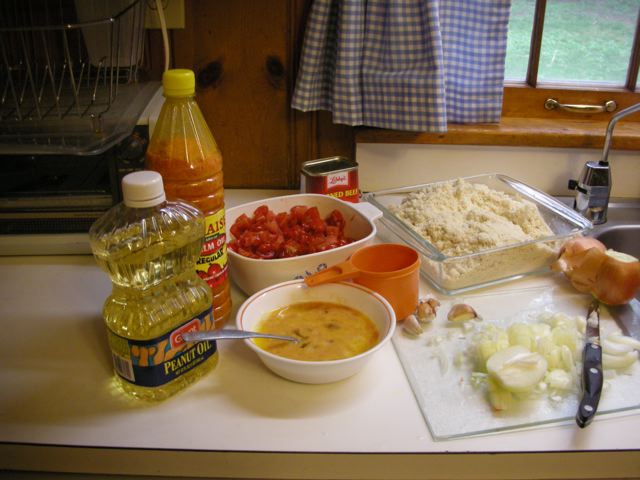
Last Sunday for a fellowship meal at church I made some gari foto (Americans would say "Gary PHOto") a one-pot dish that's hearty, quick and easy and inexpensive to prepare, and a new (but not too new--Ghanaian gari has a mild taste that is quite acceptable and accessible to North Americans) flavor combination. Basically, one whisks and cooks a couple of eggs as you would for Chinese fried rice, sets them aside and makes a simple stew of oil, chopped onions, garlic, ginger, tomatoes and red pepper (and, if you like, something like canned corned beef, or tuna or sardines, or any other leftover meat or fish; I imagine tofu would work, too), and mix it together with some gari that has been pre-moistened. If you are not near a market that sells African ingredients, locate one online that will ship it to you.

As I mentioned recently, gari is a form of cassava (aka, manioc, yuca) that has been soaked, grated, fermented, dried, and roasted to make a convenience food that is reminiscent of couscous and is gaining in popularity in urban areas of Western Africa. Gari is especially popular in Ghana and Nigeria. Another day I'll talk about a delightful cousin of gari from Côte d'Ivoire called attiéké.

Gari foto is also called gari jollof, and is similar to classic West African jollof rice, which is a one-pot stew and rice dish. The main difference is that gari foto is faster, since you don't have to wait for it to cook as you would rice. While it was once a humble end-of-the-week-leftovers dish, today it is just as likely to be served at dinner parties in Ghana.

I'm putting recipes up on this blog and hope you will try them out and send me feedback, but I've been advised that I should mention that each of these are original recipes and are copyrighted ;-) ©Fran Osseo-Asare, 2009

Basic Gari foto with Corned Beef (this is the way I most commonly make it)

1 onion, chopped
2 large fresh tomatoes, or 2 cups grape tomatoes, chopped (or 3 drained canned tomatoes, chopped), seeded if preferred
1/2 tin of canned corned beef (or about 6 oz., or 1 cup of any leftover fish, meat, or beans), in chunks
1 Tablespoon tomato sauce (optional)
6 Tablespoons of peanut or other vegetable oil
2 eggs, beaten
2 cups of gari
3/4 cup water
1/4 teaspoon salt
2 Tablespoons red palm oil (if available)
1 teaspoon fresh grated ginger (or 1/2 teaspoon dried ground ginger)
1/4 teaspoon ground red pepper (or to taste, or a little chopped fresh hot pepper)
parley for garnish, optional [that's a Western touch ;-)]
1 or 2 cloves of garlic, peeled and minced or pressed in a garlic press (optional)

Prepare ingredients: chop onion and tomatoes, grate ginger (if using fresh), peel and mince or press garlic (if using), open the corned beef can (if using), tomato sauce can (if using), break eggs in a bowl and beat well, measure out the gari in a separate bowl. Assemble other ingredients: oils, salt, ground red pepper, etc.
Measure out 3/4 cup of water and add a little (1/4 teaspoon) salt, and gradually sprinkle it over the gari, mixing it in with a fork (I usually just use my fingers so I can judge how wet it is). The gari should be dampened, but not dripping wet. Let the gari sit while you prepare the eggs and stew.

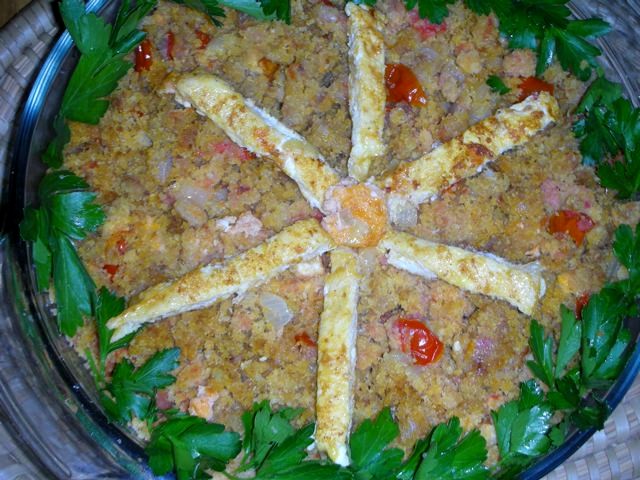
For a fancy version, you can fry a little of the chopped onion in a tablespoon of peanut or other oil, then mix a tablespoon of the tomato sauce into the beaten egg, and fry it as you would an omlett, then cut half of it into strips to garnish the finished gari foto (I usually omit this step for family meals, and just basically scramble the eggs and set them aside to break up and mix into the gari foto after mixing the gari in with the stew.)

After removing the eggs from the pan (I use a heavy cast iron skillet, but any heavy pan or pot will work), add the 2 Tablespoons red palm oil (this is called dende oil in Brazil, and there's a special spiced red palm oil from Ghana called zomi, if you can get it) and 1/3 cup, or 5 Tablespoons, peanut oil (or any other vegetable oil you like. Some Ghanaians have started using imported olive oil in cooking because they hear it is healthier, but that is not the traditional flavor). You can adjust the proportions of palm and peanut (or other oil, like canola) to taste. I usually use a light hand with the palm oil for those unfamiliar with it.

When the oil in the pan is hot, add the chopped onion and saute it until it is clear, then stir in the corned beef, if using. It will disintegrate as it cooks, which is good. After a minute or so, add the garlic, then the tomatoes, ginger, and red pepper. If you are using half of the egg mixture to garnish the dish keep it aside, then break the rest into small chunks, and stir into the stew. If you do not wish to garnish, add all of the egg into the stew. Turn the heat to low and mix in the gari mixture, using a fork to break up any lumps of gari. Keep turning it until the stew saturates the gari and there are no dry white (or yellow) lumps of the gari. Add salt to taste.

If desired, garnish the finished dish with fresh parsley and decorative egg strips.

Hints: Gari foto may be eaten alone or with a vegetable side dish, with a pepper sauce, or may be accompanied by a red bean stew.
A couple of teaspoons of dried ground shrimp may also be stirred in with the other seasonings to give it a distinctive West African flavor.
If you are leery of grating and chopping fresh hot pepper and/or ginger, just throw them into a blender with a little water and blend them together to add them. Remember that the more membrane and seeds you include from any hot pepper, the hotter it will be. I recommend using ground red pepper to have more control over the heat of this dish, which is usually not served spicy.

Enjoy.