Wednesday, July 06, 2011

Reflections and Recipe #75: Lovely Light Soup With Goat

Hello, my friends:
I've been a woman with a mission these past 3 weeks as I've pretty single mindedly spent it in the kitchen (I've even moved my computer, camera, and printer in here).

I stopped to take stock today to re-evaluate my to-do list. Sigh . . . There are still over 50 recipes I want to include. I have 9 more days blocked out to work on this before "real life" intrudes on me again and my writing retreat ends. Tomorrow my nephew-son Sam returns to State College, bringing me Ghana yam and toasted corn flour, and you can expect to see recipes (and photos) of yam oto, yam chips, and coated yam (aka yam "French toast"), aprapransa (akplijii), versions of kaklo, and some more porridges.

Other recipes I plan to include: baked and roasted things like domedu (roast pork), or roast chicken, gari "biscuits," banana, peanut, and coconut cakes, and a number of combination and other soups and stews, e.g., bean and palmnut, groundnut [peanut] and palmnut, Fante-Fante (fresh fish soup), kontomire soup, okro soup, dried vegeatable soup, agushi soup, and maybe  hibiscus or sour sop soups, garden egg stew, egg curry, and groundnut stews with condiments. Of course, kenam (seasoned fried fish), plus more snacks and appetizers: squid and octopus, cheese straws, sugar cane. Other versions of jollof rice (corn, meat), kpokpoi (the Ga festival dish), and kotokyim (crabmeat stew), maybe an avocado and shrimp salad, acheke (aka attieke, a kind of cassava couscous). . . There are several Northern Ghana dishes I'd like to include, but the lack of ingredients may preclude that: wasawasa (steamed dried yam), ayoyo soup with Guinea fowl (made with Tossa jute leaves) soup, benisi (a cowpea leaves, millet, and shea butter dish). . .You get the idea.

Before I begin to despair, I'm going to stop and make some simple, satisfying light soup with goat (accompanied by fufu) for dinner.  As I've said elsewhere, this is the first soup I learned to make in Ghana when I was in my early 20s. It's still hard to beat. Basically, it's a basic vegetable stock which also includes goat. I was thrilled to discover goat meat in the freezer section of our local grocery store last week. Here's an adaptation of Flair Catering's version.

Recipe #75: Lovely Light Soup With Goat

Assemble ingredients.

To season  
1 pound of goat meat cut into chunks, bone in:
  • ~1 teaspoon of peeled, fresh grated ginger (about an inch to 1 1/2 inch)
  • 2-3 cloves of garlic, crushed
  • 1/2 teaspoon of ground aniseed (sekoni) or other seasoning of your choice
  • 1 heaping teaspoon of no-salt seasoning of your choice (I'm using Mrs. Dash garlic and herb; many Ghanaians would likely use a couple of seasoning cubes)
  • 1/2 to 1 teaspoon of ground dried red chili pepper
  •  1 teaspoon salt (or to taste, or substitute seasoning salt)
  • 2 small bay leaves
  • 1/2  cup onion, chopped
  • 3 whole kpakpo shito, whole, if available and (if not, substitute your choice of pepper(s), top(s) sliced off (about a tablespoon), or omit altogether
Put the goat meat in a soup pot and season it with the above ingredients. Stir the goat meat well, and add 1/2 cup water to the pot. Cover, bring the water to a boil, lower the heat to simmer while you prepare a second pot with:
  • ~4 oz of washed tomatoes, whole (1 large or 2 small-to-medium. I used 4 small Campari)
  • ~4 oz of peeled onion (about 1 medium)
  • Fresh whole red chilli peppers to taste (probably 1 to 3, depending on type and heat), tops cut off, and seeded if you like
  • 4 cups of water
Bring that water to a boil and simmer 10 or 15 minutes until the vegetables are soft, then remove grind them together (in a blender or an asanka) and return them to the water in the second pot, along with 4 more cups of water. Stir in 1 tablespoon of tomato paste, let it simmer a few minutes, and add the broth to the meat. Let the soup simmer until the goat meat is tender, then remove the goat meat and, for a nice clear soup, strain the broth through a sieve, into the  using a spoon if necessary to help force some of the ground vegetables through the sieve (scrape the underside of the strainer with a spoon). Return the meat to the pot and adjust the seasonings (salt, onion, tomato, pepper, etc.) to taste. This may need to simmer for a couple of hours: goat meat tends to be tougher than beef. Add a little more water if necessary.

To simplify this recipe, grind the vegetables (tomatoes, onion, pepper) at the beginning and add them to the meat pot, along with 8 cups of water. Barbara insists that the best flavor is obtained if you first allow the goat meat to simmer for 15 minutes before adding the vegetable broth.

There are many variations of this recipe: you can cook some eggplant or zucchini in a saucepan, then blend and add it near the end for a thicker soup; or you can add many other vegetables like okra or mushrooms, or other herbs or seasonings.

This version is hard to beat. No added fats, either, it's the original "lite" soup. I'm going to enjoy mine with some fufu. Ahhhhhh! This should be called "Goat Light Soup for the Soul."


Wele update: Many Ghanaians love to chew wele (smoked cow hide), and it is often included in soups as a delicacy. However, it's one of those acquired tastes I never acquired. I notice that some concerns about using wele, however (like the now-banned  turkey tails) that are emerging.


Tuesday, July 05, 2011

Recipe #74: Savory Pastry Chips

Today's recipe, savory pastry chips, is a popular party snack in Ghana. When we made these at Flair Catering we used a pasta machine, but you can make them fine at home without one. Also, we fried them, but by adding a bit more margarine or butter, you could also bake them.

Assemble ingredients
  • 1/2 lb (8 oz) flour (that was about 2 2/3 cup unsifted for me)
  • 1 oz margarine (or butter or butter-flavored shortening)
  • 1/4 teaspoon dried ground red pepper
  • 1/4 teaspoon white pepper
  • ~ 1 teaspoon salt
  • 1 teaspoon fresh ground garlic (1 or 2 cloves, peeled)
  • 1/4 cup (4 Tablespoons) ground or finely grated onion (roughly 1/2 small onion)
  • 1/2 teaspoon baking powder
  • l or 2 bay leaves to season the oil 
  • about 5 cups of vegetable oil
  • 1/2 cup of cold water
  • extra flour for rolling out the dough
If you do not have a pasta machine, you'll need a rolling pin.

Directions:
  1. Sift the flour into a large bowl, then rub or cut the margarine or butter into it (I use my hands, or two table knives), add  the 1/4 teaspoon red pepper, the 1/4 teaspoon white pepper, 1 teaspoon salt, mixing all together until it looks like cornmeal. 
  2. Prepare the garlic and onion and add to the dough, mixing some more. I blended mine together in a blender, and added a teaspoon of water to help blend it. (NOTE: I should have added about a tablespoon).
  3. Add the 1/2 teaspoon baking powder and continue mixing.
  4. Measure out 1/2 cup of water. Sprinkle a few tablespoons of water over the dough in the bowl and mix it in with a fork. Push the moistened flour to the side and add a little more water (a couple of tablespoons), mix and push to the side of the bowl. Continue adding the water until the dough is just wet enough to hold together. 
  5. Knead the dough lightly in the bowl for half a minute.
  6. Divide the dough into 2 pieces, and roll one out to about 1/8: thick on a lightly floured surface. (If you have a pasta machine, simply cut the dough into sizes that will fit into it). I usually wet my counter with a little water and put waxed paper on it, then sprinkle the waxed paper with a little flour. This makes cleanup easier.
  7. Gently fold the dough on top of itself several times, then cut it into strips about 1/8 to 1/4" wide (the thinner, the crisper).
  8. Unfold the dough, and cut the strips into pieces (mine were about 1 3/4" long). You can also cut them into many tiny squares if you prefer.
  9. Heat about 5 cups of oil to about 260 degrees F in a deep fryer or in a heavy pan or pot on the stove, depending on the size of your fryer or pot, and making sure not to overfill it.  Season the oil with a bay leaf or a couple of slices of onion. Remove the leaf or onion before it burns.
  10. Add the strips (or squares) carefully into the pot. I put a couple dozen at a time on a slotted spoon and added them, stirring the oil occasionally while they cooked.
  11. Within a few minutes, when they are a light golden color, they are ready to remove and drain. The chips should not be as dark as  doughnuts or atwemo. Cook smaller squares separately from the strips. They will cook in just a minute or two. They should be nice and crunchy when they cool.
These chips can be frozen, or stored tightly covered in an airtight container for up to a week.
When doubled, this recipe is easily enough for 12 people.At Flair they often serve these chips with plain peanuts or coated groundnuts in small cocktail baskets set around the room. After you make this once, you can decide if you want to increase the salt, pepper, onion, etc. next time.

My grade on this recipe: If I were to give myself a grade on my execution of this recipe today, I'd probably give myself a B+. Why? First of all, I grabbed "white"whole wheat flour from the cupboard instead of the white unbleached flour I meant to, so the color is not quite right, and they're heavier and a bit drier than they should be. Secondly, I forgot to add (and then remove) the bay leaves to the oil after I heated it and before I added the chips. It's missing that subtle seasoning touch. Finally, when I blended the onion and garlic in the blender, I didn't add enough water to make a smooth paste so there are bits of onion visible in the finished chips. Still, the chips taste fine.

Pineapple flour: last week when I was making pineapple juice, I tossed the pineapple core in the blender and blended it, then put it in a saucepan over a very low heat trying to dry it to see if I can make my own pineapple flour. (Not only do I not have a pasta machine, and I don't have a dehydrator, either). That didn't work, so today I scraped out the pineapple dregs from the pan and put them on a plate outside to see if they would dry that way. I'll let you know if it ever gets dry enough to grind it again. However, I can see at best I'll only get a couple of tablespoons of flour. . .

Update on the corn dough effort: Yesterday I mentioned that I was going to try soaking some hominy corn overnight, and then try to make my own fermented corn dough using that. Today I rinsed off the corn. I ended up with about 2 3/4 cups of soaked corn. In order to blend it, I had to use a little over a cup of water (about 1/2 cup water to each cup of corn). It's much wetter than normal corn dough. I poured the mixture into a glass pitcher that I've covered loosely. I'll keep you informed. I hope it begins bubbling and fermenting by tomorrow.


Monday, July 04, 2011

Recipe #73: Palaver Sauce--2 versions

I often hear "Palaver Sauce" called "Nkontommire (Kontomire) Stew" or "Spinach Stew." This confuses me, as in my mind, "Palaver Sauce" often contains both beef and (usually smoked) fish and agushi (melon seed), whereas "Nkontommire (cocoyam leaf) stew is a less complicated version. Of course, as always, there are numerous recipes for either of these, so you should feel free to adapt the recipe to satisfy yourself, including creating vegetarian versions. Just be sure your recipe contains plenty of greens.

There are many stories of how the stew came to be called "Palaver" sauce. My best bet is that it comes from the Portuguese word meaning "word," or "speech," or "talk," palavra. While today's meaning of the word in West Africa is that there has been some kind of trouble arising from an argument, in earlier days it meant "a parley between European explorers and representatives of local populations, especially in Africa."

This is consistent with Alba Kunadu Sumprim's interpretation at her site, The Imported Ghanaian: ". . . when the Europeans came to Ghana and met with the chief in Elmina to negotiate trade, the food served at that Palaver - Nkontommire - took on its name."

Here are two ways to make it in the U.S. True-blue Ghanaians will see that I have unabashedly omitted the seasoning momoni lightheartedly described by Esi Cleland at her delightful "What Yo' Mamma Never Told You About Ghana" blog.)

Recipe #73: Palaver Sauce (time-saving version)

  • 1/2 pound of stewing beef, fat trimmed and cut into 1/2-inchcubes
  • salt (begin with 1/2  teaspoon; smoked and salted and dried fish and shrimp add quite a bit of saltiness and you can always add more salt at the end)
  • 1 cup water
  • 2 onions (or substitute part or all with scallions), chopped to get about 2 cups
  • 1/2 cup palm oil (traditional, dzomi if available, or other vegetable oil like peanut or canola; I often blend palm oil with another oil)
  • 1/2 pound fresh or frozen fish fillets (e.g., cod or haddock)
  • 2 10-oz packages of frozen greens (spinach, nkontomire, collard, kale, etc) OR  greens (several bunches, or a couple of pounds before preparing) Today I had spinach, collards and kale in the house.
  • 1 cup fresh grated tomatoes (or a 16 oz can of chopped tomatoes)
  • 1/4 cup tomato paste
  • fresh hot pepper or dried ground red pepper, to taste (begin with a small amount, like a teaspoon, and add more to taste)
  • 1/2 to 1 cup of ground agushi (OR pumpkin seeds)
  • 3 cloves of fresh garlic, pressed or minced
  • 8 oz of smoked/dried fish (whatever is available, such as smoked whiting (NOTE: substitute smoked ham cubes or turkey if smoked fish is not available). Today I had smoked mackerel and smoked whiting
  • 1Tablespoon of dried ground shrimp if available (optional). NOTE: Ghanaians would likely use this more liberally.
  • a small piece (~ a square inch) of salted codfish (optional)
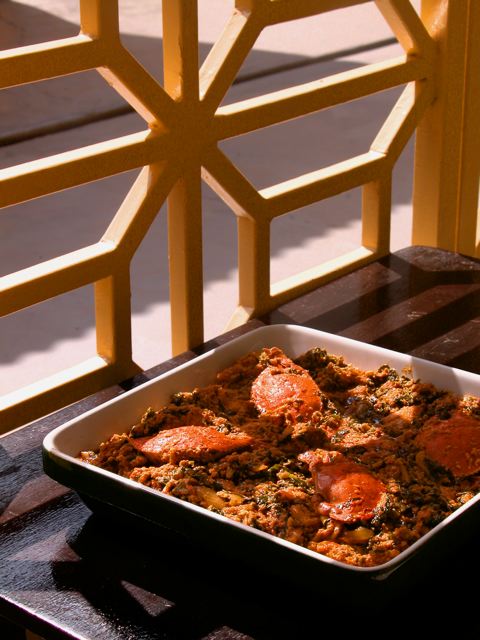
NOTE: When we prepared Palaver Sauce in Ghana, we included 4 soft-shelled crabs, as in the picture above. In Central PA these are very expensive, and I usually do not use them, but if they are available, feel free, or substitute shrimp in their shells!
  1. Wash and prepare the greens (see suggested directions for nkontommire). If using frozen greens, defrost and remove excess water using a strainer. You can save the water to use later in place of water anywhere in the recipe.
  2. Peel and chop the onions or scallions, de-seed and grate the tomatoes if you are using fresh, and discard the seeds and peelings. It's a good idea to remove the seeds with the tomato over a strainer resting in a bowl so that you can later add the tomato juice without the seeds to the grated tomato), peel and grate the ginger, and prepare the fresh red pepper (if using), and garlic cloves.
  3. Cut the meat into 1/2 inch cubes and add to a large pot with salt and 1 cup water, 1/4 cup of the onions, and  the ginger, garlic and red pepper. Bring the water to a boil, then lower the heat, cover and steam for about 10 minutes to tenderize and flavor the beef.
At this point, there are 2 approaches to making the palaver sauce. The first, and easiest, is simply to add the rest of the onion, the tomatoes, tomato paste, pepper, the fresh fish, (frozen is okay, but cut it into chunks) and the salted cod, if using, and let it cook together a few minutes, then add the chopped greens, stir well, and let the mixture simmer, covered, for 15 minutes. As the sauce simmers, prepare the smoked fish (If you are like me, you'll remove the head, skin and bones, but suit yourself). Stir them into the pot, and let it simmer, uncovered, while you prepare the agushi as described for recipe #70 (or pumpkin seeds). Aften pouring in the melon seeds, let the pot simmer covered for 10 minutes without stirring, then uncover, mix and taste and adjust the seasoning, and let it simmer until most of the water is gone. This stew is good the same day it is made, but also good reheated and can be frozen, too.

The second way, the way we did it in Ghana at Flair, was the classic way to make it, where some of the ingredients are fried separately and then mixed together.


Palaver Sauce (Version B: Classic Fried Version)
  1. Cook the greens separately in a half cup of boiling water for about 5 minutes, then drain the greens and keep the cooking water to use later as needed. 
  2. Season and steam the meat as in version 1 above, for 10 or15 minutes. Discard the onions and any chunks of chili pepper you have used if you wish.
  3.  Add the oil to a large frying pan or pot, along with a few slices of onion or a couple of bay leaves and fry them on medium until they are brown (this seasons the oil, then remove the bay leaves or onion).
  4. Stir in the  remaining onion slices and the salted cod, if using, and cook for about 10 minutes on medium heat. Stir in the tomato paste, along with 1/4 cup of water (use the water from cooking the greens) and cook, stirring constantly, for about 3 minutes before adding the fresh grated or chopped tomatoes. Add the meat that was steamed, along with any juices remaining in the pan (use a little of the water the greens were cooked in to rinse out the pan).
  5. Add the ground dried shrimp if using them (this would also be the time to add any cleaned crabs or shrimp if you would like to use them). Stir in the smoked fish in small pieces.
  6. Mix the ground seeds with an equal amount of water, then add to the stew. Allow it to set for 5 minutes, then stir and adjust any seasonings.
It was at step 6 today that I discovered that  I had barely 1/2 cup of melon seeds to thicken the sauce, and I wanted a thicker sauce. In a pinch, you can substitute a couple of beaten eggs (or even a cup of canned refried beans, or cooked, mashed beans, or a cup of cooked pureed eggplant). I simply added a tablespoon of water to a beaten egg, and added both the liquids to the stew at the same time, let it cook covered for about 10 minutes without stirring to set, and then mixed everything in and let the sauce simmer a few more minutes. It needed a little more red pepper, so I sprinkled in some dried red pepper.

The resulting stew provides a friendly mix where a lot of interesting ingredients get along very well together without any palaver: a sauce to  enjoy with yam, potatoes, rice, or whatever starch you prefer. And now it's time to eat.

Preview:
Today I decided to try again making my own fermented corn dough. I put some hominy corn on to soak, and I'll try tomorrow or the next day to grind it. Certainly I could use white Indian Head Stone Ground corn, but the flavor is different when using kernels.


Saturday, July 02, 2011

Holiday Drinks: Recipe #71: Watermelon Juice and #72: Pineapple Juice

Last night I started experimenting making some cassava cookies (biscuits). I still need to work on that recipe, and intended to do so today, but it's turned out to be too hot to turn on the oven. I don't have air conditioning ;-)

Instead, I decided to whip up some refreshing homemade juices using watermelon and pineapple. These are great fun and easy recipes for families with children home for the summer. You can teach them that juice doesn't grow in cans and cartons. It comes from real fruit! 

Recipe #71: Watermelon Juice

It's the 4th of July holiday weekend in the U.S., and watermelons are on sale everywhere. I came home from the grocery store, hot and thirsty, and realized what I wanted was some  cold watermelon juice. It's a cinch to make. Just cut up 4 cups of seedless watermelon (only the edible part, of course)  and put the chunks in the blender, then pulse it until everything is blended (turn it off and push down the pieces once or twice with a spoon if you need to get it started), then set a strainer over a bowl, line it with a folded cheesecloth (if you don't have one of these, you really ought to get one), and pour the pureed melon through the cloth, picking up the ends and twisting them to force the juice through the cloth. You could probably try using a tea strainer, but the cloth is very easy, and you can twist to get all of the juice out.

Watermelon juice is a lovely color, naturally sweet (but not too sweet) and exceedingly refreshing. It's one of the best kept secrets around. I don't know why more folks in the U.S. haven't discovered it yet. (Note: If you use a watermelon with seeds, you'll have to pick them out before you blend the melon.)

Enjoy!


Recipe #72: Pineapple Juice


Pineapple juice is a bit harder to make than watermelon juice. That's the reason I'm much more likely to use it in smoothies where you do not need to remove the pulp. However, the difference between homemade pineapple juice and store-bought is similar to the difference between homemade orange juice and even the so-called "fresh squeezed" juice in cartons.

If you haven't cut open a pineapple (in the U.S. I buy the golden pineapples; in Ghana I go for the "sugar loaf" or "Cape Coast" pineapples), I generally cut the top and bottom off to make it flat, then set it on end and cut the outside peeling all the way around. I leave some of the "eyes" in the pineapple so that I don't cut too much of the fruit away, and then cut the eyes out. Then I cut the pineapple from the top to the bottom into quarters, and cut the core out from the center. 

Follow the same directions as in making the watermelon juice: cut or break it into chunks, put them in the blender, pulse and pour through the cheesecloth over the strainer. Perhaps I should have blended mine a bit less, because this was much more difficult to strain than the watermelon. It made me think of milking a cow as I twisted the cheesecloth because it sometimes squirted out at me. Plus, I had to pour the already strained pineapple juice through a tea strainer to get it clear. BUT, the flavor was fabulous.

Hope you enjoy these. The fresh grated cassava cookies in the photo above are a work-in-progress. I'll update you on them soon, as well as a gari version.


Friday, July 01, 2011

Recipe #70: Agusi Frowee (melon seed) Stew with Fish

I have referred several times in the past to nutritious, delicious agushi (aka agusi, agushie, egusi) seeds.Today's recipe is a classic stew that combines the seeds with fish. There are, of course, other versions using meat or poultry, but this is my favorite.

I'm posting 2 versions of the same recipe: one is a richer, more nuanced, and expensive version. It uses salted cod, smoked fish, real agusi seeds, fresh tomatoes and peppers and palm oil; the other, is faster, cheaper, and lighter and uses canned tomatoes, canned fish, dried pepper, pumpkin seeds, and peanut (or canola) oil. Take your pick, or combine elements of each in your preferred version. The green seeds in the photo below are the pumpkin seeds, the white ones the agushi seeds

Let's begin with the slightly more complicated, fancier one.

Recipe #70: Agusi Frowee (melon seed) Stew with Fish

Version 1: Assemble ingredients
  • 4 oz agushi seeds (about a cup), ground or unground
  • 7-8 ounces of smoked fish (I'm using smoked whiting today), after bones and skin are removed
  • 2 good-sized ripe tomatoes (plus a Tablespoon of tomato paste if you like)
  • 1/2 cup (4 ounces) of palm oil (dzomi if available)
  • a small piece of salted cod (about an inch cube, about 1/3 of an ounce), or koobi (salted tilapia)
  • 1 large onion (about a cup, chopped)
  • fresh red pepper to taste
Prepare the ingredients:
  1.  If the agushi is not ground, grind it in a blender. Mix it with a cup of water and set aside until later.
  2. To remove some of the salt, I rinse and soak the salted fish in hot water while I prepare the other ingredients.
  3. If the fish has bones and skin remove them and discard.
  4. Peel and chop the onion.
  5. Prepare the pepper and garlic (I grind mine together in a blender with about a Tablespoon of water). You will need to judge your preference for heat. You can always adjust the heat later by adding more ground dried red pepper later.
  6. Chop the tomatoes (if you want to be extra fancy, peel and seed them first--drop in scalding water, then cold, to remove the peelings, and grind them in a blender). Mix in a Tablespoon of tomato paste if you like.
  7. Heat a heavy frying pan on the stove top, add the oil and chopped onions, stir well, then add the salted fish.
  8. Fry together on medium heat for several minutes, then add the pepper and garlic and cook a couple more minutes, then add the tomatoes and tomato paste.
  9. Stir in the smoked fish.
  10. Stir the agushi to see that all of the lumps are gone.
  11. Stir the agushi-water mixture into the stew, lower the heat, then cover and allow it to simmer, without stirring, for half an hour.
  12. The cooked agushi will look a little like scrambled eggs.
  13. If you're like me, go ahead and skim off any oil that has risen to the top (or just stir it back into the stew) and check the seasonings. Add some dried red pepper if it isn't spicy enough for you. I cannot imagine it needing more salt, but add some if you must.
This stew goes well with rice, ampesi (plain boiled starchy vegetables like yam, potatoes, plantains, banku, or kenkey. (Note: You can search Betumiblog for recipes for banku and kenkey).

Here is the second, lighter, cheaper, and faster version:

Version 2

Assemble the ingredients:
  • In place of the smoked fish, substitute a 15 oz can of mackerel
  • In place of the agushi substitute raw pumpkin seeds
  • In place of the fresh tomatoes, substitute tomato puree (a cup), OR 2 or 3 Tablespoons of tomato paste mixed with a little water OR a small can of tomato sauce
  • simply slice, rather than chop, the onions
  • Do not bother soaking the salt fish
  • In place of the palm oil, substitute any white oil like canola or peanut of safflower (I avoid olive oil because of its distinctive flavor) and reduce the amount to 1/4 cup (2 oz)
  • In place of the fresh hot peppers, substitute dried ground red pepper to taste (about 3/4 teaspoon to begin)
  • Omit the garlic

Follow the same basic steps as above, omitting any steps unnecessary due to using already processed ingredients:  grind the pumpkin seeds,  mix with a cup of water in a small bowl, chop the onion, open the can of mackerel. Heat the oil in a frying pan on medium heat and add the onion and salt fish. Cook a few minutes, then add the tomato puree (or paste, sauce), cook a couple more minutes, then add the canned fish and dried red pepper. Stir the water-pumpkin seed mixture into the stew, lower heat and cover and allow to simmer for 30 minutes without stirring.

My nephews Sam (left) and Ernest (right) stopped by at the beginning of this 4th of July holiday weekend, and sampled both versions. I topped some leftover coconut rice with the stew, and steamed a little fresh spinach on the side.

Sam added salt to the first version; Ernest found it a little too salty. Ernest added red pepper flakes to his; Sam found it spicy enough.

Both found either acceptable, but preferred the richer version (as do I).  Sam said of the second one "This is lighter. Americans will love it."


    Thursday, June 30, 2011

    Recipe #69: Spicy Coated Groundnuts (Peanuts)

    Are you tired of those same old party peanuts? Here's a way to wake them up!

    While in the U.S. we're most likely to coat peanuts with something sweet (see recipe #44, "Groundnut Cakes), here is a savory peanut snack/appetizer recipe from Ghana. The hardest part of this may be to locate raw unsalted peanuts with their skins still on. I finally found some at a health food store. Perhaps one could substitute raw peanuts without their skins, but my guess is that the batter would not stick to the peanuts as well.

    Recipe #69: Spicy Coated Groundnuts(Peanuts)

    Assemble the 9 ingredients:

    Batter:
    • 8 oz flour (1 1/2 to 2 cups unsifted)
    • 3 teaspoons ground dried red cayenne pepper
    • 1 teaspoon salt, more or less to taste (whoops, I forgot that in the picture)
    • 1/4 teaspoon white pepper
    • 1 teaspoon baking powder 
    • 1/4 cup evaporated milk (plus enough water to make the batter thin enough to coat, about 4 Tablespoons)
    • 2 eggs
    Also:
    • 1 pound (16 oz) shelled raw unsalted peanuts with their skins on (about 3 cups Spanish peanuts)
    • vegetable oil for deep-frying (I prefer canola)
    1. Add several cups of vegetable oil to a deep fryer, if using, or to a deep heavy pan. Do not fill either over half full. Heat the oil to around 360 degrees F while you make the batter (this would probably be between medium high and high on my stove top if you're frying them in a pan on the stove).
    2. Sieve (sift) together the 4 dry ingredients (flour, peppers, and salt) into a large bowl. 
    3. In a separate bowl, use a fork or wire whisk to beat together the eggs, shake the can of evaporated milk, then open it and add the 1/4 cup, and mix.
    4. Here is the first tricky part: add the liquid to the dry ingredients to make the batter, mixing well. At this point, you'll have to determine if the batter is too thick to mix the peanuts into without clumping. Add water or more milk, a tablespoon at a time, until it is thick enough to coat the peanuts, but not watery.
    5. Put a spoonful of batter into a small bowl, and mix in an equal amount of groundnuts.
    6. Here's the second tricky part: I've done a fair share of deep-frying, but I found it impossible to get the peanuts into the mixture to cook individually any way but by putting them in that way. I ended up scooping a spoonful of coated peanuts onto a long-handled spoon over the fryer, then using a knife (also with a long handle), to tap each peanut into the oil, being careful not to splatter myself. When the nuts are in the oil, stir them constantly with a long-handled metal or wooden spoon to make sure they brown evenly. As soon as they turn quite brown (the browner are they, the crispier they'll be, but being careful they do not cross the line to burned), remove with a slotted spoon and drain them on paper towels or paper.


    A perfect snack to eat while sipping a nice cold Star or Club beer (sigh, none here in central Pennsylvania), or some fruit juice, bissap (aka sobolo),  ginger beer, or iced tea. If it were winter here in Pennsylvania, they'd also go well with a hot drink like coffee.The hot oil somehow steams the peanuts so they're still chewy, but the crispy, spicy coating gives them a kick. I'd eat them soon after making them.
    NOTE: I did try frying some of the peanuts in clusters, but they seemed soggier rather than crisper. I'd stick with frying the nuts individually.


      Wednesday, June 29, 2011

      Recipe #67: Groundnut soup with chicken and Recipe #68: Ghana's benne (sesame) soup

      One of the most popular recipes I'm often asked to prepare is groundnut soup (or stew). Rather than repeat that recipe here, I'll refer you to a version I provided for African Diaspora Tourism: Recipe #67: Groundnut (peanut) Soup with Chicken. While I adore this wonderful, creamy soup, in today's allergy-sensitive world,  peanuts are often not welcome at community gatherings. In such a case, sesame soup would make a wonderful substitute. I'm amazed I've never seen an online (or published) version of it anywhere.  Perhaps it has another name I'm not familiar with? Sesame, aka "benne," is originally from Africa and has a fascinating history.

      Yesterday I began describing how to make the sesame soup popular in Northern Ghana. I told how we went to the market and bought our ingredients, and how labor intensive it was to prepare the guinea fowl. Today I'll simply (emphasis on simply) substitute Cornish game hens. If you can get the real thing, or pheasant, it would be even better. Or else, use a roasting chicken.

      To obtain our sesame paste in Tamale we searched the local market unsuccessfully for the 2 types of sesame seeds my guides wanted, but settled on 2 other varieties. We washed the dust off, dried and toasted them, then pounded them to paste in a mortar. When I tried duplicating that process (twice) using my coffee grinder and/or blender, I was unsuccessful: I burned up the motor in my coffee grinder, and the blender, even with the addition of sesame oil, was not up to the task of grinding the seeds fine enough. Without the stamina to pound the seeds, I've substituted tahini.
       
       
       Recipe #68: Ghana's Benne (Sesame) Soup with Guinea Fowl (or Cornish game hens)

      Assemble the ingredients:

      1.  Fowl (I'm using 2 Cornish game hens, around 4 lbs, total)
      2.  1.5 teaspoons salt, or to taste
      3.  1 cup of tahini (or less if you prefer)
      4.  3 - 4 cloves of garlic
      5.   About  2-inch chunk of fresh peeled ginger
      6.  1 onion (about 1 cup, red, if available)
      7.  About  4 habanero, or other milder chile peppers, seeded and membranes removed, if desired. (When ground they should make about  1 Tablespoon of pepper paste).  Americans use milder chile peppers, remove seeds, etc.)
      8.  6 small-to-medium tomatoes (or about half a large 28 oz can of tomatoes; I imagine this might also be a small can, but I never have them in the house): enough to get 1 1/2- 2 cups when blended.

      To cook:

      1. Prepare the fowl: Rinse (I cut off the end of the tails and the tips of the wings because I don't like them), and remove any extra fat and the loose skin (Ghanaians would not do this, but poultry in the U.S. tends to have a lot of fat under the skin). Keep the neck but discard the liver (too strong a flavor). While Ghanaians would likely use all of the fowl, our pre-cleaned varieties do not include other parts. Cut each fowl into serving pieces. For a chicken, I'd cut about 8-10 pieces. For the game hens, since I'm not making for a crowd, I'll simply quarter each one. I have a very nice butcher knife I use for whacking through the bones. Don't be timid.
      2. Prepare the seasonings: 
      Put the onion (chopped into large chunks), the ginger (cut into smaller chunks), the peppers (washed, the stems removed, and seeded if desired), and the peeled garlic cloves into a small container for a blender. Add just enough water (probably a tablespoon or two) to grind them into a paste. You may need to do this in several batches.
      3. Put the game hen (or chicken) pieces into a large heavy pot along with a half-cup of water and the ground seasoning. Rinse out the blender container with a little more water and add that, too, along with the salt. Stir to mix and cover the pot, and heat on high heat, then reduce to medium to steam the fowl for about 10 minutes while you prepare the tomatoes.
      4. If using fresh tomatoes, first drop in boiling water for a couple of minutes, then cold water, to loosen the skins and make it easy to remove them, then puree in a blender. If using canned tomatoes, simply puree, adding about half a cup of the juice from the can as well.
      5. Place a strainer over the soup, and add the pureed tomatoes, straining out the seeds. (Omit this step if you don't mind the seeds.) Add a few cups of water and pour it through the strainer, too, to get the last bit of tomato in the soup. Discard the seeds. Add 2 cups of water, bring to a boil, then lower the heat to simmer and allow to cook while preparing the sesame paste.
      (Here's an optional step you don't really need to do, but because I'm always looking for a smoother soup, after the soup simmers for about 10 minutes, you can remove the chicken pieces into another large pot, shaking off the seasoning, then strain the broth into the new pot with the chicken). I usually rinse out the strainer with some of the strained broth a few times, and push down on the strainer with a large spoon to get all of the liquid from the strained residue, then use a spatula to remove all the bits on the underside of the strainer, and add that to the soup as well.)
      6. Since we did not toast the seeds before adding them to the soup, I've added a step: cooking the sesame paste with a cup or two of the soup's broth in a small saucepan the same way the peanut butter was treated in Recipe #67 referenced above: first, blend the tahini with a cup of the broth from the simmering soup. Heat it on the stove for 3 or 4 minutes on medium heat, until the oil begins to separate. (I read somewhere that cooking sesame makes the sesame less nutritious. Does anyone know if that's true?).
      7. Hmmmmm. Here's the next step as I envisioned it, and the surprise I encountered. When the sesame oil began to rise to the top, I treated it like ground peanuts: added a couple of ladles of the soup broth to the tahini, mixed it in and stirred it into the soup. The surprise was that, unlike groundnut soup, the sesame kind of curdled and made some kind of emulsion that was NOT the way I remember it in Tamale, so I needed to add an additional step.
      8. Again, I removed the chicken pieces, strained the broth into the pot with it, then blended the sesame residue in the blender. Ahah! That made it the right creaminess, so I stirred it back into the soup pot, rinsing the blender with broth from the pot, and scraping the dregs with a spatula. Yes! This should be called "Cream of Sesame Soup" or "Velvet Sesame Soup." I did have to add some more hot pepper (dried red--always easier to add than remove), and a little more blended tomato (I've adjusted the ingredients above). It's creamy, but with a subtly different flavor than groundnut ("peanut butter") soup.

      I'll just make some more tuo zaafe, and then it's time to eat. BTW, if you don't plan to eat the TZ immediately, it's best to cover it with some plastic wrap (or, if it's in a wet mold, leave it there until you're ready to eat) to keep it from drying out and getting a crust on it. The top right photo shows my lunch. Very nice indeed.

      Variations/Serving Suggestions: Substitute tahini for peanut butter (paste) in any groundnut soup recipe. Use tomato sauce or paste in place of fresh or canned tomatoes. Don't do all the straining and extra pureeing. Substitute vegetables for the fowl (use mushrooms, eggplant, etc.). Use less tahini for a milder, lighter flavor. Serve as a first course in a meal and garnish with parsley, grated hard-boiled egg, or minced green onions.

      Whatever you do, enjoy!

      P.S. If any of you know why the sesame curdled, and any fix other than straining and blending it again, let me know.


      Tuesday, June 28, 2011

      Recipe #66: Tuo Zaafe ("TZ")

      Today I'd like to talk about a couple of  dishes from Northern Ghana.

      The first one is "tuo zaafe," commonly called "TZ" ("tee zed," literally "very hot"). Along with omo tuo (rice balls, generally served with groundnut soup), it is a preferred standard carbohydrate-based accompaniment that "goes with" many of the soups and sauces of Northern Ghana (Upper East, Upper West and Northern regions). TZ is a thick porridge with many variations: it can be made from millet, "guinea corn" (sorghum), corn, and/or cassava mixtures. The grain can be fermented or not. It tends to be less elastic than fufu, and ranges from soft like banku to loaf-like that can be cut with a knife.

      When I was last in Tamale, Mrs. Comfort Awu Akor and her daughter Amadu George Shetu showed me how to make both this dish and a sesame soup to accompany it. We made our TZ from fonio, but I'll give an adapted recipe from also-gluten-free millet flour. While in Ghana they've developed an ingenious way to hold the cooking pot steady over the fire using iron rods held in place by feet, those of us outside of Ghana (and some of us inside), will have to rely on a sturdy saucepan with a handle. The TZ is in the pot on the right-hand side of the photo below.


      Note: it helps if you have a really strong wooden spoon or stirring stick like those from Ghana (another worthwhile purchase if you intend to do much Ghanaian/West African cooking).


      Recipe #66: Tuo Zaffe (TZ) from millet flour 
      Ingredients:
      3 cups of boiling water
      3-4 cups of cold water
      3 cups of millet flour
      1. Heat 3 cups of water to a boil in a heavy saucepan with a handle.
      2. While the water is heating, mix 2 cups of cold water with 2 cups of millet flour.
      3. When the water boils, turn the heat to medium, or medium high, and quickly mix in the millet-water mixture, stirring constantly.
      4. Stir in another cup or two of cold water.
      5. I admit I cheated here: I was afraid my TZ would go lumpy on me, so I used a wire whisk before  the mixture thickened, to make sure I had all the lumps out ;-). Let it cook for about 10 minutes over medium to medium high heat. I stirred it constantly.
      6. Remove half of the porridge mixture and put it in another bowl.
      7. Add the additional cup of millet flour, 1/2 cup at a time, stirring vigourously after each addition.
      8. Add in the porridge mixture that you separated out, and continue to cook and stir for about 10 more minutes.
      9. Wet a large bowl, and put the mixture into it, press it down slightly and mold it into a large multi-portion size, or shape it into individual servings if desired. The TZ hardens as it cools. Alternatively, in Ghana they often shape the TZ into individual balls that they wrap in plastic bags. Or, the TZ can be ladled individually into serving bowls along with soup.


      We ate our TZ in Tamale with a wonderful soup made with pounded sesame seeds and Guinea fowl.

      First we went to the market and picked out our guinea fowl, and all the other ingredients, including the available sesame seeds. There were 2 types of sesame seeds Comfort wanted, but we had to settle for what was there. My Muslim driver, Abdul, did the honors of slaughtering the guinea fowl by cutting its head off, after first saying a prayer. Then we boiled some water and cleaned the fowl, removed its feathers, and cut it into serving pieces. (While Ghanaians enjoy almost all parts of the guinea fowl, or game hens, or chickens, for Westerners they can be cut into about 8 or 10 pieces at the joints.) Since I have no guinea fowl available, I'll be substituting Cornish game hens for this recipe today and tomorrow. Incidentally, my next-door-neighbor is a hunter, and he once brought me a wild pheasant when I was testing this recipe, which made a wonderful substitute for the guinea fowl.

      I'm afraid I've run out of time today, so come back tomorrow for the first recipe I've ever seen posted for this delicious Northern soup: Benne (Sesame) Soup with Guinea Fowl (or game hens)