Sunday, February 22, 2015

seeds and dietary trends


Today marks 2 weeks in Ghana. Still at the guest house in Legon, but plan to go by the house in Baatsona (near Tema) this afternoon. It’s taken this long to get oriented and over jet lag. 

Last week I spoke to my cookbook collaborator Barbara Baëta and we plan to meet this coming week. Also, started reading an interesting article in The Lancet, a respected online journal, on evaluating trends in global dietary patterns. Ghanaians are thrilled to claim that in it Ghana’s foods are listed as the 6th best in the world. Will study the article for answers to the many questions in my head and share my reactions.

I'm to give a guest lecture at the University of Ghana on Wednesday, and have started some seeds to plant at the house. Looking forward to an herb garden mixing seeds from both my worlds (Ghana and the U.S.), along with fruits and vegetables. The rainy season is just beginning.

Met up briefly with a young woman, Dziffa Ametam, visiting here from New York for a number of months. She's advising and interviewing young Ghanaian entrepreneurs. This includes those setting up an organic produce delivery service (sounds similar to Freshly's Farms) called "Just Fresh" in Osu, one of the projects supported by the AKO Foundation. It’s very refreshing to see the energy and enthusiasm among the youth and their dreams and plans, especially in the area of sustainable and local agriculture and entrepreneurship.

Well, the power is off again, and I need to conserve my computer power. Will check in again soon. Still not missing the snow and cold in Pennsylvania.

Wednesday, February 18, 2015

Ah, Ghana--Shito and "Dumsor"

We're beginning to fill our Ghanaian pantry, slowly. It's
great to be away from the snow and ice of Pennsylvania, but the downside is that of the first 6 days we were here, the power was off 2 of tthem. It's known locally as "dumsor" "on/off," perhaps a Ga word [Correction: I was just informed "dum" is an Akan word meaning "off," and "sor" means "on"], and is slated to become one of the big political issues for the next campaign. It's unpredictable and very frustrating to folks.

I'm temporarily  staying at the University of Ghana, Legon campus, before heading out to the house near Tema. 

Yesterday my favorite fashion designer, Abammaku, took measurements for a new outfit, and also sold me some of her famous canned shito (or "shittor"). My husband and I also enjoyed her pineapple ginger drink, and carried home some of her locally bottled sobolo (aka bissap, or hibiscus drink).

It's good to be back.


Tuesday, February 03, 2015

Heading to Ghana for 3 months

It has been strangely quiet at BetumiBlog this fall and winter. Partly because of travel,  partly due to weather and travel preparations. All that changes in a few days as I head to Ghana on February 7, 2015, staying through the end of April.  I'll be bouncing around various places, working on edits and photographs for The Ghana Cookbook, and working with son DK on our house near Tema. Plus, I'm considering offering some custom cooking classes and exploring a line of  "made in Ghana" items,  (following up on my initial Ghana wear idea in 2013) perhaps expanding to stirring sticks, asankas, etc., for those outside of Ghana.

I understand there are serious power, water, and sanitation issues in Ghana these days,  and I'll be sharing my experiences. I hope to meet up with folks from the Ghana Chef's Association, founders of the exciting entrepreneurial venture Freshly's Farms
and a host of others. 

Check back soon for updates.

Tuesday, December 09, 2014

Coming soon: The Ghana Cookbook


News flash--our forthcoming book is now listed on Amazon! The cover features some of my Ghana photography. Still lots of editing and finalizing, but please stay tuned. It should be out in time for your holiday giving next October. Kudos to Hippocrene for their lovely design.


Monday, December 08, 2014

Investigating Traditional Basotho Breads


Wheat is expensive and often imported into sub-Saharan African countries, where it is
generally the preferred ingredient in baked or steamed breads. It is often in competition with other more traditional ingredients, such as sorghum and maize.

In 2014 I had the privilege of participating in the thesis defense of another young African woman scholar, Pulane Nkhabutlane, who set out to investigate and document  the culinary practices and consumer preferences regarding traditional Basotho bread. She  sampled villages in 5 rural districts in Lesotho, a small country in southern Africa completely embedded within S. Africa.

(photo from  http://bit.ly/1IpV5yw)

A consumer science doctoral student at the University of Pretoria, Dr. Nkhabutlane's pioneering doctoral research was, like Rose Omari's, by necessity largely exploratory and descriptive.  There were 3 main phases of her research: 
  • First, to identify and describe the different traditional breads in Lesotho, to investigate the past and present culinary practices related to them, to understand the factors influencing consumers' perceptions and consumption patterns, and to identify how Basotho culture impacts traditional bread acceptance. She considered ingredients, cooking methods, and social and economic variables (e.g., age, gender, and rural-urban differences)
  •  The second phase included a more technical analysis to standardize the recipes, considering regional variation, and to identify the nutritional value (macronutrients, fatty acids, vitamins, and minerals) and yields.
  • Finally, to characterize selected traditional Basotho breads. This section included identifying sensory characteristics like texture, volume, and color, and the contributions of wheat, maize and sorghum flour to these. Also, to investigate and determine the contribution of sourdough in the bread doughs (pH and total titratable acidity).
The thesis was another fascinating contribution to filling in the hole in contemporary sub-Saharan African culinary research. It also suggests a number of policy recommendations, such as campaigns to improve nutrition and food security and a greater appreciation of the strengths of the culinary heritage of sub-Saharan Africa. 

It is exciting to observe a new generation of African scholars taking hold of their own research agendas. It also gladdens my heart that there is a generation of African fathers and husbands who are willing to support their wives to enable them to make contributions to the development of their continent, even at a personal cost to themselves. 

The full title of Dr. Nkhabutlane's thesis is: "An Investigation of Basotho Culinary Practices and Consumer Acceptance of Basotho Traditional Bread."

Some of her work has already been published: P. Nkhabutlane, G. E. du Rand, and H. L, de Kock, "Quality characterization of wheat, maize and sorghum steamed breads from Lesotho" Journal of the Science of Food and Agriculture, Volume 94, Issue 10, pages 2104–2117, August 2014.

Wednesday, December 03, 2014

Urban Food Provisioning in Ghana: Fast Food Restaurants

As 2014 draws to a close, I have returned to my desk in Pennsylvania, USA, after several
months away. A recent trip was to the Netherlands, specifically to Wageningen University, where I was pleased to be on the examining committee during Rose Omari's doctoral defense. I first met Dr. Omari when she was a student and working at the Science and Technology Policy Research Institute in Accra during a research trip to Ghana in 2010, and it is encouraging to see another young African scholar tackling some of the gaps in African culinary research. Originally trained as a food scientist, Dr. Omari transitioned into the social sciences with her doctoral research.


Intrigued by the rapid emergence of an urban social phenomenon in Ghana, the "fast-food restaurant," she wanted to use the Accra Metropolitan Area to answer basic what, why, where and when questions, and to try to make sense of it. She wanted to use a Ghanaian perspective rather than simply adopt Western models. Prof. Dr. E. O. Sakyi-Dawson, from the University of Ghana, was another of her examiners. The research is fascinating and likely to inspire further efforts. Besides doing a fine job of description, she sought to cast a wide interdisciplinary net to analyze the phenomenon considering the interacting and contradictory dimensions of social identity,  convenience, and sense of consumer responsibility.

The thesis title is: Fast Food in Ghana's Restaurants: Prevalence, Characteristics, and Relevance--An Interdisciplinary Perspective. One paper rising from the research has already been published, and several more are already submitted/accepted:

Omari, R., Jongerden, J. P., Essegbey, G. Frempong, G., and Ruivenkamp, G. T. P. (2014) Fast food in the Greater Accra Region of Ghana: Characteristics, availability and the cuisine concept. Food Studies 1 (4):29-44.

Omari R., Essegbey G. and Ruivenkamp G. (2014) Barriers to the use of locally produced food products in Ghanaian restaurants: Opportunities for investments [Accepted for publication in Journal of Scientific Research and Reports]

Dr. Omari is married and has children. From personal experience I know that a woman's academic road in that case can be a long and challenging one, requiring intense commitment and persistence, and the sustained love and support of one's spouse, family, and friends. Clearly, Dr. Omari received that. Well done!


Tuesday, October 07, 2014

Help with Nigerian snack name

It's October and I'm in Austin, Texas, visiting family. Daughter Abena just gave me a snack (grain? seed?) she bought at a Nigerian store. It  looks like barley or buckwheat, or a fat kind of rice. Can any of you tell me what it's from, and its name--English, indigenous, and/or scientific? Also, any more information about how it's prepared and eaten is welcome. As always, thank you.


Monday, September 08, 2014

A Giant Step Forward

I trust I have not completely slipped off everyone's radar. The good news: the Ghana food and culture book manuscript was sent off on August 30, 2014, as promised.

The next step is sorting through hundreds of high resolution photos to select some for Hippocrene to consider as possible illustrations. (As the photo below shows, I am a "floor filer.")

It feels great to see some light ahead. Again, thank you to everyone who assisted in testing recipes and giving me helpful feedback. 

Now there is quite a bit of "catch up" to do as well.
For anyone in the State College, PA area, I will be giving a presentation at Foxdale Village,
500 East Marylyn Avenue, State College, PA 16801 this Thursday evening, September 11, at 7 p.m. (If you come by 6:30 p.m. you can also help prepare atwemo, (a deep-fried, slightly sweet cookie/biscuit). The event is free and open to the public. During the presentation,  also sample plantain chips and bissap (hibiscus iced tea) prepared by Executive Chef Jeffrey Boggle and his staff. The talk will include some of the story behind my love affair with Ghana's food, as well as information about its vibrant food and culture.

Also, next year be prepared to see sub-Saharan Africa represented in the 2015 upcoming Oxford Companion to Sweets, edited by Darra Goldstein!

Summer flew past without a break, so several trips are on the immediate horizon (Texas, Oregon, and California), but I will be weighing in here as well.


Wednesday, May 21, 2014

Working on the book: "little by little, the chicken drinks water"

Hello, friends. Yes, it has been almost 3 months since a posting here. Let me assure you that I am alive and well. The final draft of our book  (tentatively titled "The Good Soup Comes From the Good Earth: Regional Cooking of Ghana") is due at the publishers at the end of the summer, along with photos. That is a full-time project (note  the 6 binders and file box!), taking every spare moment. As soon as the manuscript is on its way to Hippocrene Press, I will be back at the blog with renewed energy.

Though I am writing alone, many of you have offered assistance with testing the recipes--please know how much that is appreciated, and how helpful the feedback has been. Student interns from Penn State and elsewhere are helping manage that whole process to leave me free to work. To see photos as they are taken by some of the testers, see http://www.pinterest.com/afculnet/recipe-testing-for-ghana-regional-cookbook/

Once again, thank you, thank you, thank you. It is sometimes a lonely road, and it is tremendously encouraging to have a community of supporters out there cheering me on.--Fran Osseo-Asare

Tuesday, February 25, 2014

More thoughts on snacking on toasted corn


The consensus was that  the crunchy version of toasted corn from yesterday's posting was a bit hard to chew. Since there was no dried hominy corn available,  I decided to experiment with canned white hominy today. After draining off the water, I dry roasted it in a
heavy cast iron frying pan on a low heat, stirring regularly. After half an hour, even though the water had cooked away, the corn did not look toasted, so I added a little bit of oil (no more than a teaspoon) to a second pan, turned the heat to medium, and put half the corn from the dry frying pan into the second pan. Almost immediately the corn began to sizzle and jump around, and I needed to put a lid on it. I shook the pan on medium heat for about 15 minutes, lifting the lid occasionally to let the steam escape, then uncovered it and turned off the heat.

The result of both batches was tasty, though pretty far removed from the Ghanaian version: the corn was chewy, with the version cooked in a little oil (on the left above ) a bit more crispy and browned. Both were much easier on the teeth.


Monday, February 24, 2014

Ghana-style snack: toasted corn and peanuts


In Ghana, people snack on nuts (as in tiger nuts, groundnuts [peanuts], cashews, etc. ) often combined with something else, such as fresh coconut or corn. While corn is sometimes popped and eaten alone or with peanuts, it is also toasted. (Think African corn nuts.)

Toasted corn is an African snack food that I have been hesitant to prepare because I have been unable to easily locate the correct type of corn. I mentioned this a couple of weeks ago to some farmer neighbors  and they brought me a huge bucket of hard, field (sometimes called "Indian") corn to experiment with (thank you Micah and Bethany). While it is yellow corn rather than the white corn more common in Ghana, it provided me with the raw materials I needed.

I tried 3 variations:

1) Soaking the corn for 24 hours and then draining it, stirring in a couple of tablespoons of  canola oil  for a couple of cups of corn and  and roasting it in a hot (400 degree F) oven  on a greased cookie sheet, planning to stir every 5 minutes. Whoops! After 5 minutes I stirred it and before 5 more minutes were up, the corn started jumping off of the cookie sheet into the oven. It wasn't popping exactly, more the way sesame seeds pop when you put them into a pan to heat them. I had to turn off the oven and remove the cookie sheets after the oven cooled. I then drained the corn on paper towels and salted it.

2) While the corn was cooking in the oven, I also used a heavy frying pan on the stove top with a little oil (a tablespoon or so) to toast a cup of the soaked corn on a medium heat, stirring regularly. After about 7 minutes I had to put a lid on the pan, too, to keep the corn from jumping out.

3) The traditional way they do in Ghana: toasting the corn dry over a low heat (on my stovetop), then pouring the toasted corn into a pan of cold salt water to soak for an hour, then drying the corn in the same heavy cast iron frying pan I used to toast it originally.

 
I'd recommend #2 or #3 as providing the most successful result. Certainly, if I'd been able to
easily locate Goya's giant white corn or dried hominy corn, I'd have liked to have tried that.


This makes a nice crunchy snack, but not one to be recommended for small children.

Monday, February 17, 2014

Tiger Nuts: Another African food discovered by US health food enthusiasts

Tiger nuts (aka "chufa," or technically, Cyperus Esculentas), are included in the 1996 initial book in the Lost Crops of Africa series (Grains, Vol. 1), published by the National Academy Press.

In Ghana people delight in eating tiger nuts raw as a snack food, kind of like peanuts (though one spits out the fibrous coating after  chewing them to extract all the sweet milky juice.) 

Back in 2009 I posted a recipe for "atadwe milkye" or tigernut pudding. At that time I had to import the tigernuts from Spain, and they required a long soaking before grinding them to make the pudding.

While preparing to have some recipe testers try their hands at making this wonderful gluten-free pudding, I began searching for a source closer to home. 

Lo and behold: the health foods community has discovered tiger nuts! Two British-born men, Jack Sims and Jim McNulty, teamed up in 2013 to begin making this product available to the U.S. market via Tigernuts USA. They are also taking things one step further by providing the option of purchasing them with some of the outer husk removed (the part that we strained out repeatedly through silk cloth in Ghana after grinding the rice and tigernuts together). And soon, they are going to have tigernut flour available! There are all sorts of possibilities for simplifying the process of making the pudding.

My first order just arrived and I'll begin trying their nuts out soon.


Also, I want to thank all the folks who have volunteered to help out with the recipe testing. We can always use more! Just fill in the form and forward it to me. Also, the first couple of volunteers have emailed the results of their efforts and you can see their photos at the pinterest site. It is very encouraging and helpful to hear from all of you, and will definitely improve the final book.

Monday, January 27, 2014

New Year, News from BETUMI: calling recipe testers


It has been awhile since we have posted. No, we didn't lose interest in promoting, preserving, and celebrating Africa's food and culture. Most assuredly, work has neither slowed nor stopped.

BETUMI: The African Culinary Network expected to move into an office by early December, with access to new resources such as student interns (especially to help with research and the Africa Cookbook Collection and technical support). That project was repeatedly pushed back due to delays in approval and construction, but we are now at our new site.

BETUMI is now part of the community co-working space in downtown State College, Pennsylvania, USA, known as the New Leaf Initiative.

It is an exciting new venture and wonderful place to be, surrounded by energy and enthusiasm, as well as a quiet, efficiently designed place to work.

The other reason for the silence is the  intense work on the book manuscript Barbara Baeta and and I are preparing for Hippocrene on Ghana's regional cooking. The book includes a couple hundred Ghanaian recipes from regions throughout Ghana. To date, there are about a hundred that have been drafted and tested, and  about 100 in various stages of development. It is time to turn to you for help in testing the final drafts before we hand over the manuscript to the publisher. Many of you have already verbally offered to help: we need everyone's input: home cooks, foodies, Ghanaians, culinary professionals, both those who know and who know nothing about Ghanaian cooking, beginners, experienced cooks. . .  If you would like to help, please fill in and send me this form.

For those who want to follow our progress on the testing, we have set up a new Pinterest 
board for the testers to post photos of their results at Ghana Regional Cookbook testing Pinterest. Come join us!

Wednesday, November 13, 2013

Africa Cookbook Projects, Original and New

In my previous post I promised to share about what's happening with BETUMI's "mountain moving" projects. 


BETUMI's Original Africa Cookbook project:
In 2007 at the TED Global conference held in Arusha,
Tanzania, BETUMI launched the
Africa Cookbook Project --we now have collected well over 120 books written by Africans and published (mostly) in Africa. They range from mimeographed (yes, before the 1960s, before  photocopying or scanning, there was mimeographing) informal collections of recipes to sophisticated full-color print books. They are in English, French, Portuguese, Amharic, Malagasy. . . We have also collected dozens more cookbooks published outside of Africa and/or written by non-Africans, along with dozens of  African-food-related reference books.

The earliest books in the collection were originally published in 1933 (The Gold Coast Cookery Book,  by the Government Printing Office in Accra, reprinted in 2007 as The Ghana Cookery Book by Jeppestown Press in the U.K. AND the 1934 The Kudeti Book of Yoruba Cookery by J. A Mars & E. M. Tooleyo--we have the 3rd (Revised) Edition (1979) and the reprinted and repackaged 2002 edition, all from Lagos.

The most recently published additions are: from South Africa,  Ukutya Kwasekhaya: Tastes from Nelson Mandela's Kitchen by Xoliswa Ndoyiya with Anna Trapido, published in 2011;  from Ghana, Florence Sai's Aunty Mama's Cook Book launched in Ghana in December 2011, and from (Côte d'Ivoire (via France), Marguerite Abouet's  Délices d'Afrique, published in 2012 by Editions Alternatives.

A huge thank you to everyone who has contributed so far to this project. One immediate mountain that needs moving is getting all of the books into the fledgling data base. We need help to do this. Maybe the next step after that is getting some of the earlier works digitized and available to everyone, while ensuring that there is fair compensation to authors and publishers.

The Newest Africa Cookbook project:

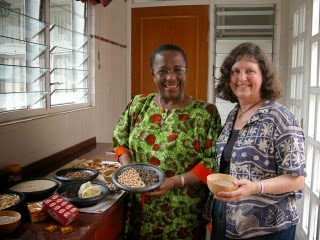
As many of you already know, for over a decade (when the photo on the left was taken), Barbara Baeta and Fran Osseo-Asare have been collaborating on compiling an ambitious Ghanaian cookbook designed as a basic cooking course. It will feature regional variations and step-by-step instructions for a wide range of Ghanaian recipes (roughly 150), along with Ghanaian artwork, scenic shots, and anecdotes from both of our lives. 

We're thrilled to report that in August 2013 we signed a contract with Hippocrene Books, respected for over 40 years as a publisher of ethnic cookbooks. The manuscript will be completed by the end of August 2014, and the book is expected out 9 months later, around May 2015. Thank you to all of you who have been supportive of this unfolding dream. We trust that, like all truly great things, it will prove worth the wait.

We're very excited! 

P.S. Those of you who have offered to help (or would like to)  with the final recipe testing, stay tuned. We welcome your involvement, and will soon give more details on how you can be a part of this project.


Monday, October 14, 2013

Bissap and Plantain Chips at TED Fellows Retreat

This past August (2013), I was invited to attend the first ever TED Fellows Retreat, held in breath-taking Whistler, Canada. The "retreat" was so action packed it would have been better named TED Fellows Advance. Amazing talks, amazing networking, amazing gifts, amazing resources, amazing energy . . .

It was also the first reunion of the original 2007 Fellows group from TEDGlobal: Africa: the next chapter We were disappointed that the Canadian government denied visas to some of the African Fellows, but it was still wonderfully encouraging to catch up on what's been happening the past 7 years all over the continent and beyond.

One activity during break times was an "international tea party," featuring teas the Fellows brought from around the world. I carried along some S. African rooibos teabags my Ghana-based architect son DK (2010 TED Global Fellow) brought me from Cape Town and gave me when I was in Ghana in July (Incidentally, I think we're the only parent-child Fellows in TED!) Plus, I cooked up some fried plantain chips to carry along. The first evening at the retreat I brewed some bissap (hibiscus iced tea) to chill and serve with the chips to my fabulously talented and amazing fellow Fellows. Very grateful to Emeka Okafor of Timbuktu Chronicles, Tom Rielly, and all the other members of the TED Fellows team who made this renewing experience possible. My next post will share the progress on my dream and the mountains I'm planning on moving (the theme of the retreat), with your help.


Monday, September 09, 2013

Around the House, kpakpo shito and water leaf

Fall is now arriving in the US. Nights are getting colder, yet the warm memories of a month in Ghana during June and July are still strong.

Here are a few photos from my time there. On the right and below are photos of the kpakpo shito bushes planted in our yard in Baatsona (near Tema). Kpakpo shito (shito means "pepper" in Ga) is my favorite pepper from Ghana. I've tried unsuccessfully to locate seeds in the U.S., with several local organic farmers willing to grow them for me.

If anyone knows how to legally import them from Ghana, please let me know. Kpakpo shito has a wonderful, almost sweet fragrance, along with a spicy heat. I didn't have to buy peppers at all the 4 weeks I was in Ghana! I wait for them to turn red before cooking with them, either whole and "popped" between my fingers, or seeded and sliced.

My son Yaw Dankwa also planted some greens he brought from Nigeria, called "water leaf" or what sounded like "boca-boca" in Ghana. They have small purple flowers. He mentioned that they can be cooked like cocoyam leaves (nkontomire), and that in Nigeria people sometimes also just cut the leaves up and add them to food. I never had a chance to cook some this trip, but did check in with the knowledgeable Ozoz Sokoh, of Kitchen Butterfly fame, who confirmed that water leaf  is ". . . an aggressive plant and I'm less than happy with it at the moment as it overtakes every thing with its self propagation. Worse than mint! . . . But we use it in soups, with other greens (pumpkin leaves and another veggie we call 'green'), with ground melon, stirred into tomato sauces aka stew." She also provided a link for more information, including its history and scientific family and name, Portulacaceae, Talinum fruticosum (T. triangulare).  Apparently the leaves are  loaded with vitamins A and C, calcium and iron, and are grown in many tropical areas of the world besides West Africa.
Thank you again, Ozoz.


Friday, August 02, 2013

Pure Sugar Cane: Swizzle Sticks to Snacks

In central Pennsylvania, it's almost impossible to get fresh sugar cane. In Ghana it's a totally different reality. Last month I experimented with this versatile natural food, (Naomi helped me break it into pieces and peel it):


The sugar cane can be cut into longer sticks as drink stirrers (shown here with grapefruit juice), aka "swizzle sticks." It can also be cut into smaller sticks (I tried cutting it into rounds, too, but that did not work as well) that can be chewed as a simple, refreshingly light dessert or afternoon snack. Yum. A perfect example of "more with less."


    Tuesday, July 16, 2013

    African Development for the Kitchen: Ghana Kitchen-wear


    During this trip to Ghana, BETUMI is working with a talented young designer at Low Design Office (who happens to be my son) and local seamstresses and tailors to design and sew a line of  “Made in Ghana” culinary "wear." (Note in the photo below that the sewing machines are not electric). It’s a great way to support local women by giving them access to wider markets. It's also a way to add a unique African touch to your kitchen, or the perfect gift for someone special. If there is interest, there are plans to develop a complete line of Ghanaian chefwear, including chef jackets. What do you think? Let us know and check back for more information on ordering soon.


    Friday, July 12, 2013

    BETUMI Photo Exhibit at Penn State

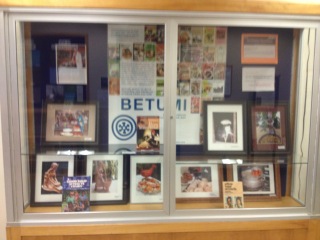
    Though I'm in Ghana, my thoughts are turning towards the upcoming fall semester that begins at Penn State in August. Helen Sheehy, Head of the Social Sciences and Donald W. Hamer Map Libraries, has curated an exhibit of photos from BETUMI that graces the entrance to the undergraduate social sciences library at the University Park campus of Penn State. I am grateful for the exposure, and hopeful that some of the undergraduates may stop to check out the exhibit and be enticed to sign up for the fall offering of my African Foodways course (AFR297B).


    Tuesday, July 09, 2013

    Flair turns 45!

    I've been in Ghana for almost 2 weeks. The highlight so far was celebrating Flair Catering's 45th Anniversary and the graduation of its 2013 class. Barbara Baeta (and her catering company and school) is legendary in her commitment to setting standards in the hospitality industry in Ghana, as well as championing Ghana's classic cuisines while preparing a wide array of international dishes with equal ease. Barbara truly brings "flair" to everything she touches. I feel honored to know her and to have been able to join them for this special time. 

    While waiting  in a bank this morning I happened to see an editorial in one of the local papers. The writer was lamenting the failure of customer service in the hospitality industry in Ghana after over 50 years of independence. Then he stated that Barbara Baeta and Flair have restored his faith in the hope that dedicated, honest, creative, hardworking individuals like her and her legacy of trained professionals, offer hope for Ghana, and for Africa as a whole. It was a moving tribute.

    The graduation speaker this year was Mrs. Lordina Mahama, the wife of Ghana's current President. It turns out she was a graduate of Flair, and in the 1990s earned the coveted "Barbara Baeta Award" for her outstanding accomplishments while


    a student. The graduates were inspired and eager to continue Flair's traditions. Mrs. Mahama also donated a new 6-burner cookstove to the school, and promised 2,000 bags of cement for the long-dreamed of expansion of the school in a new location.


    It struck me how the students truly understood the vocation before them, as they (and former students as well) transitioned effortlessly from honored graduates to earnest caterers: after the graduation on Friday, serving the hundreds of guests refreshments they had prepared , as well as at a luncheon held on Sunday after a service of Thanksgiving at Ridge Church. I was also touched by the devotion, respect,  and love they obviously have for their beloved "Auntie Shika."