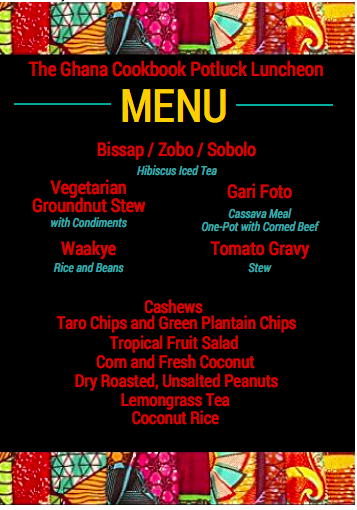
We had a great turnout today for the potluck, where community members volunteered to make and bring items from The Ghana Cookbook: from gari foto (a big hit) to peanut/groundnut stew (okay, also another big hit). They also pitched in to help prep and set up for the meal. Thank you to them, especially to those who cooked and helped. A special shout out is due to the HVC team who has been helping me with the PR for this and other events to get the word out about the book. High fives all around!BETUMI: The African Culinary Network (www.betumi.com) connects anyone who delights in African cuisine, foodways, and food history.
Friday, November 13, 2015
Pre-launch Pot Luck at New Leaf Initiative
We had a great turnout today for the potluck, where community members volunteered to make and bring items from The Ghana Cookbook: from gari foto (a big hit) to peanut/groundnut stew (okay, also another big hit). They also pitched in to help prep and set up for the meal. Thank you to them, especially to those who cooked and helped. A special shout out is due to the HVC team who has been helping me with the PR for this and other events to get the word out about the book. High fives all around!Saturday, October 31, 2015
Nkatie (peanut) "cakes": easy sweet snack
You'll find a photo of these on the cover of The Ghana Cookbook (with instructions on making them and coconut cakes, too, inside).
They're quick and easy to whip up from peanuts, a little water, and sugar. Here's a 27-second preview.
Thursday, October 29, 2015
No budget. No publisher. No photographer. No problem!
I am humbled and excited right now, and want to share a bit of the story behind The Ghana Cookbook. I hope it will encourage you.
For years, publishers and agents told me "there's just no market for a sub-Saharan Africa single-country cookbook. Why don't you do a regional Africa cookbook instead?" For years I declined. A writer friend warned me "No agent will pick up a book like that that no one will buy."
I kept saying "that's like doing a regional "Europe" cookbook, or a regional "Asia" cookbook, and lumping Italian, French, German, British, Dutch, Spanish, etc. together, or Chinese, Indian, Thai, Japanese, Korean, etc. all together.
Finally, I started the cookbook myself. Proposals came back, rejected. "There's no market." I didn't give up. I kept working. I learned to photograph food. I kept writing and speaking. I kept blogging. Along the way, many of you found me and urged me on. New African culinary voices arose. The International Association of Culinary Professionals gave me a boost with a pre-contract grant to pursue my dream. Barbara Baeta in Ghana joined the project. We kept working, fueled by belief and love that someday its time would come.
Finally, in 2014, visionary Priti Chitnis Gress at Hippocrene Books decided to take a chance.
Let's all prove those gatekeepers were wrong--may this cookbook open the floodgates to a realization of the vastness and variety of this huge second-largest continent, with over 4 dozen countries, and the culinary riches it has to share.
Incidentally, "betumi" comes from the Akan word "tumi," meaning the ability to do
something. It alludes to a kind of power that comes from the concentration of ability, the way strands come together to make a broom or a rope strong. To my thinking, "betumi" means "we can do it."
(p. s. please remember these photos are copyrighted.)
For years, publishers and agents told me "there's just no market for a sub-Saharan Africa single-country cookbook. Why don't you do a regional Africa cookbook instead?" For years I declined. A writer friend warned me "No agent will pick up a book like that that no one will buy."
I kept saying "that's like doing a regional "Europe" cookbook, or a regional "Asia" cookbook, and lumping Italian, French, German, British, Dutch, Spanish, etc. together, or Chinese, Indian, Thai, Japanese, Korean, etc. all together.
Finally, I started the cookbook myself. Proposals came back, rejected. "There's no market." I didn't give up. I kept working. I learned to photograph food. I kept writing and speaking. I kept blogging. Along the way, many of you found me and urged me on. New African culinary voices arose. The International Association of Culinary Professionals gave me a boost with a pre-contract grant to pursue my dream. Barbara Baeta in Ghana joined the project. We kept working, fueled by belief and love that someday its time would come.
Finally, in 2014, visionary Priti Chitnis Gress at Hippocrene Books decided to take a chance.
Let's all prove those gatekeepers were wrong--may this cookbook open the floodgates to a realization of the vastness and variety of this huge second-largest continent, with over 4 dozen countries, and the culinary riches it has to share.
Incidentally, "betumi" comes from the Akan word "tumi," meaning the ability to do
something. It alludes to a kind of power that comes from the concentration of ability, the way strands come together to make a broom or a rope strong. To my thinking, "betumi" means "we can do it."
(p. s. please remember these photos are copyrighted.)
Thursday, October 22, 2015
Cookbook Update: From then to now
![]() |
| Fran & Kwadwo 1972 |
All remains a labor of love on my part, and many, many hours of work, which is why I've basically ceased blogging these past months.
Projects currently underway:
- Updating BETUMI's website (a long-overdue project)
- A trailer for The Ghana Cookbook (stay tuned)
- Events, articles, and signings to be arranged. Already planned:
- November 13, 2015: cooking demonstration and luncheon at New Leaf Initiative in State College using recipes from the book.
- January 28, 2016: Accra, Ghana. Book launching at Flair Catering (with Barbara!) Hopefully, events will also take place in the San Francisco Bay Area, Boston, New York, Philadelphia, and Portland, Oregon.
Many of you know one of my favorite sayings from Ghana that has long been my mantra:
"Little, by little, the chicken drinks water."
![]() |
| The family keeps growing |
Monday, July 13, 2015
The Ghana Cookbook pre-order prices: Amazon vs. Barnes and Noble
Friends: I just noticed that while Amazon.com in the U.S. offers a descriptive blurb about The Ghana Cookbook and pre-order prices of $16.57 (a 17% discount), Barnes and Noble online is
offering pre-orders of The Ghana Cookbook for $14.95 (a 25% discount).
If you plan to buy a copy, please be advised that this first issue (due out in early October) will be a small print run. If you want to be sure to get a copy, consider getting your order in sooner rather than later. (This could make a great hostess, Christmas, or Kwanzaa gift for someone special on your list.)
Coming soon: a recipe that will not be in the cookbook: benisi from northern Ghana. It uses shea butter and young black-eyed pea leaves. Does anyone know where I might find some of these leaves, fresh and tender, in central Pennsylvania? Otherwise, I will substitute baby spinach leaves.
If you plan to buy a copy, please be advised that this first issue (due out in early October) will be a small print run. If you want to be sure to get a copy, consider getting your order in sooner rather than later. (This could make a great hostess, Christmas, or Kwanzaa gift for someone special on your list.)
Coming soon: a recipe that will not be in the cookbook: benisi from northern Ghana. It uses shea butter and young black-eyed pea leaves. Does anyone know where I might find some of these leaves, fresh and tender, in central Pennsylvania? Otherwise, I will substitute baby spinach leaves.
Wednesday, July 08, 2015
Pierre Thiam on the move in Lagos
I cringe every time I am offered ice cream in Ghana that is flavored by strawberries or cherries or other imported ingredients. Some day West Africans will favor locally available ingredients to make delicious indigenous versions. In Northern Ghana an entrepreneur once enthused to me about her corn-flavored ice cream.
That day may be coming sooner rather than later in Lagos, Nigeria, where coconut and lime-flavored ice cream is planned for the menu of the the fabulous Lagos center designed by famed British-Ghanaian architect David Adjaye.
Anyone who cares about African cuisine knows (or should know) about Senegalese chef and cultural ambassador Pierre Thiam, the former owner of Yolele and Le Grand Dakar restaurants and author of 2 Senegalese cookbooks. He's recently been in the news as the culinary force behind the recipes to be served at a new luxurious Lagos, Nigeria, store and restaurant . I'm happy to know about this new venture and wish them wonderful success.
That day may be coming sooner rather than later in Lagos, Nigeria, where coconut and lime-flavored ice cream is planned for the menu of the the fabulous Lagos center designed by famed British-Ghanaian architect David Adjaye.
Anyone who cares about African cuisine knows (or should know) about Senegalese chef and cultural ambassador Pierre Thiam, the former owner of Yolele and Le Grand Dakar restaurants and author of 2 Senegalese cookbooks. He's recently been in the news as the culinary force behind the recipes to be served at a new luxurious Lagos, Nigeria, store and restaurant . I'm happy to know about this new venture and wish them wonderful success.
Labels:
African ice cream.,
David Adjaye,
Lagos center,
pierre thiam
Tuesday, June 23, 2015
So Much Fun. . .Akpabli's Tickling the Ghanaian
Earlier this year I discovered Accra-based writer Kofi Akpabli's slim but delightful book of humorous essays: Tickling the Ghanaian: Encounters with Contemporary Culture. A fun book featuring an insider's accurate and hilarious musings targeting the food and culture of my favorite African country.
I especially like "The Truth About Fufu," "Between Tinapa and Boflot," and, of course, "The Serious Business of Soup in Ghana." However, he also covers cloth and clothes, rings, akpeteshi and schnapps, bartering, the Black Stars, kokonte, funerals, Nigerian-Ghanaian relations, and other topics with wit and veracity.
It's a kindle bargain at Amazon.com. Apparently, Kofi Akpabli, was selected as a CNN/Multichoice African Journalist for Arts and Culture in 2010 and 2011, and is well known for his "useful humour, rooted in truth." A great gift for anyone who knows Ghanaians, plans to visit, or just in need of a refreshing read.
Labels:
Akpabli,
akpeteshie,
boflot,
fufu,
Ghanaian culture,
kokonte,
soup,
tinapa
Tuesday, June 09, 2015
Stewed bambara beans and tatale anyone?
Have you ever had Ghana-style stewed bambara beans or groundnuts (aka aboboe)? The photo shows the dried uncooked beans/peas on the left and the cooked ones on the right. They're wonderful with ripe plantain pancakes (tatale) or fried plantain balls (kakro). And a cinch to make in a slow cooker/crockpot.
Incidentally, there is also an extensive description of bambara beans in Lost Crops of Africa: Volume II: Vegetables . Washington, DC: The National Academies Press, 2006, p. 52-73 (this can be downloaded free as a pdf if you sign up at their website.) Native to West Africa, these legumes are similar to "peanuts" in that they ripen in pods underground, and are valuable for their hardiness in tropical Africa and their high protein content. They have a mild flavor that pairs very well with sweet, ripe, spicy plantain pancakes or plantain balls, and, incidentally, are one of the few savory dishes to which I have seen some Ghanaians add sugar when eating.
Apologies for the long silence at this end. Working to complete the final edits on The Ghana Cookbook (where you'll find all three recipes). Stay tuned. (By the way, if you preorder the book from Amazon,now (it's due out in October) there's a sizable discount ($16.57 rather than $19.95).
Wednesday, April 22, 2015
Making Palm Butter or Cream of Palm Fruit
A few days ago another cluster of palm nuts ripened on the tree in our yard in Tema. When they are bright orange-red, they are ready to be harvested. While extracting the palm butter/cream of palm fruit from them I realized that many North Americans have probably never seen the process: After using a cutlass to cut the palm nuts off the tree, one whacks the cluster to loosen the actual fruits before collecting them in a bowl or basket. If the fruit is not quite ripe it may be necessary to carefully pick some of the fruits off individually. Next, the nuts are placed in a large pot, covered with water that is brought to a boil, and boiled to loosen the skins and fiber. The fruits turn a little darker as they cook. I boiled mine for about 20 to 30 minutes.
After removing them from the water they are placed in a specially shaped wooden mortar and pounded with a wooden pestle to loosen the skin and fiber from the nuts. I pounded mine in 2 batches for about 10 to 15 minutes each. Then, everything is poured into a large pot or bowl, and enough warm water is added to allow one to loosen the fibers by hand from the kernel (by the way, it's the palm kernel oil that has the really bad rep, not the red carotene-rich palm oil, aka dendê in Brazil).
Eventually everything is strained once or twice to remove the kernels, skin and fibers, leaving only the pulp and oil. The texture is kind of like pureed pumpkin. This is a somewhat messy job, and one needs to be careful to avoid getting the bright orange-red oil on one's clothes. Below is an awkward picture of me holding the camera with my right hand as I pound with my left, and a very brief video clip.Tuesday, April 21, 2015
Reflections on the time in Ghana
It's hard to believe that our almost 3 months in Ghana are drawing to a close.
The time here has been a collage of memories: from the soothing beach at Accra to the massive recycling/scrap/toxic site at Agbgbloshie (and a painful memory of tear gas and brute force and inhumane treatment of the immigrant workers there). From the lovely tree-studded campus at the University of Ghana, Legon, to our emerging home at Tema. From days without electricity to the installation of solar panels and an inverter.
Here are just an eclectic few of my "Lessons learned":
The time here has been a collage of memories: from the soothing beach at Accra to the massive recycling/scrap/toxic site at Agbgbloshie (and a painful memory of tear gas and brute force and inhumane treatment of the immigrant workers there). From the lovely tree-studded campus at the University of Ghana, Legon, to our emerging home at Tema. From days without electricity to the installation of solar panels and an inverter.
Here are just an eclectic few of my "Lessons learned":
- I prefer mosquitoes and sweating to snow and ice.
- Things move much more slowly and with a lot more "hiccups" than American me wants them to (though this does cause me to reflect a bit on the frenzied pace of life in the U.S. and my inordinate dependence on electronic media).
- Schools in Ghana still reward memorization and obedience over critical thinking and creativity.
- Ghanaians still seem to suffer from an identity crisis: their models in most areas of life, from food to hairstyles to architecture, seem based on the Americas or Asia rather than emerging from their indigenous societies.
- There are many signs of hope springing up (e.g., the African "maker movement," sustainable agriculture and improved hygiene efforts, and a number of true Ghanaian entrepreneurs)
- There's still a long way to go to overcome the lack of a maintenance culture, and to improve customer service.
- An especially painful lesson: don't forget to back up your photos on your new phone or you'll kick yourself when you lose it in a taxi and all those photos are gone, gone, gone. . .
Friday, March 06, 2015
Happy Ghana Independence Day
We have been here 4 weeks tomorrow.
Recent highlights include:
- lunching and catching up with Barbara Baeta at her house (and learning that in 2011 she was honored with the Order of the Volta, one of Ghana's highest honors for service to the nation)
- a guest lecture in husband's professional development class for materials science students (mostly tips on better writing) to final year undergraduate students at the University of Ghana, Legon
- initial inroads on turning the house near Community 18 (Baatsona) into a home (e.g., moving some of the seedlings there for the kitchen garden, buying water tanks, commissioning local terracotta tiles for the kitchen floor . . .)
- beginning revisions to the cookbook (tick, tock--the end of March is getting closer)

Subscribe to:
Posts (Atom)